Eastleigh Building Collapse Rescue Operation Reaches 95% Completion as Five People Remain Missing
The multi-agency rescue and recovery operation at the site of the collapsed building in Eastleigh, Nairobi, has reached 95 per cent completion, marking a major milestone in the search for victims of the October 23 disaster.
The latest update from the Ministry of Interior indicates that emergency response teams are now working to clear the remaining rubble and establish the whereabouts of everyone reported missing following the collapse.
However, despite the significant progress, the operation remains deeply painful for families who are still waiting for news about their loved ones. Five people remain unaccounted for, while eight bodies have been recovered and four people have been rescued alive.
The operation has brought together several government agencies and humanitarian organisations, including the Kenya Defence Forces (KDF), the National Disaster Management Unit (NDMU), the National Disaster Operations Centre, Nairobi City County Government and the Kenya Red Cross.
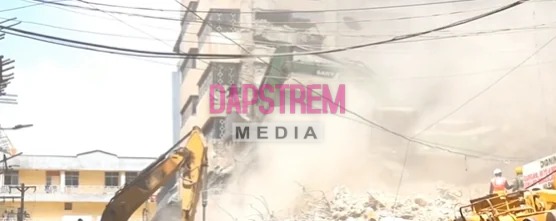
Since the building came down, the teams have faced the difficult task of navigating tonnes of concrete, twisted metal and other construction materials in an effort to reach people believed to have been trapped inside.
The latest 95 per cent completion mark offers hope that the operation could soon conclude, although authorities have maintained that the remaining sections must be thoroughly examined to account for everyone.
Eight bodies recovered as search continues
The latest progress comes after six more bodies were recovered from the collapsed structure on Thursday, November 5, bringing the confirmed death toll to eight.
According to authorities, the six victims comprised four women and two men. Their bodies were retrieved after rescue teams managed to reach the basement section of the building, where some of the missing occupants were believed to have been trapped.
The breakthrough was particularly significant because accessing the lower sections of the collapsed structure had proved difficult throughout the operation.
The recovered bodies were transferred to Nairobi City Mortuary, where post-mortem examinations and formal identification procedures are underway.
Authorities have been working with affected families to establish the identities of the victims. DNA profiling is also being used where necessary, particularly in cases where the condition of the recovered remains makes immediate identification difficult.
The identification process is an important step in ensuring that families receive accurate information and that the remains are released to the rightful relatives.
Meanwhile, four people have so far been rescued alive from the wreckage. Their rescue offered moments of hope during an otherwise devastating operation that has stretched over several days.
Despite these recoveries, the five people who remain unaccounted for continue to be the focus of the final phase of the search.
The authorities are expected to establish their whereabouts as teams clear the remaining debris and complete the verification process.
Rescue teams overcome difficult conditions to reach basement
One of the most significant developments in the operation was the successful access to the basement section of the building.
The section had presented a major challenge to emergency responders because of the massive concrete slabs and debris that covered the lower levels.
National Disaster Management Unit Director Duncan Ochieng previously described the exercise as particularly difficult, noting that Kenya had not experienced a building collapse of this scale and nature involving an 18-storey structure.
The confined nature of the site also complicated the rescue exercise, limiting the areas through which heavy equipment and emergency personnel could access the wreckage.
Rescue teams had to work carefully to avoid causing further instability as they removed concrete and other materials.
The operation also required coordination between different agencies, each bringing specialised personnel, equipment and technical support to the scene.
The successful access to the basement allowed rescuers to reach areas that had remained difficult to examine during the earlier stages of the operation.
The recovery of six additional bodies from the lower section subsequently raised the death toll to eight and reduced the number of people still unaccounted for.
With the operation now 95 per cent complete, attention has shifted towards clearing the remaining debris and ensuring that no section of the building is left unchecked.
Families continue waiting for answers
Beyond the statistics and operational updates, the Eastleigh building collapse has left families facing days of uncertainty, grief and emotional distress.
Since the incident, relatives of people believed to have been inside the building have been following developments closely, hoping to receive information about their loved ones.
For some families, the recovery of bodies has brought painful confirmation of their worst fears. For others, the uncertainty surrounding missing relatives remains difficult to bear.
The identification process has also added another layer of anxiety, as families wait for forensic examinations and DNA procedures to establish the identities of those recovered.
Authorities have urged relatives to cooperate with the identification process and provide the necessary information to assist investigators.
The National Police Service has also advised families seeking information about missing persons to visit the Kenya Red Cross desk at the scene or contact the emergency response line on 1199.
Psychological support has been provided to affected families as the recovery exercise continues.
As teams approach the final stages of the operation, the priority remains accounting for every person reported missing and ensuring that families receive reliable information.
How the Eastleigh building collapse happened
The disaster occurred on October 23, 2026, when a multi-storey building under construction collapsed along 9th Street in Eastleigh, Nairobi.
The structure, described by authorities as an 18-storey building, came down while construction work was still ongoing on its upper floors. Some lower sections were already occupied, with businesses and other activities taking place within the building.
The collapse trapped several people beneath tonnes of concrete and construction debris, triggering an emergency response involving government agencies, security teams and humanitarian organisations.
The incident immediately raised concerns about the safety of buildings in Nairobi, particularly those under construction in densely populated commercial and residential areas.
Eastleigh is one of Nairobi’s busiest commercial neighbourhoods, attracting traders, workers, residents and visitors throughout the day. The collapse therefore highlighted the serious risks that poorly regulated construction activities can pose to people living and working around construction sites.
Emergency responders faced significant challenges in accessing the wreckage, particularly because of the building’s size and the difficulty of manoeuvring equipment around the collapsed structure.
The operation has since evolved from an urgent search for survivors into a wider recovery exercise focused on retrieving victims, clearing debris and establishing the whereabouts of those still missing.
Building safety and construction regulations under scrutiny
As the rescue operation approaches completion, attention is increasingly shifting towards the circumstances that led to the collapse.
The tragedy has renewed concerns about building approvals, construction supervision, inspection procedures and the enforcement of safety regulations in Nairobi.
Nairobi Governor Johnson Sakaja has previously raised concerns over the building’s construction approvals, arguing that the development lacked the necessary authorisation.
The incident has also revived questions about how structures can progress to advanced stages of construction without adequate regulatory oversight.
For many residents, the disaster is another reminder of the dangers associated with buildings that may not meet the required structural and safety standards.
Construction regulations are designed to ensure that developers follow approved building plans, use appropriate materials and maintain the required safety standards throughout the construction process.
They also provide for inspections by relevant authorities to establish whether projects comply with approved designs and legal requirements.
When these procedures are ignored or poorly enforced, the consequences can be devastating.
The Eastleigh tragedy has therefore placed renewed pressure on authorities to strengthen inspections, improve coordination between regulatory agencies and take firm action against developers who violate construction standards.
It has also highlighted the importance of protecting workers, tenants, traders and members of the public who may be exposed to risks arising from unsafe construction projects.
Investigations launched to establish responsibility
The building collapse has prompted investigations into possible negligence, regulatory failures and violations of construction requirements.
The Office of the Director of Public Prosecutions (ODPP) has directed the Directorate of Criminal Investigations (DCI) to investigate possible criminal conduct connected to the project.
The investigations are expected to examine the roles played by the developer, contractors, construction professionals and relevant public officials involved in the planning, approval, construction and supervision of the building.
Investigators will also seek to establish whether negligence, omissions or misconduct contributed to the collapse.
The probe is particularly important because it could help determine whether the tragedy resulted from construction failures, inadequate supervision, regulatory shortcomings or a combination of factors.
Authorities have indicated that anyone found criminally responsible could face appropriate legal action, subject to the evidence gathered and the relevant legal procedures.
The investigations are also expected to provide answers to questions surrounding the approval and occupation of the building.
For families who lost loved ones, establishing accountability is an important part of the process of seeking justice.
However, the investigations must be thorough, independent and guided by evidence rather than speculation. Those found responsible should be held accountable through the appropriate legal channels.
A wider warning about Nairobi’s building safety
The Eastleigh collapse has once again exposed the challenges facing Nairobi as the city continues to experience rapid urban development.
The growing demand for residential and commercial space has encouraged construction of multi-storey buildings in several neighbourhoods.
While urban development is important for economic growth, it must be accompanied by strict compliance with construction standards and effective supervision.
The collapse has raised questions about whether existing inspection systems are sufficiently equipped to monitor the increasing number of construction projects across the city.
It has also strengthened calls for comprehensive inspections of buildings, particularly those under construction or suspected of violating approved plans.
Property developers, contractors, engineers and government agencies all have responsibilities in ensuring that buildings are structurally sound and safe for occupation.
County authorities must also strengthen enforcement mechanisms to prevent unauthorised developments and ensure that safety concerns are addressed before they result in disasters.
The tragedy should therefore serve as an opportunity for authorities to review existing procedures and identify gaps that could expose residents to similar risks in the future.
Preventing another disaster will require more than issuing warnings after a building collapses. It will require consistent inspections, transparent approval processes and decisive enforcement of the law.
Rescue operation enters its final phase
With the recovery operation now 95 per cent complete, emergency responders are concentrating on clearing the remaining debris and accounting for the five people whose whereabouts remain unknown.
The Ministry of Interior has indicated that the teams are working towards completing the exercise, although the final stages remain critical.
The successful completion of the operation will mark the end of an exhausting search that has involved several agencies and required extensive coordination.
However, the conclusion of the rescue exercise will not bring an end to the wider questions surrounding the disaster.
Families will still need answers, authorities will need to complete identification procedures, and investigators will have to establish the circumstances that led to the collapse.
The incident has also renewed the need for stronger construction safety measures to protect lives and prevent similar tragedies.
For the families affected, the most important priority remains knowing what happened to their loved ones and receiving the support they need during this difficult period.
As the final phase of the recovery operation continues, the hope is that every missing person will be accounted for and that the investigations will establish the truth behind the Eastleigh building collapse.
The tragedy is a painful reminder that construction safety cannot be treated as a formality. Every building must meet the required standards because behind every construction project are lives that depend on its safety.