Eastleigh Building Collapse: Two Rescued Alive as Search Enters Seventh Day
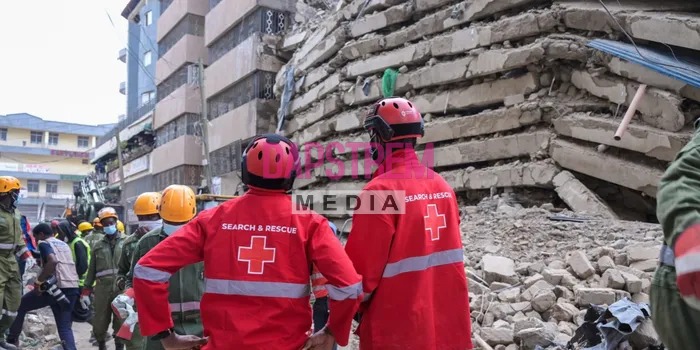
The search for survivors trapped beneath the rubble of a collapsed building in Nairobi’s Eastleigh estate has entered its seventh day, with rescue teams continuing to work against time to reach people believed to be buried beneath the debris.
The collapse, which occurred on Friday, October 23, 2026, along 9th Street in Eastleigh, has left families desperate for news about their missing relatives. The incident has also raised serious concerns about building safety, construction standards and the enforcement of regulations governing high-rise developments in Kenya.
Two people have been rescued alive during the operation, providing a much-needed ray of hope for families who have spent days waiting anxiously at the scene. Meanwhile, specialised rescue teams have detected two possible signs of life beneath the rubble, prompting further efforts to reach areas where survivors could still be trapped.
According to reports published on Thursday, October 29, rescue teams had cleared approximately 80 per cent of the debris. However, reaching the lower sections of the collapsed structure remained a major challenge, with rescuers concentrating on accessing the basement, where additional people were believed to be trapped.
The operation has become a race against time as emergency responders attempt to establish whether more people remain alive beneath the wreckage.
Rescue Teams Intensify Search for Survivors
The latest developments have renewed hope that more people could be found alive despite the prolonged rescue operation. Specialised equipment brought to the scene by Chinese rescue experts has helped teams identify possible signs of life beneath the collapsed building.
According to The Eastleigh Voice, the Chinese team detected two possible signs of life using specialised equipment designed to identify human presence beneath debris. The experts were working alongside other emergency responders to create access routes to the locations where the signals were detected.
The equipment includes radar-based life detectors, devices that identify sounds and vibrations, and thermal imaging probes fitted with cameras. These technologies help rescuers examine spaces that cannot easily be reached through conventional excavation.
The search has been complicated by the condition of the wreckage and the limited access to certain sections of the building. Heavy machinery has been used to remove debris, but rescuers must proceed carefully to avoid causing further collapses that could endanger both survivors and emergency personnel.
National Disaster Management Unit Director Duncan Ochieng said the team was determined to reach the lower sections of the building as soon as possible. He indicated that the operation could extend into Thursday night or Friday morning, depending on the technical challenges encountered.
Rescuers have continued to express hope that people could survive for extended periods if they remain uninjured and have access to suitable conditions. However, survival prospects depend on several factors, including the severity of injuries, the availability of air and water, and the nature of the spaces in which people may be trapped.
The detection of possible signs of life has therefore given the operation renewed urgency, even as responders acknowledge the difficulties associated with reaching people buried deep beneath the wreckage.
Families Continue to Wait for Missing Relatives
Away from the heavy machinery and specialised rescue equipment, families continue to endure one of the most painful aspects of the disaster: uncertainty.
Relatives of people believed to have been inside the building have spent days waiting for updates from emergency teams. Some have remained close to the scene, hoping that the next breakthrough will bring news that their loved ones have been found alive.
The wait has been particularly difficult because families cannot be certain whether their relatives were inside the building when it collapsed or whether they managed to leave before the incident.
Authorities have been working with the Kenya Red Cross Society and other agencies to verify reports of missing people. Earlier figures varied as different families reported missing relatives and investigators sought to establish who had been present at the site.
By Wednesday, October 28, Nairobi North Regional Commissioner Simon Osumba said the number of people still unaccounted for had fallen to 16 following verification. Officials were also working with telecommunications companies to establish whether phone signals could help determine the last known locations of some missing individuals.
The verification process is important because the initial reports included people whose whereabouts had not yet been confirmed. Some workers may have left the construction site before the collapse, while others could have been in nearby businesses or other sections of the building.
For families, however, the distinction between a person who is confirmed missing and one whose whereabouts remain unverified does little to ease the emotional strain of waiting.
Every new update carries the possibility of relief or heartbreak. The rescue operation has therefore become not only a technical emergency but also a deeply personal struggle for the people searching for their loved ones.
Basement Emerges as a Key Area in the Search
One of the main areas of focus is the basement, where rescuers believe some of the missing people could be trapped.
According to a report by The Eastleigh Voice, Chinese rescue team member Zhang Yuran said people trapped in the basement might have access to food and water from a supermarket located there. This possibility has attracted attention because access to essential supplies could improve survival prospects for people who remain alive.
However, the presence of a supermarket does not confirm that those trapped have access to its supplies. The condition of the basement, the extent of the structural damage and the availability of open spaces remain important factors in determining whether survivors can remain alive until rescuers reach them.
The basement is also among the most challenging areas to access because of the large volume of debris and the confined spaces created by the collapse.
Rescue teams must identify safe routes through the wreckage before attempting to reach suspected survivors. Moving debris without a clear understanding of the structure could cause further movement, potentially blocking access routes or putting trapped people at greater risk.
This explains why the operation has required a combination of heavy machinery, technical expertise and specialised life-detection equipment.
The priority remains to locate people who may still be alive while ensuring that rescue personnel can carry out their work without exposing themselves to unnecessary danger.
Multi-Agency Teams Lead the Rescue Operation
The rescue operation has brought together several agencies, reflecting the scale and complexity of the disaster.
National disaster management officers, Nairobi County officials, Kenya Red Cross personnel, National Youth Service teams, police officers and military personnel have been involved in the response. Specialised equipment has also been deployed to improve the search and help teams identify areas where people may be trapped.
The involvement of multiple agencies has been necessary because the operation requires different forms of expertise, from heavy-debris removal and emergency medical support to missing-person tracing and structural safety assessments.
Authorities have also urged members of the public to avoid interfering with rescue activities. Keeping the area clear allows excavators, emergency vehicles and specialised teams to operate more effectively.
The safety of responders remains a major consideration. Unstable debris, restricted access and underground infrastructure can create dangerous conditions for those working at the site.
Officials have therefore had to balance the urgency of reaching possible survivors with the need to prevent further accidents during the operation.
Although the clearance of approximately 80 per cent of the rubble represents significant progress, the remaining sections could contain some of the most difficult areas to reach. The final stages of excavation may therefore require additional time and careful technical planning.
Building Safety Concerns Return to the Spotlight
Beyond the rescue operation, the Eastleigh building collapse has renewed scrutiny of how construction projects are approved, supervised and inspected in Kenya.
The incident occurred in one of Nairobi’s busiest commercial neighbourhoods, where residential buildings, shops, businesses and construction sites operate close to one another. A structural failure in such an environment can affect not only people working inside the building but also traders, residents, pedestrians and nearby businesses.
Nairobi Governor Johnson Sakaja said the collapsed building lacked an occupation certificate, raising questions about the circumstances under which businesses were operating on the ground floor while construction continued above.
Authorities have not yet established the definitive cause of the collapse. Investigations will be necessary to determine whether structural design problems, construction practices, materials, supervision or other factors contributed to the disaster.
The incident has also drawn attention to broader concerns about building inspections across the country.
A report published by People Daily on October 29, citing the Architectural Association of Kenya’s Status of the Built Environment Report 2025, stated that 87 per cent of the 396 developments audited by the National Building Inspectorate in 2025 either failed to meet basic standards or lacked the required approvals.
The figure relates specifically to the developments assessed and should not be interpreted as meaning that 87 per cent of all buildings in Kenya are unsafe. Nevertheless, the findings have renewed questions about the capacity of regulatory agencies to identify and address non-compliance before it leads to tragedy.
The report also highlighted a sharp reduction in the number of buildings audited, from 20,649 in 2024 to 396 in 2025. While the figures raise concerns about inspection coverage, they do not, on their own, establish the reasons for the decline.
The wider issue is whether building regulations are being consistently enforced throughout the construction process, particularly in rapidly growing urban areas.
Calls for Accountability Grow
The Eastleigh tragedy has increased pressure on authorities to establish who was responsible for the building and whether any laws or safety requirements were violated.
The National Police Service announced an investigation into the collapse, working with relevant professional bodies to determine the circumstances surrounding the incident and establish whether criminal liability arose.
The Office of the Director of Public Prosecutions also directed the Directorate of Criminal Investigations to move with speed in establishing what led to the collapse.
Police previously said they were pursuing the building owner and contractor as part of the investigation. However, responsibility for the incident must be established through evidence and the appropriate legal process.
The investigation is expected to examine the building’s approvals, structural design, construction work, supervision and compliance with applicable regulations. It will also be important to establish whether the required inspections were conducted and whether any warnings about the structure had been raised before the collapse.
Accountability matters because a building collapse can have consequences extending far beyond the loss of property. People may lose their lives, families may lose their main sources of income, and traders may face significant financial losses.
Where negligence or violations are established, appropriate legal action would help ensure that those responsible are held accountable.
At the same time, the investigations should identify weaknesses in the systems responsible for regulating construction, so that corrective measures can prevent similar incidents elsewhere.
Eastleigh Traders and Residents Face Uncertainty
The collapse has also disrupted business activity in the surrounding area. Eastleigh is a major commercial centre, attracting traders, customers, transport operators and workers throughout the day.
The presence of emergency vehicles, heavy machinery and safety restrictions has affected movement around the scene. Businesses near the collapsed structure have faced uncertainty as rescue teams continue working and authorities manage access to the affected area.
For small businesses, even a temporary interruption can mean lost sales, delayed deliveries and reduced customer traffic. Traders operating in or near the affected building may also face questions about damaged stock, equipment and the future of their businesses.
The effects extend to employees and families who depend on daily earnings. Some workers may be unable to access their workplaces, while customers may avoid the area until rescue operations and safety assessments are completed.
The incident has therefore highlighted the wider economic consequences of building failures in densely populated commercial districts.
Beyond immediate financial losses, the tragedy could influence public confidence in the safety of buildings used for business and accommodation. Residents and traders need assurance that structures around them have been properly assessed and that potential risks are addressed before people are exposed to danger.
A comprehensive assessment of neighbouring buildings may help identify immediate hazards and reassure the public that the response extends beyond the collapsed structure itself.
The Need for Stronger Building Inspections
The tragedy has revived calls for more effective building inspections and stricter enforcement of construction standards.
Kenya has regulations governing building design, construction materials, inspections and occupation. However, the existence of rules is not enough if compliance is not consistently monitored and enforced.
Experts and policy researchers have repeatedly highlighted risks associated with poor workmanship, substandard construction materials, faulty structural designs, inadequate supervision and unauthorised alterations.
Addressing these risks requires action throughout a building’s lifecycle, beginning with the approval of architectural and structural plans and continuing through construction, inspection and occupation.
High-rise buildings and developments in densely populated areas deserve particular attention because a structural failure can affect large numbers of people.
Authorities also need sufficient technical personnel and resources to conduct inspections at critical stages of construction. Checks should not be treated as a one-time administrative exercise but as an ongoing process that confirms whether a project continues to meet approved standards.
Clear records of approvals, inspection reports, contractor credentials and professional sign-offs would also improve accountability. If a building develops structural problems, investigators should be able to establish who designed it, who supervised the work and whether the required safety procedures were followed.
The Eastleigh collapse provides a painful reminder of the consequences of gaps in oversight. Preventing future disasters will require more than promises of stricter enforcement; it will require practical measures, transparent investigations and consistent action against violations.
What Happens Next?
As rescue teams continue clearing the remaining rubble, attention remains focused on reaching the areas where possible survivors have been detected.
The two people rescued alive during the operation have offered a reminder that breakthroughs remain possible, even as the search enters its seventh day. The possible signs of life detected beneath the debris have also reinforced the importance of completing the operation carefully.
The immediate priority is to locate anyone who may still be trapped, provide emergency medical assistance where necessary and establish the whereabouts of all people reported missing.
Once the rescue phase is completed, authorities will face the task of accounting for the victims, supporting affected families and determining the full circumstances of the collapse.
The subsequent investigations should provide clear answers about the building’s approval status, construction process and the factors that contributed to its failure. Any identified regulatory shortcomings will also need to be addressed to reduce the risk of similar incidents.
For families waiting at the scene, however, the most urgent concern remains the fate of their loved ones. They continue to depend on the rescue teams for information, hoping that another person may be found alive.
The Eastleigh building collapse has become a test of Kenya’s emergency response capacity and a reminder of the responsibility that comes with constructing buildings where people live, work and conduct business.
As the search continues, the country will be watching closely for news from the site. The rescue operation must be completed with care, while the demand for accountability and stronger building safety enforcement must remain firmly on the national agenda.