Babu Owino Reveals Ruto Offered Him Education CS Job During Gen Z Protests
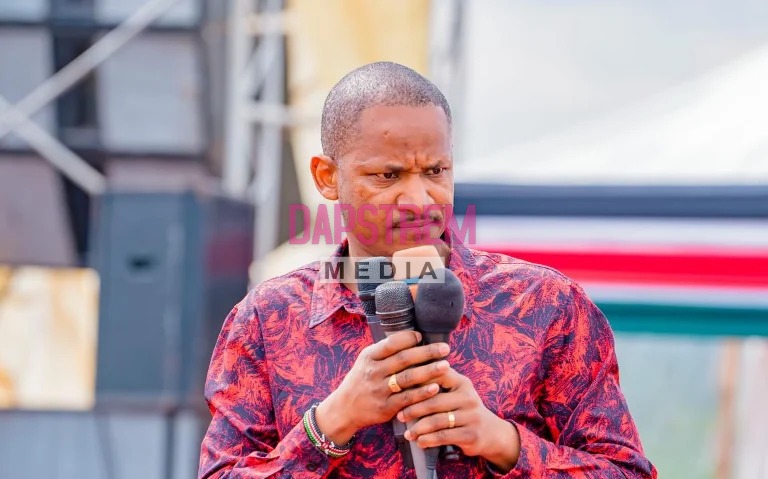
Embakasi East Member of Parliament Babu Owino has revealed that President William Ruto allegedly offered him the position of Cabinet Secretary for Education during the 2024 Gen Z protests, but he turned down the opportunity because of his political principles.
Owino made the revelation during an interview on Thee Alfa House YouTube channel, where he discussed his political journey, his relationship with the broad-based government and his decision to establish his own political party.
The legislator claimed that the offer came at a time when the country was experiencing intense political pressure following demonstrations against the Finance Bill 2024. The protests, largely driven by young Kenyans, challenged proposed tax measures and raised broader concerns about the cost of living, government accountability and the direction of national leadership.
According to Owino, he was approached about joining President Ruto’s administration but chose not to accept the position. He said his decision was guided by his beliefs and his opposition to the broad-based government arrangement that emerged after the protests.
The MP also maintained that he remained outside the arrangement even when the late former Prime Minister Raila Odinga, who was a prominent figure in the Orange Democratic Movement (ODM), joined the broad-based government.
Owino’s remarks have brought renewed attention to the political negotiations that followed the Gen Z protests and the efforts to reshape government leadership during one of the most challenging periods of President Ruto’s administration.
The alleged offer has also sparked questions about the political calculations behind efforts to bring different leaders into government and whether prominent opposition figures were approached as part of attempts to widen political cooperation.
However, the reported offer remains Owino’s account. The claim does not, on its own, establish the circumstances of the alleged discussions or whether a formal appointment process was initiated.
How the Gen Z protests changed Kenya’s political landscape
The background to Owino’s revelation can be traced to the nationwide demonstrations that erupted in June 2024 over the Finance Bill 2024.
The proposed legislation introduced or sought to introduce tax measures that attracted widespread criticism from Kenyans concerned about the rising cost of living and the financial pressure facing households and businesses.
Young people, particularly members of Generation Z, played a major role in organising and sustaining the protests. Social media platforms became important tools for mobilising demonstrators, sharing information and coordinating activities across different parts of the country.
The movement stood out because many participants presented themselves as independent of traditional political parties and established political structures. Their demands extended beyond taxation to include accountability, transparency, corruption concerns, employment opportunities and the conduct of public officials.
As demonstrations spread, the government faced mounting pressure to reconsider its approach to the Finance Bill. The protests also raised questions about police conduct and the protection of citizens exercising their constitutional right to demonstrate peacefully.
President Ruto eventually announced the withdrawal of the Finance Bill on June 26, 2024, following sustained public opposition. However, the demonstrations and public discontent continued, placing additional pressure on his administration.
On July 11, 2024, Ruto announced the dismissal of most members of his Cabinet, saying he would form a new government after reflecting on the country’s needs. The move opened the way for consultations and the nomination of a new team, including figures associated with different political backgrounds.
It was against this unsettled political backdrop that Owino says he received the offer to become Education Cabinet Secretary.
His account suggests that efforts to assemble a broader government may have involved discussions with political figures who had criticised the administration. However, the precise details of the alleged offer have not been independently established in the reporting available.
The episode nevertheless illustrates how the protests created pressure for political realignment and forced leaders to reconsider their relationships with the government and the opposition.
Why Babu Owino says he rejected the alleged offer
Owino attributed his decision to his political ideology and his opposition to the broad-based government arrangement.
During the interview, he questioned why the alleged offer would be relevant to him now when he had declined it during the protests.
The MP also argued that he had remained opposed to the arrangement even when Raila Odinga, who died in October 2025, supported cooperation between ODM and Ruto’s administration.
Owino presented his decision as a matter of principle rather than a question of whether he had an opportunity to serve in Cabinet.
His comments are significant because accepting a Cabinet position would have placed him within the executive branch of government, where he would be expected to help implement administration policies and work within the collective responsibilities of the Cabinet.
Remaining outside the executive, by contrast, allows a member of Parliament to continue participating in legislative debates and scrutinising government decisions without taking on the responsibilities of a Cabinet secretary.
The two roles are different, and political leaders must weigh the implications of each when considering whether to join an administration.
For Owino, his account suggests that the prospect of holding a senior government position did not outweigh his stated disagreement with the political arrangement.
Nevertheless, the public has only his account of the alleged offer and his reasons for declining it. The circumstances surrounding the reported discussions would require further confirmation to establish the full picture.
The broad-based government arrangement explained
The broad-based government emerged after the 2024 protests and the subsequent changes within the executive.
President Ruto’s administration sought to expand cooperation across political lines at a time when public dissatisfaction had created significant pressure for change. The arrangement brought figures associated with ODM into government, creating a new political relationship between Ruto’s United Democratic Alliance (UDA) and sections of the opposition.
Supporters of broad-based cooperation have argued that bringing different political interests together can encourage dialogue, promote stability and create opportunities to address national challenges.
Critics, however, have questioned whether such arrangements weaken opposition oversight by bringing leaders who previously challenged the government into the executive.
The debate is particularly important in a multiparty democracy, where opposition parties are expected to scrutinise government decisions, question public spending and present alternative policies.
Owino’s remarks place him among the politicians who say they did not support the arrangement, even when leaders within their broader political circles chose to participate.
His account also highlights the difficulties political parties can face when their leaders and members take different positions on cooperation with the government.
Political parties are not always internally uniform. Members may agree on some policy issues while disagreeing on alliances, appointments and the best way to influence national decision-making.
The broad-based government debate has therefore involved more than the question of who receives Cabinet positions. It has also concerned the role of opposition politics, party independence and the extent to which political cooperation should change the relationship between the government and those who previously challenged it.
Owino’s decision, as he describes it, reflects his stated preference to remain outside that arrangement.
Raila Odinga’s role in the political debate
Owino also used the interview to distinguish his position from that of the late Raila Odinga, who supported cooperation with Ruto’s administration.
Raila had long been one of Kenya’s most influential opposition leaders. His political career included repeated challenges to incumbent governments, large-scale political mobilisation and campaigns centred on governance and electoral reform.
His decision to cooperate with Ruto’s administration marked a significant development in Kenya’s political landscape. It also generated debate among ODM supporters and other opposition figures over the future of the party and the nature of its relationship with the government.
Owino said he remained outside the broad-based government even when Raila joined the arrangement. His statement suggests that he regarded his own political position as separate from the choices made by other leaders within ODM.
The issue highlights a recurring challenge in Kenyan politics: the tension between party loyalty, individual political beliefs and strategic cooperation.
When influential leaders endorse a political arrangement, their supporters and colleagues may not necessarily agree with every aspect of the decision. Some may view cooperation as an opportunity to influence government policy from within, while others may believe that remaining outside the administration provides a stronger basis for accountability.
These differing views can shape internal party debates and influence how politicians position themselves ahead of elections.
Owino’s comments do not, by themselves, establish the motives behind Raila’s decision or those of other ODM members. They show how Owino describes his own position in relation to the former prime minister’s political choices.
The debate remains relevant as politicians and parties continue to consider how best to balance cooperation, independence and accountability.
Why the Education Cabinet position matters
The Education Cabinet Secretary position is one of the country’s most significant executive offices because it oversees policies affecting millions of learners, teachers, parents and educational institutions.
The Ministry of Education plays a central role in implementing national education policies, coordinating education institutions and addressing challenges affecting access, quality and financing.
Kenya’s education sector has faced several longstanding concerns, including school funding, teacher shortages, infrastructure gaps, examination administration, university financing and the cost of education for households.
Changes in leadership can influence how the ministry prioritises these issues, although major reforms also depend on legislation, budget allocations, institutional capacity and cooperation with other government agencies.
Had Owino accepted the alleged offer and subsequently been appointed through the required constitutional process, he would have entered a role with substantial responsibilities for public policy and administration.
However, an alleged offer should not be confused with an actual appointment. Cabinet secretaries are formally appointed through the constitutional process involving presidential nomination and approval by the National Assembly.
Owino’s statement is therefore a claim about a political approach rather than evidence that he was formally appointed or that the appointment process began.
The Education docket also gives the story broader public interest because it concerns a ministry that directly affects families across the country.
Nevertheless, the significance of the revelation lies primarily in what it suggests about political discussions during the protests, rather than in any change to the leadership of the Ministry of Education.
Babu Owino’s political ambitions and independent party
During the interview, Owino also defended his decision to establish his own political party, The Mwananchi Party (TMP).
He argued that the existence of numerous political parties in Kenya should not make the formation of another party an unusual development.
The legislator said his party could provide a platform for young people seeking elective positions, including seats in county assemblies, Parliament and the Senate, as well as governorships.
His remarks place party-building within a wider discussion about youth participation and the organisation of political competition ahead of the 2027 General Election.
Kenya has a multiparty political system, and parties provide structures through which candidates organise campaigns, develop policy positions and seek elective office.
However, establishing a party is only one part of the political process. A party also needs organisational structures, members, candidates, resources and a clear programme through which it can engage voters.
Owino’s argument is that having an independent party can give political actors a platform to pursue their positions without necessarily depending on an established political organisation.
He also cited previous political coalitions, including the National Rainbow Coalition, Jubilee, the National Super Alliance and Azimio la Umoja, to make the point that parties can work together to contest elections.
His comments reflect the distinction between maintaining an independent party and participating in a coalition. Parties can preserve their identities while entering electoral or political agreements with other organisations, subject to the applicable laws and their own decisions.
The development of TMP will therefore be watched as part of the broader political activity ahead of the 2027 elections. Its role will depend on the structures it establishes, the candidates it supports and the political programme it advances.
The importance of party independence and political accountability
Owino’s comments have also raised questions about whether independent political structures can help leaders maintain their positions when faced with offers of government appointments or pressure to join political alliances.
He argued that having a political party does not automatically make a leader more susceptible to political persuasion. In his view, an individual’s decisions ultimately depend on personal beliefs and political principles.
The point is relevant to the wider debate about party independence in Kenya. Political parties can provide platforms for policy development and public participation, but their effectiveness also depends on their internal governance and the commitment of their leaders to stated objectives.
A party’s independence is not determined solely by its name or registration. It is also reflected in how it makes decisions, chooses candidates, manages resources and responds to political pressure.
At the same time, cooperation with a government is not necessarily evidence that a politician has abandoned their principles. Leaders may support specific policies or enter agreements because they believe those decisions will benefit the public.
The important question is whether political choices are explained transparently and whether leaders remain accountable for their commitments.
Owino’s account presents his rejection of the alleged Education CS offer as a decision based on ideology. That explanation can be reported as his stated position without assuming that the full circumstances of the alleged discussions are known.
As the country approaches another election cycle, such questions are likely to remain part of discussions about political alliances, independent parties and the responsibilities of elected leaders.
What the revelation means ahead of the 2027 elections
The timing of Owino’s disclosure is notable because political parties and individual leaders are preparing for the next general election, scheduled for August 2027.
During the run-up to an election, politicians often reassess alliances, build party structures and communicate their positions on national issues. Public statements about earlier political offers can also become part of discussions about a leader’s record and the choices they have made.
Owino’s revelation places his account of the 2024 political negotiations back into public discussion. It also gives him an opportunity to explain why he says he remained outside the broad-based government despite the alleged offer.
His leadership of The Mwananchi Party adds another dimension to the story because he is now presenting an independent political platform as part of his wider political activity.
However, the revelation alone does not establish how voters will respond to his position or determine the future of his party. Those questions depend on a range of factors, including party organisation, policy proposals, public engagement and the political environment.
For the government, the claim draws attention to the broader question of how political negotiations unfolded after the Gen Z protests and the Cabinet changes of July 2024.
For opposition figures, it highlights the choices involved in remaining outside government or participating in arrangements that offer access to executive decision-making.
For the public, the story raises questions about transparency in political negotiations and how leaders reconcile their stated principles with opportunities to serve in government.
These are important issues in a multiparty democracy, where citizens have an interest in understanding the positions of the people who represent them.
Babu Owino’s claim that President William Ruto offered him the Education Cabinet Secretary position during the 2024 Gen Z protests has reopened discussion about the political negotiations that followed one of Kenya’s most significant protest movements.
The Embakasi East MP says he declined the alleged offer because of his political beliefs and opposition to the broad-based government, maintaining that his position differed from that of leaders who joined the arrangement.
He has also defended the creation of The Mwananchi Party as a platform for independent political participation and opportunities for young people seeking elective office.
While the reported offer has not been independently confirmed, Owino’s account highlights the political pressures and choices that emerged after the Finance Bill protests and the subsequent changes within government.
As Kenya moves towards the 2027 General Election, questions about political independence, party alliances, executive appointments and accountability are likely to remain central to public debate.
Ultimately, the story is not only about an alleged Cabinet position. It is also about how political leaders explain their decisions, maintain their stated principles and engage with a public that increasingly demands transparency from those in power.