Why Eastleigh Building Collapse Is Not an Accident, Engineers Board Boss Harrison Keter Explains
The collapse of an 18-storey building in Eastleigh, Nairobi, has sparked renewed debate over construction safety, regulatory failures and accountability in Kenya’s building sector. Engineers Board of Kenya President Harrison Keter has dismissed the incident as an accident, arguing that the tragedy raises serious questions about whether the required construction procedures were followed at every stage of the project.
Speaking during a television interview on Wednesday, October 28, 2026, Keter said building collapses should not be treated as unavoidable incidents when established safety procedures exist to prevent them. He pointed to possible failures in planning, structural design, approval processes, construction supervision and regulatory enforcement.
His remarks have intensified calls for a comprehensive investigation into the circumstances surrounding the collapse of the building along 9th Street in Eastleigh on Friday, October 23. The incident has also raised questions about the responsibilities of developers, contractors, engineers, architects, county officials and the National Construction Authority (NCA).
Keter argued that accountability must extend beyond political leaders to every professional and institution involved in the construction process. He said investigators should establish who approved the project, which professionals supervised the work, whether the building followed the approved designs and why construction was reportedly allowed to continue despite questions surrounding its authorisation.
“This cannot be called an accident,” Keter said, arguing that procedures may have been disregarded at several stages of the project. His comments were reported by Eastleigh Voice on October 28, as investigations into the collapse continued.
The tragedy has placed Nairobi’s building approval and inspection systems under renewed scrutiny, particularly in densely populated commercial neighbourhoods where construction activity continues to expand.
Keter Questions Construction Procedures and Regulatory Oversight
Keter’s central argument is that construction projects must follow a clearly defined process designed to protect occupants, workers and the public. This process begins with planning and architectural design before moving to structural engineering, approval by the relevant authorities, implementation and continuous professional supervision.
Each stage serves a specific purpose. Architects develop plans that determine the building’s layout and intended use, while structural engineers assess whether the proposed structure can safely support its expected loads. Other professionals may be required to assess the ground conditions, foundations, materials and additional technical requirements.
The relevant authorities must then review the documentation and determine whether the proposed development meets applicable planning and construction requirements. Once work begins, qualified professionals must ensure that construction follows the approved designs and that any proposed changes undergo the necessary technical review and approval.
Keter questioned how a building could reportedly proceed without the required approvals, saying that county governments have a responsibility to approve developments and enforce compliance with construction regulations.
He challenged the explanation that a building lacked approval if construction had nevertheless continued for an extended period. In his view, investigators must establish what enforcement measures were taken, whether the relevant authorities knew about the development and why any violations were not stopped earlier.
The questions are significant because regulatory oversight is not limited to reviewing paperwork. Authorities must also ensure that developers comply with the conditions attached to approvals and that construction work does not proceed in ways that compromise public safety.
Where officials discover unauthorised construction, enforcement mechanisms should be used to prevent further work until the necessary requirements have been satisfied. If inspections identify structural concerns, the relevant agencies must ensure that corrective action is taken.
Keter’s remarks therefore point to a broader issue: whether Kenya’s construction regulations are being enforced effectively, rather than simply existing on paper.
The Eastleigh collapse has also highlighted the need for clear records showing who approved the project, which designs were accepted, whether inspections were conducted and whether any warnings or enforcement notices were issued.
Without these records, it becomes difficult to establish how the building progressed from a proposed development to a structure that collapsed while construction and commercial activity were taking place.
Questions Over the Building’s Height and Approval Status
One of the major concerns surrounding the Eastleigh building is the reported difference between its proposed height and the structure that eventually emerged.
According to Keter, questions had been raised about a building initially approved for 15 floors but reportedly reaching 18 floors. He said any increase in the number of floors requires a review of the architectural plans and structural calculations, followed by the necessary approvals.
Adding floors to a building is not simply a matter of extending the walls and adding more space. Every additional level increases the load that the foundations, columns, beams and other structural components must support.
Structural engineers must therefore determine whether the original design can accommodate the proposed changes. If the design is revised, the updated plans must be assessed and approved through the appropriate procedures before construction proceeds.
Failure to review such changes can create serious safety concerns, particularly if the foundations or supporting columns were designed for a different building configuration.
However, the question of the building’s approval status remains central to the investigation.
Nairobi Governor Johnson Sakaja previously said county records showed that an application for the proposed 15-storey development, including a basement, had not been approved. He also said a change-of-use application had been granted in 2024, but that this did not amount to approval for the subsequent construction.
The National Construction Authority, meanwhile, identified the development in its records as a proposed project registered on July 30, 2025. Its statement named 9th Street Plaza Limited as the developer, Stromax Holdings E.A Limited as the contractor, Emmanuel Mwangi Maina as the architect and Joseph Muturi Mugu as the structural engineer listed for the project.
These details do not, by themselves, establish that every required construction approval was granted. Registration with a construction regulator and approval of a particular building design are separate issues that investigators must examine against the relevant records.
The authorities must establish which applications were submitted, whether they were approved, what conditions applied and whether the building was constructed in accordance with the authorised plans.
They must also establish whether the relevant agencies conducted inspections and what action, if any, was taken when concerns emerged.
The findings will be important in determining whether the collapse involved unauthorised construction, structural deficiencies, inadequate supervision or a combination of factors.
Engineers, Architects and Developers Face Questions
Keter has insisted that responsibility must be established across the entire construction process, rather than allowing individual parties to shift blame to others.
A building project involves several professionals and organisations, each with distinct responsibilities. Developers initiate and finance projects, contractors undertake construction, architects prepare and coordinate building designs, and structural engineers assess the safety and stability of the proposed structure.
County authorities and the NCA also have regulatory responsibilities under the applicable laws and procedures.
When a building collapses, investigators must examine the role played by each party and determine whether their actions complied with professional obligations and legal requirements.
The structural engineer named in the NCA’s records, Joseph Muturi Mugu, has disputed responsibility for the collapse. Through his lawyers, he said he prepared structural designs and handed them to the client for submission but did not receive the approval code needed to proceed with further professional services.
His lawyers subsequently requested project records from the NCA, including structural drawings, calculations, approval documents and electronic submission records, to establish how his professional details were linked to the development.
This dispute highlights the importance of verifying professional appointments and documenting the responsibilities of everyone involved in a construction project.
Investigators must establish whether the designs were submitted, whether they were approved, who authorised construction to proceed and whether qualified professionals supervised the work.
They must also examine whether any changes were made to the building without the involvement or approval of the professionals responsible for assessing its safety.
Keter argued that professionals who withdraw from projects should follow the relevant procedures and notify the appropriate authorities where required. Such steps help prevent a situation in which construction continues without proper technical oversight.
The investigation must nevertheless distinguish between the allegations and the evidence. Being named in project records does not, on its own, prove that a person caused the collapse or committed professional misconduct.
Each individual’s role must be established through documentary evidence, technical assessments and the findings of the relevant investigations.
If the authorities establish that any professional knowingly approved unsafe designs, failed to fulfil required duties or participated in unlawful construction practices, the appropriate regulatory or legal action should follow.
Concerns Over Building Materials and Workmanship
Beyond questions of approvals and professional supervision, Keter called for investigations into the quality of materials used in the Eastleigh building.
He said samples of steel, cement, aggregates and other construction materials should be collected and tested to determine whether they met the specifications required by the structural designs.
The quality of construction materials is a critical part of building safety. Concrete, steel reinforcement and other components must meet the relevant technical standards and be used in the correct quantities and manner.
Steel reinforcement helps concrete structures withstand forces that would otherwise make them vulnerable to cracking or failure. Concrete must also achieve the required strength, while foundations must be designed to suit the building’s loads and ground conditions.
If materials are substandard, incorrectly mixed or poorly installed, the strength and durability of a structure can be compromised.
Keter raised concerns about alleged discrepancies in the weight of some cement bags, suggesting that construction materials should be subjected to independent testing. Such claims require verification and should not be treated as established facts about the Eastleigh project until investigators examine the materials used at the site.
The quality of workmanship is equally important. Even when a building has sound designs and approved materials, mistakes during construction can undermine its safety.
Poor placement of reinforcement, inadequate concrete curing, deviations from structural drawings and insufficient supervision can all create risks. Investigators therefore need to examine not only the materials delivered to the site but also how they were stored, mixed, installed and tested.
Independent laboratory testing can help determine whether the materials met the required specifications. The results should then be compared with the approved designs and other project documentation.
Keter also raised concerns about possible malpractice in testing and certification. This makes independent verification important, particularly where test results may influence decisions about whether a building is safe.
Ultimately, the cause of the collapse must be established through a detailed technical investigation. Material defects may be one possibility, but they should not be assumed to be the cause without supporting evidence.
The Role of County Governments and the National Construction Authority
The Eastleigh incident has renewed scrutiny of the institutions responsible for ensuring that buildings comply with construction and planning requirements.
County governments play a central role in development control, including reviewing building applications, granting relevant approvals and enforcing planning regulations. The NCA regulates the construction industry within its statutory mandate, including the registration of construction projects and contractors and the enforcement of applicable construction requirements.
Keter questioned how a building could continue rising if the required authorisation had not been obtained. His remarks place renewed focus on whether the responsible agencies acted promptly and whether their systems were adequate to detect and stop non-compliant construction.
One of the questions raised by the incident is whether regulatory authorities have sufficient qualified personnel to inspect the growing number of developments in Nairobi.
As the city expands, building control teams must deal with increasing demands involving residential apartments, commercial premises, mixed-use developments and high-rise structures.
Effective oversight requires adequately trained inspectors, reliable project records, regular site inspections and clear procedures for responding to violations.
Authorities also need mechanisms that allow them to identify construction work that differs from approved plans. Where a developer changes a building’s height, use or structural design, the changes must be reviewed under the relevant requirements rather than being treated as minor adjustments.
The existence of an enforcement order or an inspection record is not necessarily enough. Authorities must establish whether the required action was taken and whether construction stopped when compliance concerns emerged.
The governor has said the county forwarded documents to the Directorate of Criminal Investigations for further examination. Police have also indicated that responsibility for the collapse would be assessed through investigations before any charges are determined.
The findings should establish whether any public officers failed to perform their duties, whether enforcement mechanisms were applied effectively and whether any individuals deliberately ignored legal requirements.
If failures are confirmed, the appropriate authorities should take action according to the law. That process must apply to public officials and private-sector actors alike.
A National Building Safety Problem
The Eastleigh collapse has also revived concerns about building safety beyond the immediate site.
Kenya has experienced other incidents involving collapsing structures, often prompting public questions about the quality of construction, professional oversight and the enforcement of building regulations.
Each incident raises concerns about whether lessons from previous tragedies have been translated into effective action.
Keter referred to a national building audit conducted between 2015 and 2018, questioning why concerns identified in earlier assessments had not resulted in stronger measures to protect the public.
The broader challenge is ensuring that construction safety remains a priority throughout a building’s life cycle. Regulations must be enforced during planning and construction, while completed buildings must also meet the applicable requirements before they are occupied.
A building that looks complete from the outside may still contain structural or safety defects that are not visible to ordinary occupants. This is why professional assessment, documentation and compliance checks are essential.
The Eastleigh incident also raises questions about how buildings are used before all required approvals and certificates have been obtained.
Reports indicated that shops were operating on the ground floor and in the basement of the collapsed structure. Sakaja said the building did not have an occupation certificate, raising further questions about how the premises were being used.
Where buildings are occupied or used without meeting the relevant requirements, occupants, employees, customers and passers-by may be exposed to risks they cannot easily assess for themselves.
Authorities must therefore ensure that enforcement does not end once construction begins or when a project is registered. Compliance must be checked throughout the process, including before a building is put into use.
Developers must also understand that cutting corners to save money or accelerate construction can have serious consequences. Safety requirements exist to protect human lives, and they cannot be replaced by informal assurances that a structure is strong enough.
Rescue Efforts and the Human Cost of the Collapse
While questions about responsibility continue, the collapse has had an immediate impact on people who were at or near the building when it came down.
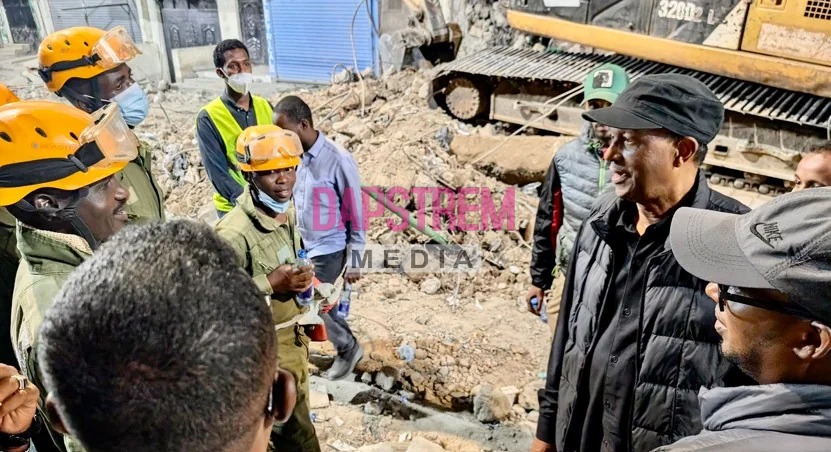
The 18-storey structure collapsed on October 23, triggering a multi-agency rescue operation involving emergency responders, security teams and other specialists. The search has focused on locating people who may have been trapped beneath the rubble.
Reports published on October 27 indicated that specialised radar and acoustic equipment had detected possible signs of life from two people beneath the debris, prompting rescue teams to concentrate on the indicated location. The Kenya Red Cross had also reported dozens of people missing as the operation continued.
Such operations are difficult because collapsed concrete, twisted steel and unstable debris can prevent rescuers from reaching people trapped inside the structure. Removing rubble requires caution to avoid causing further movement that could endanger survivors or rescue personnel.
Specialised equipment can help teams identify possible voids and signs of life, although indications from technology must be confirmed by rescuers on the ground.
For families waiting for information about relatives, every delay adds to the uncertainty. The rescue operation is therefore not only a technical challenge but also a deeply human crisis affecting workers, residents, business owners and loved ones.
The incident has also disrupted business activity in Eastleigh, a busy commercial area where many people depend on daily trade for their livelihoods. The collapse forced busines