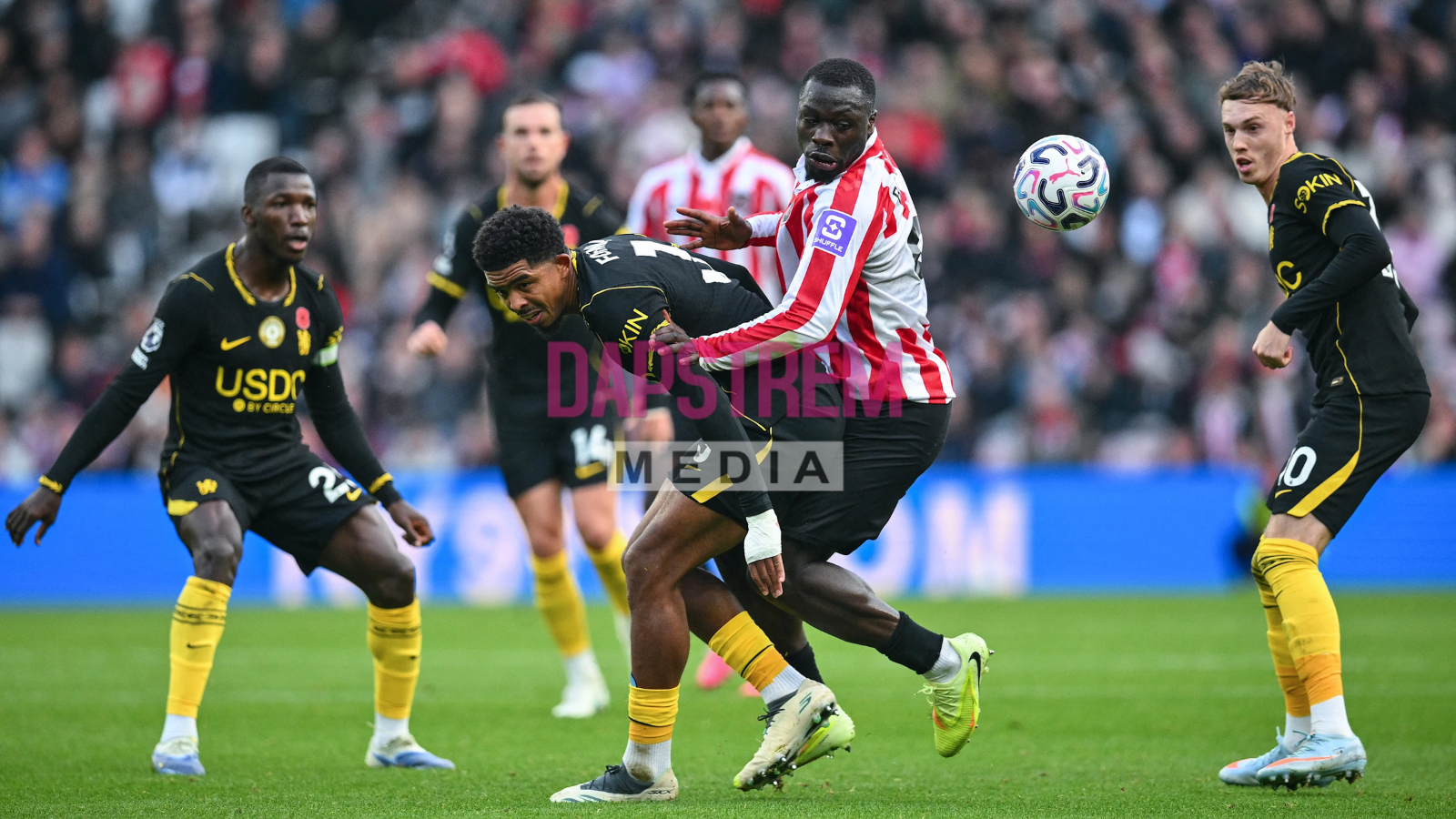
A first-half penalty from Enzo Le Fée proved decisive in a fiercely contested encounter in which Sunderland showed greater intensity, determination and attacking purpose.
For Chelsea, it was another disappointing afternoon under Xabi Alonso, whose team struggled to impose themselves against a Sunderland side desperate for points.
The victory was particularly important for Sunderland manager Régis Le Bris, who had been under increasing pressure following his team’s difficult start to the campaign.
Sunderland suffer an early setback but refuse to back down
The home supporters arrived at the Stadium of Light hoping for a response from their team, but Sunderland’s afternoon began with an unexpected problem.
Captain Granit Xhaka was forced off with an injury just three minutes into the contest, creating an early challenge for Le Bris.
Jules Ahoka was introduced in his place, and the young midfielder quickly settled into the game.
Rather than allowing the setback to disrupt their plans, Sunderland responded with impressive energy. They pressed Chelsea aggressively, challenged for second balls and looked determined to make life uncomfortable for the visitors.
Brian Brobbey was particularly influential, using his strength and physical presence to trouble Chelsea defenders Levi Colwill and Wesley Fofana.
Sunderland created several promising opportunities, with Brobbey missing a close-range chance after meeting a dangerous Chemsdine Talbi cross.
The Dutch striker continued to cause problems, showing the kind of physical presence that Chelsea struggled to contain throughout the opening period.
Chelsea escape controversy before Sunderland strike
Chelsea had an opportunity to take control of the contest when Cole Palmer went down following a challenge from Luke O’Nien near the Sunderland penalty area.
The visitors appealed for a penalty, but the officials determined that the contact occurred outside the box.
It was a significant decision, particularly because Chelsea were looking for a breakthrough in a match where clear attacking opportunities were proving difficult to find.
Morgan Rogers also missed a promising opportunity, failing to direct his header on target after connecting with Marco Palestra’s delivery.
But while Chelsea wasted their chances, Sunderland continued pushing forward.
Their persistence eventually paid off in the 36th minute.
Le Fée delivers from the penalty spot
The breakthrough came through the determination of Brobbey.
The Sunderland striker got the better of Colwill inside the penalty area, using his strength to get goal-side of the Chelsea defender before being pulled back.
Referee Jarred Gillett pointed to the spot, and despite Chelsea’s protests, the penalty decision stood following a VAR review.
Enzo Le Fée stepped forward with the responsibility of giving Sunderland the lead.
The French midfielder kept his composure, sending goalkeeper Mike Penders the wrong way to make it 1-0.
The Stadium of Light erupted.
It was a particularly meaningful goal for Sunderland, ending a 321-minute wait for a home league goal.
Le Fée’s penalty also rewarded a first-half performance in which the hosts had looked more aggressive and purposeful than their opponents.
Sunderland went into the interval deservedly ahead.
Alonso makes changes as Chelsea search for a response
Chelsea manager Xabi Alonso wasted little time making adjustments.
At half-time, Colwill was withdrawn and replaced by Brazilian youngster Estevão, with Moisés Caicedo dropping into central defence.
The change was intended to give Chelsea more attacking options and increase their ability to break down Sunderland’s defensive structure.
Danny Welbeck and Malo Gusto were also introduced later as Alonso attempted to inject fresh energy into his team.
Chelsea enjoyed more possession after the interval, but possession alone was not enough.
Sunderland remained organised, disciplined and committed to their defensive responsibilities.
Thomas Meunier, Nordi Mukiele and Luke O’Nien were particularly important in keeping Chelsea’s attackers under control.
Palmer struggled to find the spaces he needed, while Chelsea’s attacking movements frequently broke down before producing clear opportunities.
According to Sky Sports’ match analysis, Chelsea lost 63 per cent of their first-half duels, a statistic that illustrated Sunderland’s physical dominance.
Brobbey leads the battle as Sunderland threaten a second
Although Le Fée scored the only goal, Brobbey was arguably Sunderland’s most influential player.
His strength, movement and willingness to compete for every ball made him a constant problem for Chelsea’s defence.
He repeatedly occupied Colwill and Fofana, preventing them from comfortably building attacks from the back.
Brobbey eventually left the field in the 67th minute, with Wilson Isidor coming on.
The substitute nearly doubled Sunderland’s advantage when a defensive mistake allowed him to break through on goal.
However, Penders rushed off his line and produced an excellent save to keep Chelsea within touching distance.
It was an important intervention, although it did little to change the overall direction of the match.
Chelsea throw everything forward but Sunderland hold firm
The closing stages brought increasing pressure from Chelsea.
Estevão looked dangerous in attacking positions, while Geovany Quenda came close after cutting inside and firing towards the far corner.
Sunderland’s defenders, however, continued to stand firm.
The visitors’ clearest opportunity to rescue a point arrived deep into stoppage time.
Estevão delivered a dangerous free-kick into the penalty area, and Welbeck rose to meet it with a header.
Unfortunately for Chelsea, his effort sailed over the crossbar.
It was their final major opportunity.
When the referee blew the final whistle, Sunderland players and supporters celebrated a victory that could prove hugely important in their season.
For Le Bris, it was a welcome moment of relief. For Alonso, it was another afternoon filled with questions about Chelsea’s consistency and attacking effectiveness.