Fleetwood Town 1–1 Arsenal (Fleetwood win 5–3 on penalties)
Fleetwood Town produced a night to remember on Tuesday, eliminating Premier League champions Arsenal from the Carabao Cup after a dramatic penalty shootout victory that sent Highbury Stadium into celebration and secured the League Two club a historic place in the quarter-finals.
In a contest that defied expectations, Fleetwood held Arsenal to a 1–1 draw over 90 minutes before winning 5–3 on penalties. Aaron Loupalo-Bi gave the hosts a first-half lead, Viktor Gyökeres restored parity after the break, and goalkeeper Jay Lynch emerged as one of the night’s outstanding performers as the underdogs completed a remarkable upset.
For Fleetwood, this was more than a cup victory. It was a statement of resilience, organisation and belief against opponents possessing vastly greater resources and a squad packed with international quality. For Arsenal, meanwhile, the defeat represented a painful early exit from a competition in which their depth and attacking talent had appeared sufficient to carry them into the last eight.
The result was especially striking given the contrast between the clubs. Arsenal arrived as England’s reigning top-flight champions, while Fleetwood, competing in League Two, were fighting to turn their cup adventure into a defining moment of their season. By the final whistle, the gulf in status had counted for little.
A chaotic beginning to an extraordinary night
The atmosphere at Highbury Stadium was charged with anticipation as Fleetwood welcomed one of English football’s biggest clubs for a fourth-round tie that promised to be a landmark occasion for the home supporters.
The opening minutes, however, brought an unusual interruption. Play was halted after a drone was spotted above the stadium, delaying the match while officials addressed the situation. The stoppage briefly disrupted the rhythm of both teams, but it did little to diminish the intensity of the occasion.
When the action resumed, Arsenal enjoyed much of the possession, attempting to impose their technical superiority through controlled passing and movement. Mikel Arteta had made several changes to his starting side, but the visitors still fielded an imposing line-up featuring Gyökeres, Kai Havertz and promising youngster Max Dowman.
Fleetwood refused to be intimidated. Rather than allowing Arsenal to dictate the match without resistance, the hosts remained disciplined, defended their penalty area with determination and looked for opportunities to attack directly.
Their willingness to compete physically and exploit openings soon paid dividends.
Loupalo-Bi punishes Arsenal’s defensive lapse
The breakthrough arrived in the 21st minute, when Aaron Loupalo-Bi gave Fleetwood a shock lead.
The forward, on loan from Fulham, demonstrated the strength and composure required to make the most of a promising opportunity. He outmuscled young Arsenal defender Marli Salmon before guiding the ball beyond goalkeeper Illan Meslier.
The goal transformed the contest. Fleetwood’s supporters erupted, sensing that the possibility of a famous upset was becoming increasingly real, while Arsenal suddenly faced the challenge of recovering from an unexpected setback.
Loupalo-Bi’s finish also exposed a weakness in Arsenal’s defensive organisation. The visitors had enjoyed territorial control, but possession alone offered little protection against a determined opponent prepared to exploit individual mistakes.
Fleetwood responded to their lead with maturity. Rather than abandoning their shape in pursuit of another goal, they concentrated on protecting their advantage, closing spaces and forcing Arsenal to search for openings against a compact defensive unit.
Arsenal struggled to find the necessary incision before the interval. Havertz had a notable opportunity when he headed over from close range following a cross from Dowman, while the visitors found it difficult to turn their territorial dominance into a consistent stream of clear chances.
At half-time, Fleetwood had every reason to believe that history was within reach.
Gyökeres restores parity, but Arsenal cannot finish the job
Arteta responded by introducing greater creativity and experience after the interval, with Martin Ødegaard and Ben White among the players brought on to strengthen Arsenal’s pursuit of an equaliser.
The changes improved the visitors’ attacking rhythm. Ødegaard, in particular, helped Arsenal move the ball with greater urgency and imagination, giving them a more effective means of breaking through Fleetwood’s defensive structure.
The equaliser arrived in the 50th minute. Ceadach O’Neill, making his first Arsenal start, produced the attacking work that opened up the opportunity, delivering from the left for Gyökeres to bundle the ball over the line at the far post.
It was the striker’s first goal of the season, and it appeared to place Arsenal firmly back in control of the tie.
The equaliser also shifted the psychological balance of the match. Arsenal began to create more dangerous openings, while Fleetwood were increasingly required to defend deep and withstand sustained pressure.
Yet the visitors’ failure to convert their opportunities ultimately proved decisive. Havertz missed two promising chances in quick succession, and Arsenal continued to waste openings that might have put the match beyond Fleetwood’s reach.
The home side, despite spending long periods without the ball, defended with impressive concentration. Whenever Arsenal threatened to take control, Fleetwood found a way to frustrate them, turning what could have been a one-sided second half into a tense battle of endurance.
Eberechi Eze was also introduced as Arsenal sought a winner, but Fleetwood refused to buckle.
Their goalkeeper, Lynch, became increasingly important as the pressure intensified, producing crucial interventions to keep the hosts level. In stoppage time, he denied White and then thwarted another dangerous effort from Gyökeres, ensuring that the tie would be decided from the penalty spot.
Arsenal had dominated much of the second half, but their inability to finish their chances had given Fleetwood a lifeline and the hosts were determined to seize it.
Dowman’s red card adds to Arsenal’s frustration
The closing stages took another dramatic turn when Arsenal teenager Max Dowman was sent off following an altercation involving Fleetwood midfielder Harrison Neal.
The dismissal, which came in the final minutes, followed an incident in which Dowman was judged to have kicked out at his opponent. The decision proved contentious, with questions raised over the severity of the punishment.
Whatever the debate surrounding the red card, its immediate effect was unmistakable. Arsenal were reduced to ten men just as they were attempting to force a decisive breakthrough, complicating their task and adding further tension to an already difficult evening.
For Fleetwood, the dismissal offered another opportunity to capitalise on the circumstances. They maintained their composure, continued to defend resolutely and saw out the remaining moments without conceding.
After 90 minutes, neither side had managed to separate itself from the other. The score remained 1–1, setting up a penalty shootout that would determine whether Fleetwood’s remarkable performance would become a historic triumph or a valiant defeat.
Jay Lynch the hero as Fleetwood hold their nerve
When the match went to penalties, Fleetwood faced the ultimate test of composure. Arsenal’s superior experience and pedigree made them dangerous opponents from the spot, but the home side approached the shootout with remarkable confidence.
The decisive moment came when Lynch saved Bruno Guimarães’ penalty, diving to his left to deny the Brazilian midfielder and give Fleetwood the advantage.
The save placed the hosts within touching distance of a victory that few had dared to imagine before kick-off. With the pressure mounting, Fleetwood’s players continued to deliver, converting their opportunities while Arsenal were left to contemplate the consequences of a costly miss.
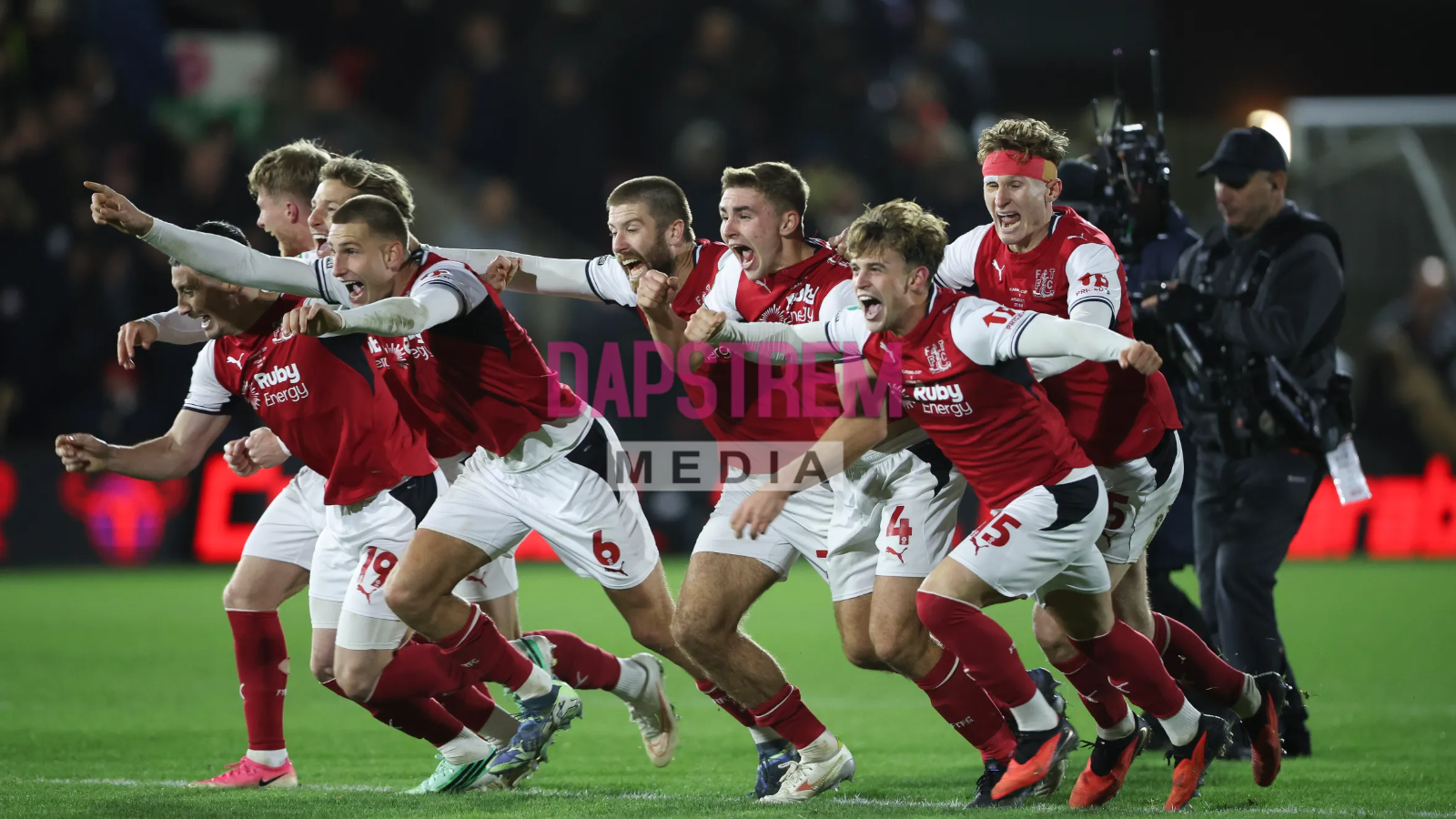
Conor Haughey then stepped forward and struck the decisive penalty, sending the ball beyond Meslier to secure a 5–3 shootout triumph.
The celebrations were immediate and unrestrained. Players and supporters erupted as the reality of the achievement sank in, while Fleetwood manager Matt Lawlor struggled to contain his emotions.
For Lynch, the performance represented a defining moment in a career shaped by perseverance. His late saves during normal time had already kept Fleetwood alive, and his penalty stop completed a goalkeeping display that will be remembered by the club’s supporters for years to come.
The goalkeeper later highlighted the importance of Fleetwood’s collective effort and the inspiration the squad had drawn from Grimsby Town’s famous cup victory over Manchester United the previous season. The message was clear: football’s biggest names can be beaten when belief is matched by determination.
What the defeat means for Arsenal
For Arsenal, the elimination raises questions about their ability to manage matches in which they are expected to dominate.
Arteta’s decision to rotate his starting line-up was understandable in a demanding season, particularly with several competitions placing demands on the squad. Nevertheless, the team still contained enough quality to be expected to overcome a League Two opponent.
The manager acknowledged the disappointment after the match, congratulating Fleetwood while expressing frustration that Arsenal had failed to make their superiority count. He pointed to the volume of possession and chances created, arguing that the team should have established a greater margin before the contest reached penalties.
That assessment reflects the distinction between creating opportunities and executing them. Arsenal did enough to threaten repeatedly, but missed chances, defensive vulnerability and Dowman’s dismissal combined to leave them exposed to an outcome that their pre-match status had made difficult to anticipate.
The defeat should not automatically be interpreted as evidence of a wider crisis. Cup football is often shaped by fine margins, and Arsenal’s overall ambitions extend beyond a single knockout competition. However, the result will inevitably intensify scrutiny of their finishing and their ability to put supposedly smaller opponents away.
For the young players involved, the evening also offered a demanding lesson in senior football. Technical ability and promise must be accompanied by decision-making, composure and discipline, particularly when matches become emotionally charged.
A defining achievement for Fleetwood Town
Fleetwood’s victory carries significance well beyond progression to the quarter-finals.
For a club competing in the fourth tier, defeating the reigning Premier League champions represents an extraordinary sporting achievement. It places the players, coaching staff and supporters at the centre of one of the competition’s most memorable stories.
The journey to this stage had already demonstrated Fleetwood’s capacity to compete in knockout football. Their victories over Chesterfield, Shrewsbury Town and Sheffield United had brought them to the fourth round, with their defensive record providing a foundation for further progress.
The Arsenal tie, however, was a different proposition. Facing a club with international players, substantial financial resources and recent success at the highest level required a level of concentration and belief that Fleetwood sustained throughout the evening.
Their achievement also carries significance for the wider community. Nights such as this create memories that transcend league positions, bringing supporters together around a shared sense of possibility. The result will remain part of Fleetwood’s history regardless of what happens in the quarter-finals.
It is also a reminder of the distinctive appeal of the Carabao Cup. The competition gives clubs from different levels of English football an opportunity to meet on the same pitch, where preparation, discipline and execution can temporarily narrow the gap in resources.