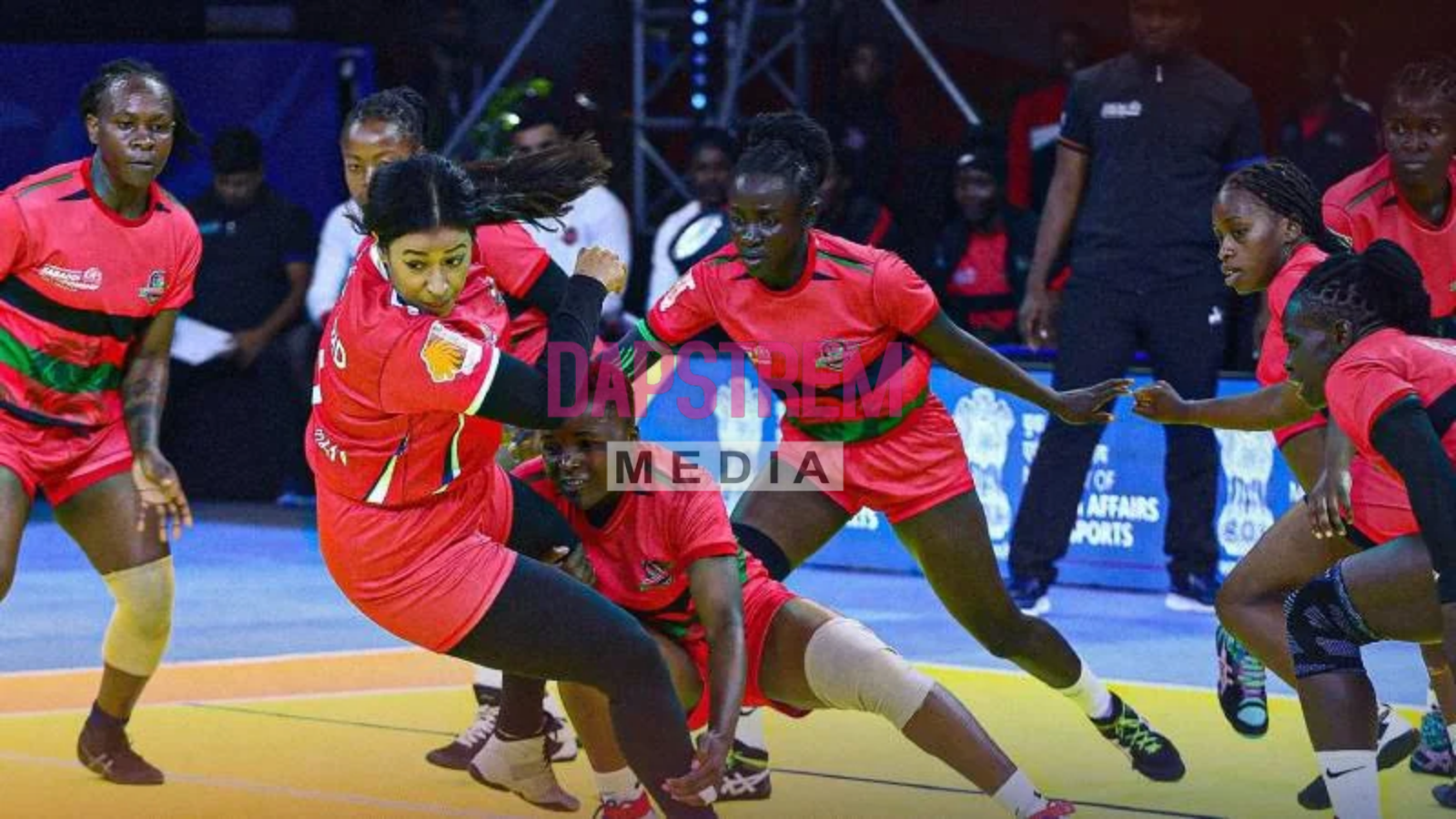
Kenya’s women’s kabaddi team delivered a commanding performance to thrash England 82–6 and secure their place in the semi-finals of the 2026 Commonwealth Kabaddi Championship, underlining their growing status as serious contenders for the title.
The Kenyan side produced a ruthless display at the Veer Savarkar Sports Complex in Ahmedabad, India, on Monday, October 26, overwhelming England with relentless raiding, disciplined defending and impressive teamwork. The 76-point winning margin was the biggest of Kenya’s campaign, while their 82-point haul set a new record for the highest team score at the championship.
The emphatic victory also extended Kenya’s unbeaten run in the women’s competition to three matches, confirming their qualification from Group B for the last four with a match to spare.
For a team carrying the hopes of Kenyan sports fans onto an international stage, the result was more than a convincing win. It was a statement of intent, demonstrating the squad’s ability to combine individual brilliance with collective discipline against Commonwealth opposition.
Onyango leads Kenya’s attacking onslaught
At the heart of Kenya’s triumph was Joy Vanessa Onyango, whose outstanding raiding performance proved too much for England to contain.
Onyango collected an extraordinary 27 raid points, repeatedly breaching England’s defensive line and creating scoring opportunities that helped Kenya build an unassailable advantage. Her performance was the defining individual contribution of a match in which the Kenyan attack operated with remarkable efficiency.
Shabbie Yongo added six points, while Lavenda Odhiambo contributed five as Kenya maintained pressure across the contest. The contributions from multiple players ensured England could not concentrate their defensive efforts on stopping a single raider.
Kenya’s approach was both aggressive and calculated. Their raiders consistently looked for openings, while the team capitalised on England’s inability to recover once players were eliminated from the mat.
The result was a one-sided contest in which Kenya dictated the pace and England struggled to establish any meaningful attacking rhythm.
Defensive strength seals a historic victory
While Onyango spearheaded the attack, Kenya’s defensive unit ensured England had little opportunity to mount a comeback.
Stacy Karanja and Mary Oteki each registered four tackle points, demonstrating the coordination and determination that underpinned Kenya’s commanding performance. Their contribution helped restrict England to just six points, with Anisa Khan scoring four and Erin Nicholson adding two.
One of the most telling statistics was Kenya’s eight all-outs. In kabaddi, an all-out occurs when every player on a team is eliminated from the mat, rewarding the opposing side with additional points. Kenya achieved this eight times, highlighting the extent of England’s struggles to withstand the pressure.
The balance between raiding and defending was central to Kenya’s success. While Onyango and her fellow raiders consistently penetrated England’s defence, the defenders ensured that the opposition could not respond with similar effectiveness.
It was a complete team performance rather than a victory built around one individual.
Scotland victory confirms Kenya’s growing momentum
Kenya’s demolition of England followed another impressive result against Scotland, whom they defeated 61–16 to maintain their unbeaten start to the tournament.
In that encounter, Lavenda Odhiambo led the scoring with 16 points, while Esther Omolo added nine and Onyango contributed six. Kenya registered 37 raid points and 13 tackle points, while also forcing Scotland into eight all-outs.
The two victories illustrated the depth of Kenya’s attacking options. Against Scotland, Odhiambo led the way; against England, Onyango took centre stage. Such contributions from different players make Kenya a more difficult opponent to contain, as their attacking threat is not dependent on a single raider.
Their defensive consistency has been equally important, allowing the team to maintain control even when opponents attempt to change their approach.
With three consecutive victories in Group B, Kenya have established themselves as one of the teams to watch as the competition moves towards its decisive stages.
Semi-final qualification raises hopes of a title challenge
The victory over England confirmed Kenya’s place in the semi-finals, with the knockout matches scheduled for Friday, October 30. Sri Lanka also secured qualification from Group B after defeating Bangladesh 31–20.
Kenya’s next challenge will be to carry their group-stage dominance into the knockout rounds, where the margin for error is considerably smaller. A strong group-stage record provides confidence, but the semi-finals will demand the same precision, composure and teamwork against opponents equally determined to reach the final.
The scale of the England victory will undoubtedly attract attention, but Kenya must guard against complacency. Their success has been built on disciplined execution, and maintaining those standards will be crucial as the competition intensifies.
Nevertheless, the team has given itself an excellent platform from which to pursue the championship title. Their scoring power, defensive organisation and ability to produce standout performances from different players suggest a squad capable of competing at the highest level of the tournament.
A proud moment for Kenyan sport
Kenya’s achievement in Ahmedabad is a reminder that the country’s sporting ambitions extend beyond its celebrated distance runners, rugby players and footballers.
Kabaddi, a fast-paced contact sport that combines agility, strength, tactical awareness and teamwork, offers Kenyan athletes another opportunity to make their mark internationally. The women’s team has seized that opportunity with performances that have demonstrated both technical ability and competitive maturity.
The 82–6 result against England will stand out for its sheer scale, but its wider significance lies in what it reveals about the team’s potential. Kenya have shown they can dominate through both individual excellence and collective discipline, qualities that will be essential in their pursuit of a title.
For Onyango, Karanja, Oteki, Odhiambo and their teammates, the focus now shifts to the semi-finals and the possibility of turning an outstanding group-stage campaign into a championship-winning run.