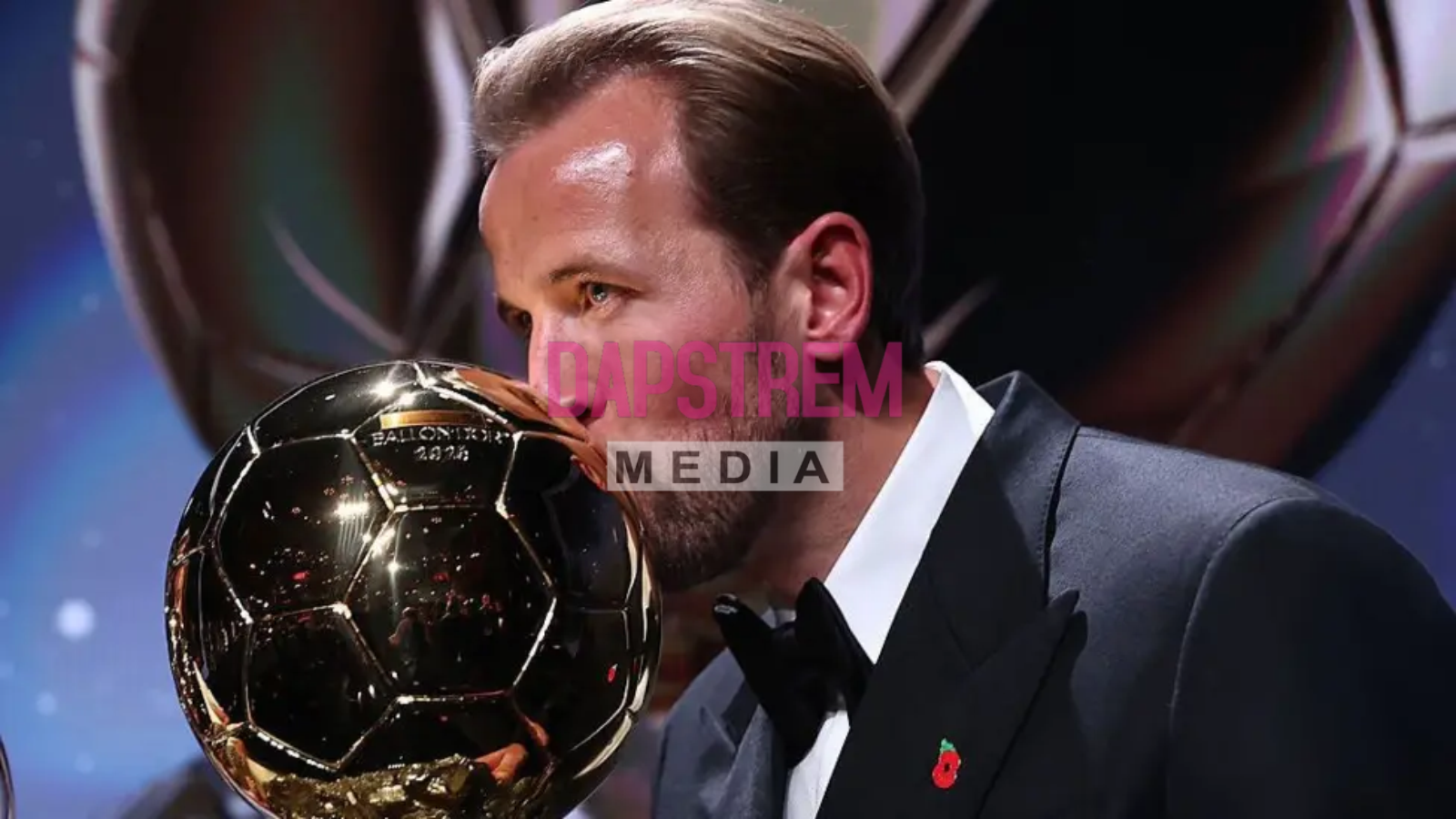
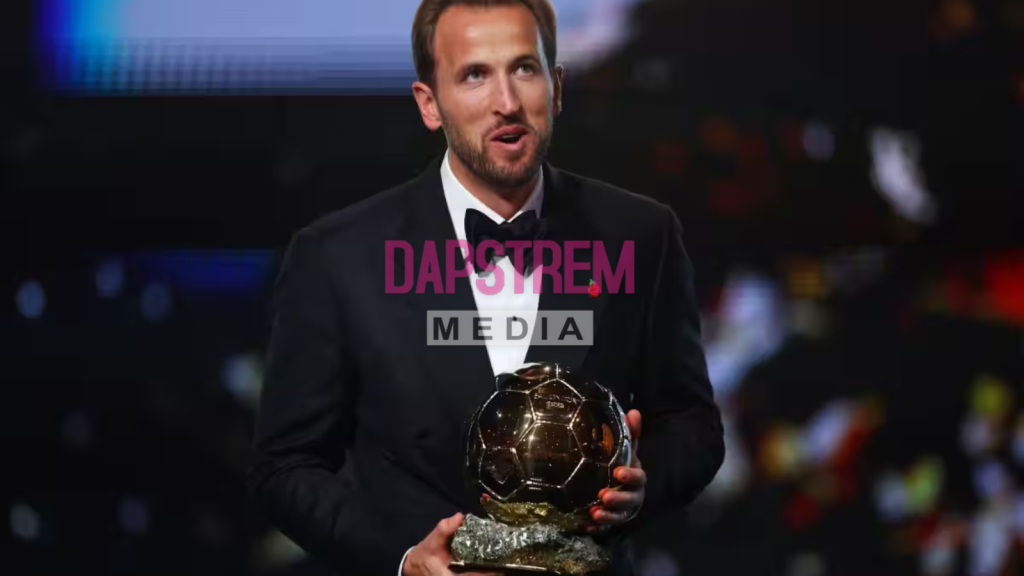
For years, Harry Kane has been celebrated as one of football’s most dependable goalscorers, a striker whose consistency has rarely been in doubt but whose career has been accompanied by persistent questions about whether he would win the biggest trophies. On Monday night, October 26, the England captain answered his critics in the most emphatic fashion, winning the 2026 men’s Ballon d’Or at the London Palladium.
The 33-year-old Bayern Munich forward was crowned the best men’s footballer in the world after an outstanding 2025–26 campaign, finishing ahead of Real Madrid’s Kylian Mbappé and Barcelona’s Lamine Yamal. His victory ended a 25-year wait for an English winner of football’s most prestigious individual award, following Michael Owen’s triumph in 2001. UEFA confirmed Kane’s historic achievement.
It was an occasion that brought together football’s leading figures in the British capital, but the evening belonged to a player whose journey to the summit of the game has been defined by perseverance, relentless ambition and an extraordinary capacity to score goals.
A season that made the difference
Kane’s victory was built on numbers that placed him among the most productive forwards in world football. He scored 73 goals in 65 appearances for club and country during the campaign, according to England Football, combining individual brilliance with a decisive contribution to his teams’ successes.
At Bayern Munich, Kane helped the German giants retain their Bundesliga crown and win the DFB-Pokal and Franz Beckenbauer Supercup. His performances reinforced his reputation as more than a traditional penalty-box striker: he can drop into midfield, link attacks, create opportunities for teammates and deliver the decisive finish when matches are on the line.
He also finished as the Bundesliga’s leading scorer for a third consecutive season and registered 14 goals in the UEFA Champions League as Bayern reached the semi-finals. Those achievements demonstrated the breadth of his influence across domestic and European competition.
The numbers alone, however, do not fully explain Kane’s significance. His greatest strength has been his ability to combine elite finishing with an understanding of how to make an entire attacking system function. He can occupy central defenders, draw opponents out of position, deliver incisive passes and still arrive in the penalty area to complete moves.
That combination helped distinguish him in a field containing extraordinary individual talents. Mbappé offered explosive pace and direct attacking threat, while Yamal represented the creativity and fearlessness of a new generation. Kane’s case rested on sustained productivity and his contribution to a successful season.
From loan spells to football’s highest individual honour
Kane’s achievement carries particular significance because his rise was neither immediate nor effortless.
Early in his career, he endured a succession of loan spells, including periods at Leyton Orient and Millwall, as he attempted to establish himself in professional football. His route to the top required patience and persistence before he became a leading figure at Tottenham Hotspur and one of the Premier League’s most prolific forwards.
At Tottenham, Kane established himself as a prolific scorer and eventually became the club’s all-time leading goalscorer. Yet major team honours remained elusive during his time in north London, and the absence of a major trophy became an increasingly prominent part of the debate surrounding his career.
His move to Bayern Munich in 2023 represented a decisive change. The transfer offered him a new competitive environment and an opportunity to pursue silverware at one of Europe’s most successful clubs.
The decision initially attracted scrutiny, particularly given the substantial transfer fee and Kane’s age at the time. His subsequent performances have helped justify the investment, with his scoring record and contribution to Bayern’s domestic success making him central to the club’s ambitions.
The Ballon d’Or now adds an extraordinary personal milestone to that transformation. It does not erase the disappointments of earlier years, but it places them in the context of a career that continued to develop rather than standing still.
England’s captain reaches another historic milestone
Kane’s triumph is also a landmark for English football.
Since Owen won the award in 2001, the men’s Ballon d’Or has been dominated by players from other countries, with Lionel Messi and Cristiano Ronaldo accounting for much of the competition’s modern history. Kane’s victory restores an English name to the top of the honours list after a quarter-century.
He becomes the fifth Englishman to win the men’s award, joining Sir Stanley Matthews, Sir Bobby Charlton, Kevin Keegan and Owen. Matthews won the inaugural Ballon d’Or in 1956, making the location and anniversary of Kane’s achievement especially symbolic.
Kane’s international career has also helped shape his standing. As England captain, he has carried the expectations of a football nation that has long sought to translate its depth of talent into major tournament success. His leadership and goalscoring have made him one of the defining figures of the national team’s modern era.
The Ballon d’Or is an individual award, but its significance extends beyond one player. For England, it is recognition that a homegrown forward has reached the highest level of sustained individual performance in the global game.
London provides a fitting stage
The setting added another layer of history to the occasion.
The 70th Ballon d’Or ceremony was held at the London Palladium on October 26, marking the first time the event had taken place outside the French capital. The move paid tribute to Sir Stanley Matthews, the English winger who became the award’s first recipient in 1956.
For Kane, lifting the trophy on home soil made an already historic achievement even more meaningful. The ceremony connected the modern game with its history, linking Matthews’ pioneering recognition seven decades ago with a new English winner whose career has unfolded across different generations of football.
The evening also recognised excellence elsewhere in the sport. Kane collected the men’s Ballon d’Or and the Gerd Müller Trophy for the leading male goalscorer, while Yamal won the men’s young-player award. Spain’s Unai Simón received the men’s goalkeeper honour, and national-team coach Luis de la Fuente was named men’s coach of the year. Paris Saint-Germain won the men’s club award.
In the women’s category, Alexia Putellas won her third Ballon d’Or Féminin, adding another chapter to an outstanding career. Arsenal and England winger Bukayo Saka received the Sócrates Award in recognition of his humanitarian work and social initiatives.
The results reflected a sport in which individual brilliance, collective achievement and contributions away from the pitch are increasingly celebrated alongside one another.
A victory that goes beyond goals
Kane’s Ballon d’Or is ultimately a recognition of a complete season rather than a single spectacular performance.
Goals remain the most visible measure of a striker, and his return of 73 across club and country provided a compelling foundation for his candidacy. But his tactical intelligence, professionalism and ability to influence teammates have also strengthened his case.
The award also highlights how a footballer’s legacy can change as his career develops. Kane was already recognised as an exceptional goalscorer before leaving Tottenham. His move to Germany, continued production and contribution to Bayern’s success have added a new dimension to his reputation.
There is still football ahead of him, and the Ballon d’Or does not settle every debate about his place among the great forwards of his generation. What it does establish is that, during the season under consideration, his performances earned him the sport’s most celebrated individual distinction.
The beginning of a new chapter
As the celebrations in London gave way to the next demands of the football calendar, Kane’s achievement offered a moment to reflect on a career built through persistence.
He has travelled from loan spells and the struggle to establish himself to becoming England’s captain, Bayern Munich’s leading attacking figure and now a Ballon d’Or winner. The journey has not followed the simplest route, but it has culminated in one of football’s most significant honours.
For England, the victory ends a long wait. For Bayern Munich, it recognises the influence of a player whose goals have helped deliver major domestic success. For Kane himself, it represents personal validation after years spent chasing excellence.
And for the next generation of footballers, his story offers a reminder that careers are not always defined by the speed of their beginnings. Sometimes, they are defined by the persistence with which a player continues to improve.
On a historic night at the London Palladium, Harry Kane moved beyond the familiar label of prolific striker. He became the 2026 men’s Ballon d’Or winner and the Englishman who brought one of football’s most coveted individual prizes home after 25 years.