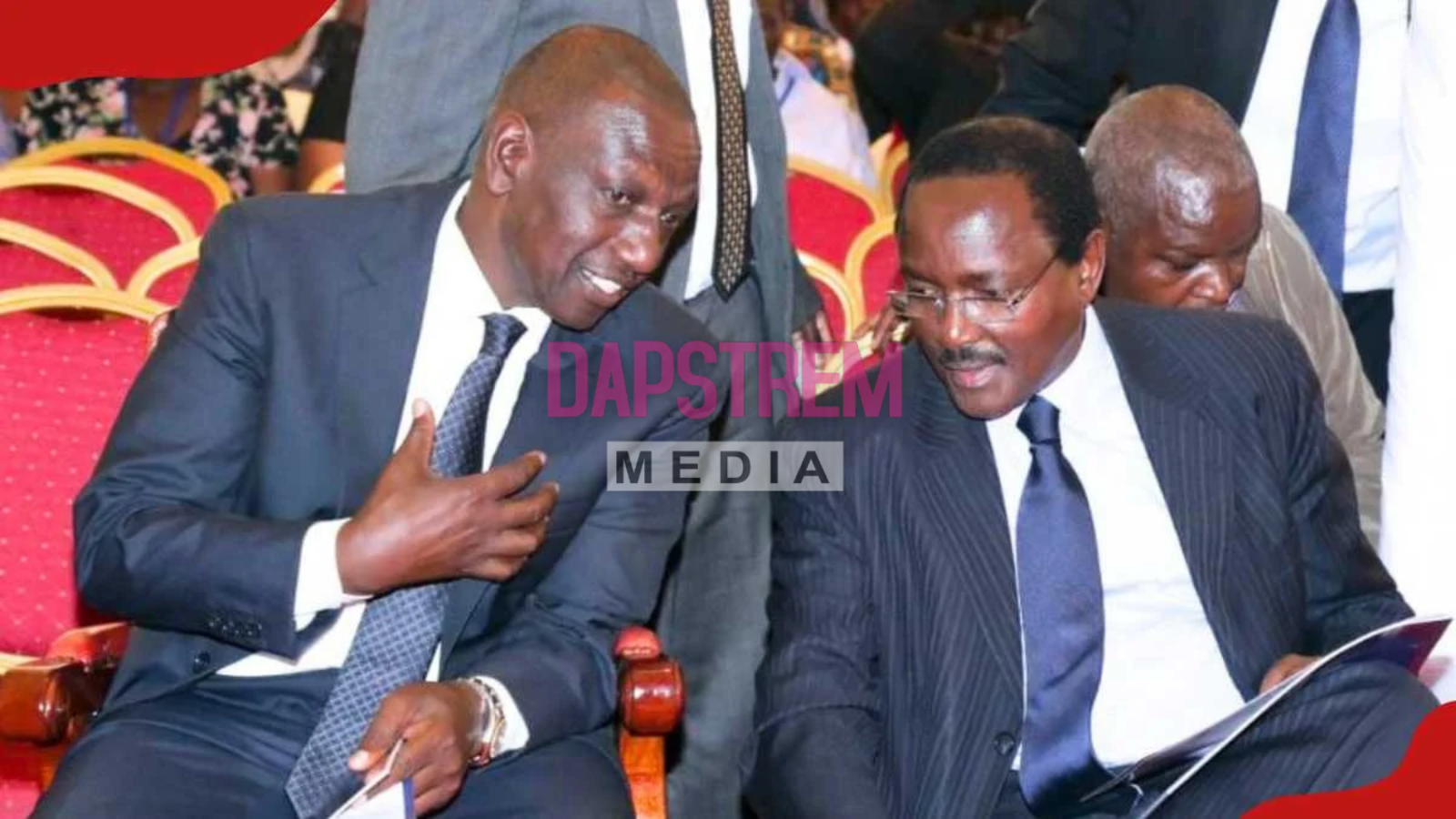
President William Ruto has directed a contractor to extend road tarmacking to the rural home of Wiper Patriotic Front leader Kalonzo Musyoka in Tseikuru, Kitui County, as he intensified efforts to win political support in Ukambani ahead of the 2027 General Election.
The President issued the directive on Monday, October 26, 2026, during the launch of the Kandwia–Kyuso–Tseikuru Road project in Kora, Kitui County.
Ruto instructed the contractor to include an additional three-kilometre stretch leading to Kalonzo’s residence, arguing that the former Vice President should benefit from government development projects despite belonging to the opposition.
The announcement was accompanied by a direct political appeal, with Ruto asking residents of Tseikuru to remind Kalonzo of their longstanding political relationship and encourage him to support his bid for a second presidential term.
The President’s remarks brought together two themes that have defined his recent engagements in Ukambani: promises of infrastructure development and efforts to weaken the opposition’s political influence in the region.
According to The Kenya Times, Ruto said the road leading to Kalonzo’s home should be included in the ongoing works, emphasising that his responsibility as President extended to all Kenyans regardless of their political affiliations. Read the report here.
Ruto invokes political history to court Kalonzo
Beyond the road announcement, Ruto appealed to Kalonzo to reciprocate what he described as political support dating back more than three decades.
Addressing residents, the President recalled travelling to Mwingi in 1992 to campaign for Kalonzo, who was seeking election as Mwingi North Member of Parliament on a Kenya African National Union (KANU) ticket.
Ruto was then associated with the Youth for KANU ’92 movement, which campaigned in support of the ruling party during the country’s first multiparty general election in more than two decades.
Kalonzo won the parliamentary seat, beginning a political career that would later see him serve as Vice President under former President Mwai Kibaki from 2008 to 2013.
Ruto argued that the history of their political relationship should count as Kenya approaches the next election.
He asked residents to deliver a message to Kalonzo, whom he described as a friend and neighbour, reminding him that the time had come to return the favour.
“Now tell him to remember me next year. Let him return the favour,” Ruto said, according to Capital FM’s report on the event.
The President’s appeal appeared designed to persuade Kalonzo to reconsider his political position and support the incumbent rather than pursue an opposition campaign in 2027. Read Capital FM’s report.
President brings Kindiki into the political appeal
Ruto also invoked the political relationship between Kalonzo and Deputy President Kithure Kindiki, arguing that the Wiper leader had previously benefited from support extended by both leaders.
The President referred to Kalonzo’s past remarks about Kindiki’s involvement in his political camp during the 2007 presidential election.
Ruto questioned why Kalonzo should not similarly extend support to him and his deputy as they seek another electoral mandate.
The appeal effectively framed the 2027 contest as an opportunity for Kalonzo to reciprocate past political goodwill.
However, the President’s remarks do not indicate that Kalonzo has agreed to support his re-election campaign.
Kalonzo remains a prominent opposition figure and has been associated with efforts to build a united front capable of challenging Ruto in the next general election.
His political decision could therefore have significant implications for the opposition’s presidential succession discussions and its prospects in Ukambani.
Why the Tseikuru road matters
The road directive carries significance beyond the convenience of improving access to Kalonzo’s rural home.
The Kandwia–Kyuso–Tseikuru route serves communities in a region where road infrastructure is important for transporting agricultural produce, accessing markets, reaching schools and health facilities, and connecting rural settlements to commercial centres.
For residents, improved road conditions could reduce transport difficulties, improve access during rainy weather and make movement between communities easier.
The project also places the government’s development agenda directly in Kalonzo’s political backyard, where the Wiper leader has maintained a substantial political following.
During the opening days of his four-day tour of Ukambani, Ruto repeatedly argued that the region should not be excluded from development because of its political affiliations.
Citizen Digital reported that the President had earlier promised to address the road leading to Kalonzo’s home, arguing that it was inappropriate for a former Vice President to continue using a dusty road to reach his rural residence. Read the report.
The latest directive gives that promise a more specific scope by instructing the contractor to include the three-kilometre stretch.
The announcement, however, is a directive to extend the works. The final cost, implementation schedule and completion date for the additional section would need to be confirmed through official project documentation.
Ruto steps up efforts to win Ukambani
The road announcement comes as Ruto intensifies his outreach in Kitui, Machakos and Makueni counties ahead of the 2027 General Election.
The President’s four-day tour has included launches and inspections of infrastructure projects, water initiatives, educational facilities and other development programmes.
His message has been that residents should judge the government by the development it delivers rather than by political loyalties.
At the same time, Ruto has criticised opposition leaders, arguing that they have not presented a convincing development agenda for the region.
The Daily Nation reported on October 24 that the President had urged Ukambani residents to abandon the opposition and support his re-election campaign, describing his administration as better placed to deliver development in the region. Read the report.
The strategy places infrastructure at the centre of the President’s political outreach.
By highlighting road construction and other public investments, Ruto is seeking to demonstrate that his administration can deliver tangible benefits in areas where his political support has traditionally been weaker.
The road to Kalonzo’s home has consequently become both a development issue and a talking point in the emerging 2027 political contest.
Will Kalonzo accept Ruto’s offer?
Despite the President’s appeal, Kalonzo’s political position remains an important unknown.
The Wiper leader has been a central figure in opposition politics and has previously sought the presidency. He also participated in the Azimio la Umoja-One Kenya coalition’s 2022 presidential campaign, during which negotiations over the running-mate position became a major political issue.
Ruto used that experience to warn Kalonzo that opposition leaders could subject him to another selection process ahead of the 2027 election.
According to People Daily, the President recalled the 2022 running-mate selection process and suggested that Kalonzo could face similar scrutiny again if he pursued the presidency or sought a leading position in an opposition alliance. Read the report.
The remarks suggest that Ruto is seeking to exploit potential disagreements within the opposition while presenting cooperation with his administration as an alternative.
Whether the approach will persuade Kalonzo remains uncertain. The Wiper leader’s response, the direction of opposition coalition negotiations and the political calculations of other regional leaders will help determine how the contest develops.
A development promise with political implications
Ruto’s directive to extend tarmacking to Kalonzo’s home illustrates the intersection of public infrastructure and electoral politics in Kenya.
On one hand, the improved road could benefit Kalonzo’s household and surrounding communities. On the other, the announcement gives the President an opportunity to demonstrate that his administration is willing to invest in an opposition stronghold while asking its most prominent political figure to support his re-election.
The project will ultimately need to be assessed by whether the road is funded, completed to the required standards and delivered in a way that benefits the wider community.
For now, Ruto has made his position clear: he wants the road extended to Kalonzo’s residence, and he wants the Wiper leader to reconsider his political allegiance before the 2027 election.
The question is whether the gesture will open the door to political cooperation or remain a development promise delivered in the middle of an increasingly competitive election campaign.