
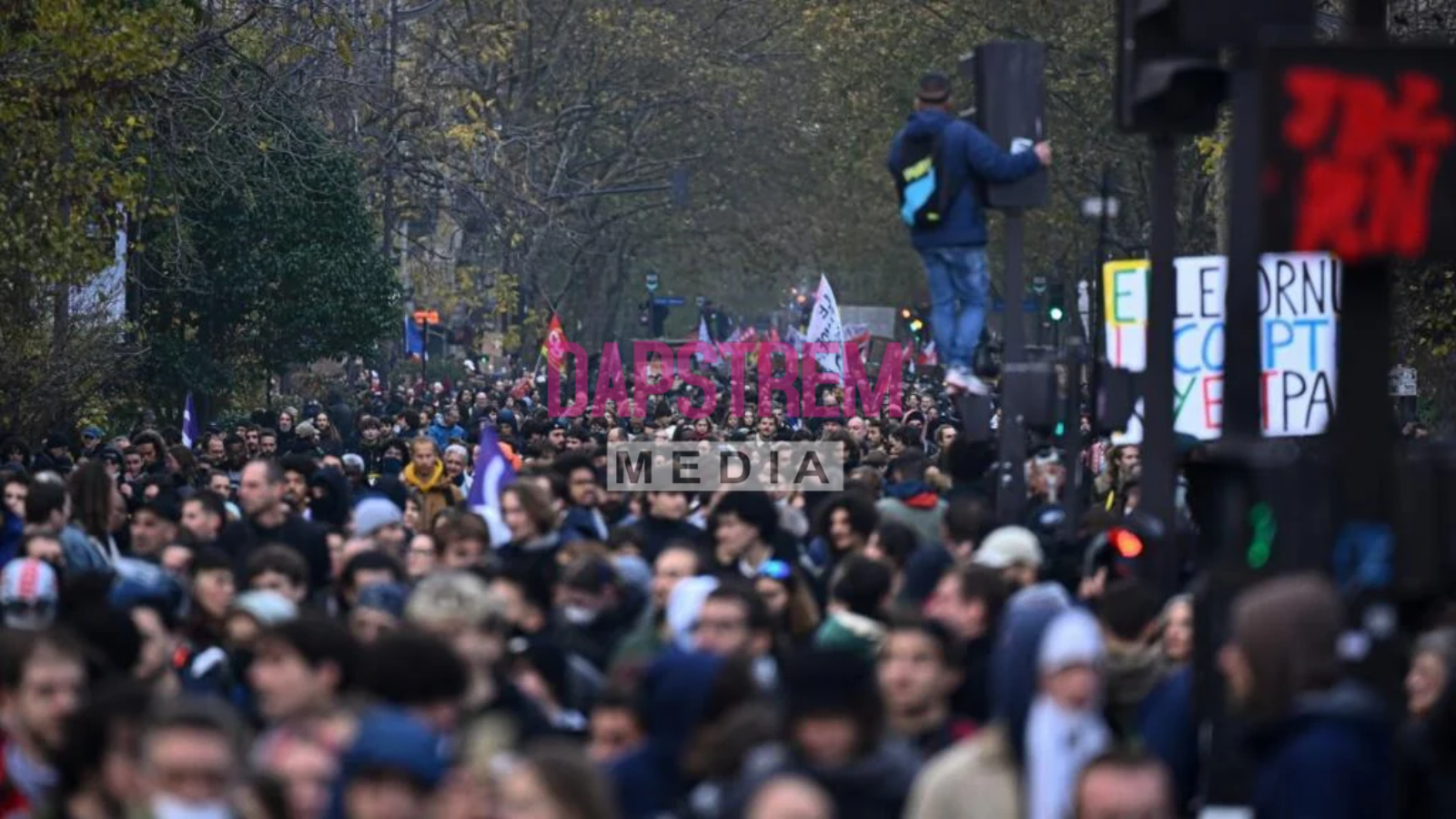
Thousands of protesters took to the streets across France on Saturday for a sixth consecutive weekend, demanding better public services, higher wages and relief from soaring living costs as public frustration continues to challenge President Emmanuel Macron’s government.
The demonstrations brought together students, trade union members, left-wing activists and supporters of the Yellow Vest movement, reflecting growing anger over economic inequality, declining purchasing power and concerns about police conduct.
In Paris, thousands gathered at Place de la République in a largely festive atmosphere, with musicians, food trucks, costumes and handmade placards accompanying the march. Protesters carried trade union flags and banners highlighting what they described as the deterioration of essential public services, particularly education and social security.
Organisers estimated that approximately 150,000 people participated in demonstrations nationwide, down from 200,000 the previous weekend and 800,000 during the movement’s first major mobilisation on October 17.
France’s Interior Ministry reported a lower turnout of 82,500 demonstrators, compared with 106,000 a week earlier, indicating that participation has gradually declined despite continuing public discontent.
The movement initially emerged in mid-September, when high school students protested against poor learning conditions before expanding into a broader nationwide campaign over rising prices, inadequate public services and alleged police brutality.
For many demonstrators, the crisis goes beyond wages, touching on the increasing difficulty of meeting basic household expenses.
“People are having to choose between having a roof over their heads, getting medical care, and being able to eat their fill,” said Manon Moret, general secretary of the student union Unef.
Protesters also criticised a law adopted by parliament on Friday that increases legal protection for law enforcement officers using their firearms. Opponents argue that the legislation risks weakening accountability over police violence.
Although most demonstrations remained peaceful, isolated confrontations erupted in some cities. In Marseille, clashes involving protesters and police prompted officers to fire tear gas, while vehicles and rubbish bins were reportedly set alight. By 6 p.m., the Interior Ministry had reported 144 arrests nationwide.
The unrest has also created a significant challenge for Prime Minister Sébastien Lecornu, whose government faces pressure to address economic grievances while managing concerns over public finances.
Trade unions have demanded higher wages and stronger protection for public services, while the government has faced criticism over the pace and scale of its response.
With France approaching its 2027 presidential election, the demonstrations could become an important political battleground, forcing political leaders to confront issues of inequality, economic security and the future of public services.
Despite declining attendance, organisers and activists have vowed to continue mobilising in the coming weeks, suggesting that France’s social tensions remain far from resolved.