French Prime Minister Sébastien Lecornu is meeting trade union leaders on Wednesday as the government prepares for another wave of demonstrations following days of unrest that have rocked several French cities.
The talks come after protests on October 17 escalated into violence, looting, arson and attacks on public buildings, prompting authorities to impose localised curfews and prepare a substantial security deployment for further demonstrations.
Lecornu is scheduled to meet representatives of five major trade unions to discuss how the government can protect the right to peaceful protest while preventing demonstrations from being exploited for violent acts.
The meeting comes amid growing public frustration over the cost of living, deteriorating school conditions and demands for better public services, putting additional pressure on President Emmanuel Macron’s government ahead of the 2027 presidential election.
According to Reuters and France’s parliamentary broadcaster LCP, the prime minister has also promised further consultations with unions on purchasing power and other economic concerns.
Government seeks to prevent further violence
The latest unrest has presented Lecornu’s government with a difficult balancing act: restoring public order while responding to the grievances that have brought demonstrators onto the streets.
The prime minister has acknowledged shortcomings in the security response to the October 17 demonstrations, when police struggled to contain violence in several cities.
The disturbances included looting, fires and attacks on public buildings. Businesses were also affected, prompting the government to promise financial assistance to those that suffered damage.
Following emergency consultations, authorities introduced localised curfews in affected areas, including parts of Paris and other major cities. The restrictions were intended to prevent further destruction while allowing normal activities to continue elsewhere.
Lecornu has also promised a substantial deployment of police and security personnel for upcoming demonstrations, with the government seeking to avoid a repeat of the violence.
The authorities have maintained that peaceful demonstrations must remain possible, while those responsible for looting, arson and other criminal acts will face prosecution.
The government’s response has nevertheless come under scrutiny, with questions raised about whether security agencies adequately anticipated the scale of the unrest.
Reuters reported that the prime minister acknowledged failures in intelligence and policing, while the government prepared further measures ahead of the next protests.
Trade unions demand attention to economic concerns
Although the immediate focus of Wednesday’s meeting is the protection of peaceful demonstrations, trade unions are expected to press the government on broader economic grievances.
Representatives of the CFDT, CGT, Force Ouvrière, CFTC and CFE-CGC have been invited to the talks.
Union leaders have stressed that discussions should not be limited to protest organisation and public security. They want the government to address purchasing power, particularly the rising cost of energy and the pressure on household budgets.
The CFDT has indicated that it does not want the meeting to become a lecture on responsibility, arguing that workers’ concerns must receive meaningful attention.
The government has said the consultations will continue in the coming weeks and that Labour Minister Jean-Pierre Farandou has been asked to work with unions on possible measures, including those related to purchasing power.
However, the absence of student representatives from Wednesday’s meeting has raised questions about whether the government is adequately including young people in discussions about the unrest.
Student protests have been a significant part of the wider movement, with demonstrators raising concerns about school resources, overcrowded classrooms, long school days and teacher shortages.
The government has defended its efforts to address these issues, but unions and student organisations have argued that existing measures have not sufficiently met their demands.
Students and Yellow Vests prepare new demonstrations
Further demonstrations are expected on Saturday, October 24, with calls for mobilisation from Yellow Vest activists and student movements.
Trade unions have also announced a demonstration and strike day for November 5, adding to concerns that the unrest could continue into the coming weeks.
The Yellow Vest movement, which emerged in 2018 over fuel taxes and the cost of living, has historically mobilised people who feel economically disadvantaged or politically overlooked.
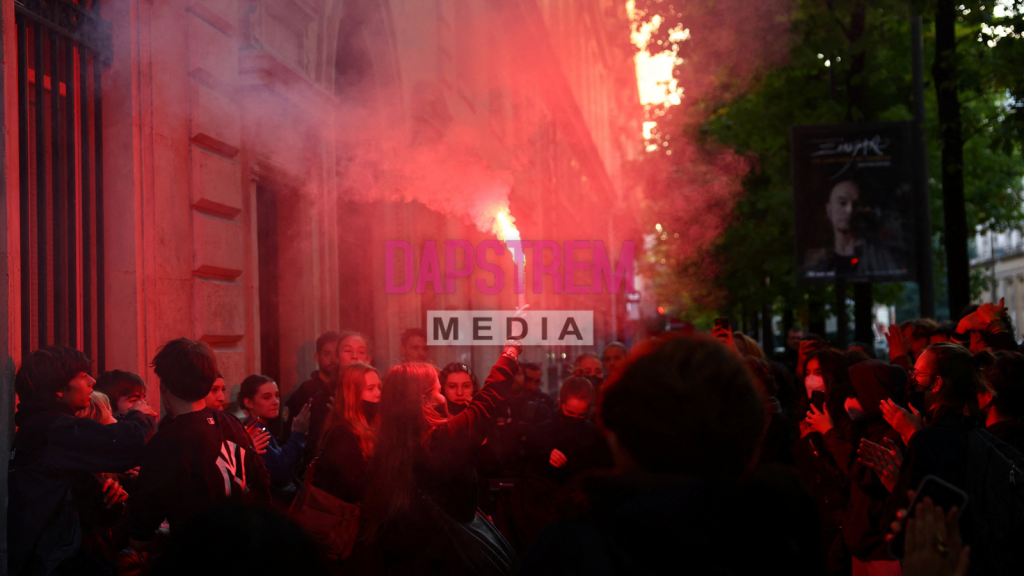
Its renewed involvement highlights the persistence of economic grievances in France, particularly concerns about purchasing power and the cost of essential goods and services.
Student organisations, meanwhile, have focused on education, calling for better-resourced schools and improvements to learning conditions.
The overlapping demands have created a broader movement in which economic dissatisfaction, concerns about public services and frustration with political decision-making are converging.
While many demonstrations have been peaceful, violent incidents have complicated the government’s response and intensified debate over policing, protest rights and accountability.
The coming demonstrations will test whether the authorities can maintain public order without provoking further confrontation with protesters
Macron faces mounting political pressure
The unrest has also increased pressure on President Emmanuel Macron, whose government is navigating a difficult political and economic environment.
Macron has condemned the violence while acknowledging that the concerns expressed by peaceful demonstrators deserve attention. He has tasked Lecornu with bringing together unions, political parties and other stakeholders to seek solutions.
However, the government faces limitations in its ability to respond quickly, particularly as it deals with budgetary pressures and disagreements in Parliament.
France has been struggling to control its public deficit, making new spending commitments politically and financially difficult.
The government’s 2027 budget proposals have also faced criticism from education groups, which argue that additional funding does not adequately address staffing shortages, overcrowded classrooms and deteriorating facilities.
The political stakes are significant because France is due to elect a new president in 2027, when Macron’s current presidency ends.
Opposition parties have criticised the government’s handling of the unrest, with some accusing it of failing to anticipate the scale of the demonstrations and others arguing that its response has been insufficient to address the underlying social problems.
The administration, in turn, has insisted that violence and attacks on public institutions cannot be tolerated, regardless of the grievances motivating peaceful protesters.
Businesses count the cost of unrest
The violence has also created an economic burden for businesses and local authorities.
French officials have said that at least 3,000 businesses suffered damage or looting during the unrest, prompting the government to promise targeted financial assistance.
The damage comes at a difficult time for businesses already facing uncertainty over consumer spending and the broader economic outlook.
Shop owners and other affected businesses now face the costs of repairing premises, replacing stolen goods and dealing with interruptions to normal operations.
The government has promised a dedicated support fund for affected businesses, although the details and extent of the assistance remain important questions for those seeking compensation.
The unrest has also attracted attention from international observers, with reports of travel warnings and concerns about the effect of continued instability on France’s economic and political climate.
For the government, restoring confidence will require both effective security measures and a credible response to the grievances driving the demonstrations.
A critical test for dialogue
Wednesday’s meeting represents an attempt to reopen dialogue between the government and organised labour at a time when tensions remain high.
The unions want assurances that the right to demonstrate will be protected and that the government will address concerns about living costs and public services.
The administration, meanwhile, is seeking cooperation from established organisations to prevent peaceful demonstrations from being overshadowed by violence.
Yet the exclusion of student representatives from the talks leaves an important part of the protest movement outside the immediate discussions, even as the government acknowledges young people’s concerns.
With further demonstrations planned for October 24 and November 5, the outcome of the consultations could help determine whether negotiations ease tensions or whether protests continue.
For Lecornu, the challenge is to demonstrate that the government can maintain public order while engaging seriously with the social and economic issues behind the unrest.
For France, the coming days will test whether dialogue can offer a path forward in a crisis that has combined street violence, economic frustration and a wider debate over the country’s political direction.