University Lecturers Set to End Four-Week Strike After KSh20 Billion Deal With Government, Classes to Resume Monday
University lecturers in Kenya are expected to return to classrooms on Monday, November 2, 2026, following a breakthrough in negotiations between university staff unions and the government over a KSh20 billion financial agreement. The deal offers hope of ending a nationwide strike that has disrupted learning in public universities for four weeks, leaving thousands of students uncertain about their academic calendars, examinations and graduation plans.
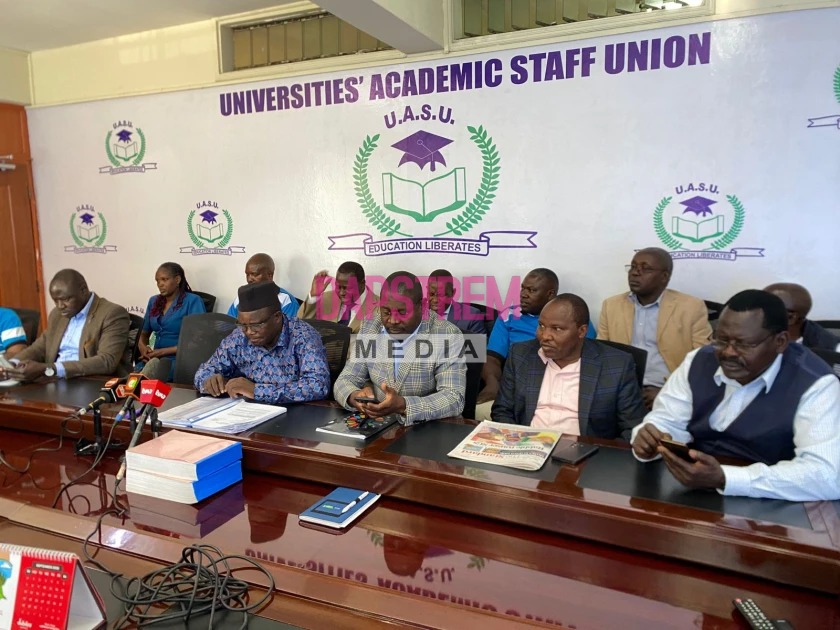
The Universities Academic Staff Union (UASU) Secretary-General, Dr Constantine Wasonga, announced the breakthrough on Wednesday, October 28, following weeks of negotiations over lecturers’ salaries, allowances and the implementation of the 2025–2029 Collective Bargaining Agreement (CBA).
Wasonga said the two sides had agreed on the financial terms and that technical teams would document the agreement before its formal signing, which was expected on Friday, October 30. The union also indicated that it would officially call off the strike once the agreed terms had been put in writing.
The development marks a significant turning point in a dispute that had threatened to derail the academic calendar across the country’s public universities. The industrial action began on October 2 after negotiations failed to produce an agreement acceptable to the unions.
The strike involved members of UASU, the Kenya Universities Staff Union (KUSU) and the Kenya Union of Domestic, Hotels, Educational Institutions, Hospitals and Allied Workers (KUDHEIHA). It affected teaching and other university operations across 35 public institutions.
The reported KSh20 billion package represents a major increase from the government’s earlier offers, which the unions had rejected as insufficient to address their demands. The breakthrough has raised hopes that lecturers will resume their duties and students will return to learning after weeks of uncertainty.
However, the detailed terms of implementation, including the distribution of the money and the payment schedule, had not been fully disclosed when the agreement was announced.
How the KSh20 Billion Deal Was Reached
The agreement followed a series of negotiations between university staff unions, university employers and government representatives over the cost of implementing the 2025–2029 CBA.
The unions had maintained that the government needed to commit sufficient resources to address lecturers’ concerns about basic salaries, allowances and other employment benefits. They argued that previous proposals did not adequately reflect their demands or the financial pressures facing university employees.
At the centre of the dispute was the amount the government was willing to allocate towards the four-year agreement.
The unions had sought approximately KSh98 billion for the CBA, while the government had presented substantially lower offers during the negotiations. Earlier proposals included allocations of approximately KSh9.76 billion and KSh11.96 billion, both of which were rejected by the unions.
The most recent offer of about KSh11.96 billion was presented on October 26 but failed to end the standoff. Union officials questioned the amount and argued that it would not adequately address the outstanding issues.
The government subsequently increased its offer to KSh20 billion, paving the way for the breakthrough announced two days later.
Wasonga welcomed the revised figure, saying the unions had negotiated the amount rather than having it imposed on them. His remarks suggested that reaching an acceptable financial commitment was central to resolving the dispute.
The difference between the KSh11.96 billion offer and the new KSh20 billion package is approximately KSh8.04 billion. The increase represents a substantial shift in the government’s negotiating position, although the final impact on individual employees will depend on the agreement’s detailed terms.
Despite the breakthrough, the KSh20 billion package remains below the unions’ original KSh98 billion demand. The final agreement will therefore be important in establishing which demands have been accommodated, how the funds will be allocated and what commitments the government and university employers will make.
The negotiations also involved Education Cabinet Secretary Julius Ogamba, National Treasury Cabinet Secretary John Mbadi and Interior Principal Secretary Raymond Omollo, among other officials.
Their involvement reflected the broader nature of the dispute, which required coordination between the education sector, government financing authorities and university staff representatives.
The agreement is expected to provide a framework for resolving the immediate salary and allowance dispute while allowing universities to resume their core academic responsibilities.
What the Agreement Means for Lecturers
For lecturers and other affected university employees, the deal offers hope that the prolonged dispute over remuneration will finally move towards resolution.
The unions had argued that their members needed a fair compensation arrangement that recognised their professional responsibilities, qualifications and contribution to higher education.
University lecturers play a central role in teaching, supervising research, assessing students and preparing graduates for employment. Their work also supports research, innovation and the development of skilled professionals in areas such as medicine, engineering, education, agriculture and technology.
The unions’ position has been that compensation and employment conditions must reflect these responsibilities and enable universities to retain qualified academic staff.
The 2025–2029 CBA negotiations have focused on basic salary adjustments and allowances, alongside other employment benefits. The unions have also raised wider concerns about medical benefits, staff welfare and the implementation of previous agreements.
UASU had proposed substantial salary increases across different staff grades, arguing that the earlier offers did not adequately address its demands. Its proposals also included higher housing allowances and other benefits.
However, the precise salary adjustments and individual benefits arising from the reported KSh20 billion agreement had not been fully detailed in the initial announcement.
It would therefore be premature to conclude that every demand presented by the unions has been accepted or that all employees will receive the same level of adjustment.
The written agreement will need to clarify how the money will be shared across staff categories, which allowances are covered and when the agreed payments will take effect.
For lecturers, the immediate priority will be ensuring that the verbal agreement translates into a formal commitment that can be implemented. The return to work is an important step, but the long-term success of the settlement will depend on whether both sides honour their obligations.
Students Finally Get Hope After Weeks of Disrupted Learning
The agreement has brought relief to thousands of university students who have spent nearly a month without normal classroom teaching.
Since the strike began on October 2, students in affected public universities have faced uncertainty over lectures, continuous assessments, examinations and the completion of their academic programmes.
Many learners had expected to spend the semester attending classes, conducting research, completing assignments and preparing for examinations. Instead, the industrial action interrupted these activities and left students waiting for a resolution.
The disruption has been particularly difficult for students approaching the end of their studies. Those preparing for final examinations, research presentations or graduation may have to adjust their plans depending on how their institutions revise their academic calendars.
Students in professional courses could also face challenges because some programmes require practical sessions, clinical placements, laboratory work or supervised field activities. Such requirements cannot always be recovered simply by adding a few extra lectures.
The strike has also affected students who depend on university facilities and structured academic schedules to remain on track with their studies.
For those living away from home, the disruption may have created additional financial pressure. Some students continue paying rent, food expenses and other living costs even when regular academic activities have been suspended.
Parents and guardians have also been affected by the uncertainty, particularly families that have made financial sacrifices to support their children’s university education.
The anticipated return to class on November 2 is therefore an important development for learners and their families. It offers the prospect of renewed academic activity and a clearer path towards completing the semester.
Nevertheless, students will still need official communication from their respective universities regarding revised timetables, examinations and other academic arrangements.
The end of the strike will not automatically restore every lost academic activity. University administrators will need to determine how to recover missed teaching hours without compromising the quality of education.
Institutions may have to extend semesters, rearrange examination periods or revise graduation dates where necessary. These decisions will depend on the extent of the disruption and the requirements of individual programmes.
Students will also expect universities to communicate changes early enough to help them plan their studies, accommodation and personal commitments.
University of Nairobi Students Had Raised Alarm
The lecturers’ strike had also triggered growing frustration among students, some of whom took to the streets to demand an immediate resolution.
On Tuesday, October 27, University of Nairobi students staged protests over the prolonged interruption of learning. The demonstrations reflected increasing concern that the dispute between lecturers and the government was unfairly affecting students who had little influence over the negotiations.
Student leaders called on the government and education authorities to intervene and ensure that the parties reached an agreement.
The protests came as the strike approached its fourth week, with students warning that continued delays could affect academic progress and disrupt important university activities.
The demonstrations added pressure on the parties to reach a settlement, particularly as students faced uncertainty over examinations and graduation schedules.
For many learners, the dispute had become more than a disagreement over salaries and allowances. It had directly affected their education, finances and expectations about completing their studies on time.
The reported KSh20 billion deal may therefore help ease tensions between students, university management and striking staff.
However, the resumption of lectures will need to be accompanied by a clear plan for recovering lost academic time. Students will want assurances that the interruption will not unfairly disadvantage them or reduce the quality of instruction they receive.
The government and university administrators will also need to address the broader concern that recurring industrial disputes can undermine confidence in public higher education.
Why the 2025–2029 Collective Bargaining Agreement Matters
The dispute has highlighted the importance of collective bargaining in determining employment conditions within Kenya’s public universities.
A Collective Bargaining Agreement sets out negotiated terms governing aspects of employment, including salaries, allowances and other benefits covered by the parties’ agreement.
For university staff, the 2025–2029 CBA is significant because it is intended to guide remuneration and employment arrangements over several years.
The negotiations became contentious because the unions and university employers disagreed over the financial resources needed to implement the proposed terms.
The unions argued that the government’s earlier offers were inadequate, while the government had to consider the cost of the agreement and the resources available to fund it.
The resulting standoff demonstrated how disagreements over the financing of employment agreements can have consequences far beyond the negotiating table.
When lecturers withdraw their services, students lose teaching time, universities face operational uncertainty and families may incur additional costs. The wider economy can also be affected when the training of future professionals is delayed.
The reported KSh20 billion agreement could help resolve the immediate dispute, but its lasting value will depend on the clarity of the written terms and the commitment of both parties to implementation.
The parties will need to establish clear timelines, payment arrangements and procedures for addressing disagreements that may arise during implementation.
A reliable framework for monitoring the agreement could also reduce the risk of future misunderstandings.
The experience of the latest strike may encourage the government, university employers and staff unions to begin future negotiations earlier and resolve disagreements before they escalate into industrial action.
Funding and Implementation Remain Important Questions
Although the KSh20 billion figure has raised hopes of a settlement, the financial details will be crucial in determining how effectively the agreement addresses the dispute.
The money is expected to cover basic salaries and allowances under the 2025–2029 CBA. However, the exact allocation across different staff categories and the timetable for implementation had not been fully disclosed following the announcement.
This leaves several questions for the parties to clarify in the final document.
These include how the funds will be distributed, when the adjustments will take effect and whether the package will be implemented in phases. The agreement will also need to specify the responsibilities of the government and university employers.
The unions will be looking for clear commitments that can be measured and enforced, while the government will need to ensure that the agreed payments are supported by a workable financing arrangement.
Transparent communication will be essential to prevent confusion among lecturers and other university employees.
The formal signing of the agreement is therefore an important step, but implementation will ultimately determine whether the settlement delivers the intended results.
The government and the unions will also need to communicate the agreement’s provisions accurately so that employees understand what has been negotiated and what they should expect.
For students, the immediate concern is the return of lecturers and the restoration of teaching. For university staff, the priority is ensuring that the negotiated terms are honoured.
Both objectives depend on the parties following through on their commitments.
The Wider Impact on Kenya’s Higher Education Sector
The strike has once again drawn attention to the challenges facing Kenya’s public university system.
Public universities are responsible for training professionals, conducting research and supporting innovation across many sectors. Their ability to operate effectively is therefore important to the country’s social and economic development.
When academic activities are repeatedly disrupted, the consequences can extend beyond the students directly affected.
Delayed graduation can postpone entry into the labour market, while interruptions to research may affect projects, partnerships and the development of new knowledge.
Universities also depend on experienced academic staff to maintain teaching standards, supervise postgraduate research and support institutional development.
Disagreements over compensation and working conditions can make it harder for institutions to maintain stable academic operations, particularly when negotiations remain unresolved for long periods.
The latest agreement provides an opportunity to address the immediate dispute and begin rebuilding confidence among lecturers, students and university administrators.
However, the sector will need more than a temporary return to class to avoid similar disruptions in the future.
Consistent implementation of collective agreements, realistic budgeting and timely negotiations could help prevent disputes from escalating into prolonged strikes.
The government and university employers may also need to maintain regular engagement with staff unions so that emerging concerns can be addressed before they lead to industrial action.
Students should not repeatedly bear the cost of unresolved employment disputes. Their education depends on a stable learning environment, predictable academic schedules and institutions that can deliver the programmes they promise.
A lasting solution must therefore balance the legitimate concerns of university employees with the need to protect students’ academic progress.
What Happens Next?
The next major step is the formal documentation and signing of the KSh20 billion agreement.
Technical teams were expected to put the negotiated terms in writing before the parties signed the document on Friday, October 30. UASU indicated that it would officially call off the strike after the agreement was formalised.
Lecturers were then expected to resume teaching on Monday, November 2, bringing the four-week industrial action closer to an end.
Students should continue monitoring official announcements from their respective universities for confirmation of the resumption of classes and details of revised academic schedules.
University administrations will need to communicate whether lectures will resume immediately across all programmes and how missed lessons, examinations and other academic activities will be handled.
The implementation of the CBA will also remain under scrutiny, particularly regarding the distribution of the funds and the timing of salary and allowance adjustments.
For the government and university unions, the immediate task will be ensuring that the settlement delivers the promised return to normal operations while addressing the underlying concerns that led to the strike.
For students, parents and guardians, the priority is getting learning back on track and avoiding further uncertainty.
The reported KSh20 billion agreement between the government and university lecturers marks a significant breakthrough in efforts to end Kenya’s four-week public university strike. Following weeks of failed negotiations over the 2025–2029 Collective Bargaining Agreement, the deal has raised hopes that lecturers will resume teaching on Monday, November 2, 2026.
The settlement offers relief to thousands of students whose learning has been disrupted and to families worried about delayed examinations, graduation plans and additional expenses.
However, the final outcome will depend on the formal signing of the agreement, the clarity of its terms and the commitment of both parties to implementation. Questions about the distribution of the money and the timing of payments will need to be addressed.
As universities prepare for the expected return to class, attention will shift towards recovering lost academic time and restoring stability across the higher education sector.
The latest breakthrough also provides an opportunity for the government, university employers and staff unions to develop more effective ways of resolving future disputes before they disrupt learning.
Ultimately, the success of the agreement will be measured not only by the return of lecturers to classrooms, but also by whether the negotiated commitments are honoured and students can continue their education without another prolonged interruption.