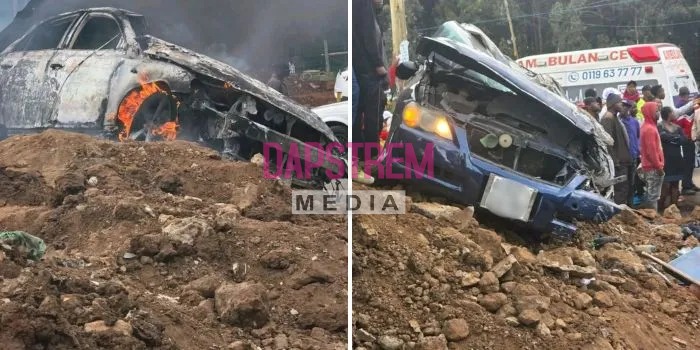
Three Feared Dead as Car Bursts Into Flames Near Raila Odinga Stadium Along Ngong Road
A tragic road accident along Ngong Road in Nairobi has raised fresh concerns about road safety after a vehicle crashed and burst into flames near the Raila Odinga International Stadium on Thursday morning, October 29, 2026.
The incident occurred at Kenol Stage, a busy section of the road used daily by motorists, pedestrians and public service vehicles. Initial reports indicated that several people were feared dead, while others reportedly sustained injuries in the accident.
The crash attracted the attention of members of the public, with people gathering near the scene as the vehicle burned. The circumstances surrounding the incident remained unclear at the time of reporting, and authorities had not released a comprehensive account of the number of people killed or injured.
The incident has once again drawn attention to the dangers faced by road users in Nairobi, where busy roads carry a constant mix of private vehicles, public transport, pedestrians and commercial traffic.
Details of the Ngong Road Accident
According to the initial report, the vehicle crashed at Kenol Stage before catching fire. The incident happened near the Raila Odinga International Stadium, placing it close to a prominent landmark along Ngong Road.
The early reports suggested that several people may have lost their lives in the crash. However, the reported fatalities had not been independently confirmed, and the identities and number of people involved were not immediately available.
Details about those who sustained injuries were also limited. It was unclear how many injured people required medical attention, the severity of their injuries or whether all those affected had been taken to hospital.
The cause of the crash was equally uncertain. Investigators had yet to establish what happened before the vehicle crashed or why it burst into flames.
Such details are important in determining whether the accident involved a loss of control, a mechanical problem, a collision with another vehicle or another contributing factor. Until investigators complete their work, any explanation of the cause would remain speculation.
The incident therefore calls for caution as more information emerges. While the initial reports have raised fears of multiple deaths, the confirmed toll and the full circumstances of the accident remain matters for the relevant authorities to establish.
Emergency Response and Concerns at the Scene
Vehicle fires following road accidents can create extremely dangerous conditions for occupants, bystanders and emergency responders. Once a vehicle catches fire, smoke, intense heat and the possibility of further ignition can make rescue efforts difficult.
The incident at Kenol Stage highlights the importance of a coordinated response whenever a serious crash occurs on a busy urban road. Police officers, firefighters, ambulance crews and other emergency personnel may need to secure the scene, control traffic, assist injured people and prevent members of the public from approaching the burning vehicle.
Keeping a safe distance from a vehicle that is on fire is particularly important. Although members of the public may be eager to help, approaching a burning wreck without suitable equipment can expose them to serious danger.
Where it is safe to do so, witnesses can assist by alerting emergency services, providing accurate information about the location and directing responders towards the scene. They should avoid entering a burning vehicle or attempting a rescue that places them in immediate danger.
The available initial report did not provide a complete account of the emergency response or confirm the condition of everyone involved. Further information from authorities will be necessary to establish how the rescue operation unfolded and whether any additional measures were required to manage the scene.
Cause of the Crash Remains Unclear
One of the key questions following the accident is what caused the vehicle to crash before bursting into flames.
Road accidents can result from several factors, including excessive speed, driver error, poor visibility, mechanical defects, road conditions and the actions of other road users. In some cases, more than one factor contributes to a collision.
However, none of these possible explanations should be treated as the cause of the Kenol Stage incident without evidence. The available report did not establish why the vehicle crashed, and investigators would need to examine the circumstances before drawing conclusions.
A proper investigation may involve examining the damaged vehicle, assessing the scene, reviewing any available CCTV footage and gathering accounts from witnesses. Investigators may also seek information from other motorists or passengers who were present before the crash.
Where necessary, a technical inspection can help establish whether a mechanical defect contributed to the accident or whether the fire began after the impact. Such findings can help authorities distinguish between the cause of the crash and the factors that allowed the fire to spread.
Establishing the facts is essential not only for accountability but also for identifying lessons that could help prevent similar incidents. Premature conclusions can mislead the public and unfairly place blame on people before the evidence has been examined.
Ngong Road and the Challenge of Urban Road Safety
Ngong Road is an important transport corridor in Nairobi. It serves residential neighbourhoods, businesses, institutions and other destinations, making it a busy route throughout much of the day.
The road is used by private motorists, public service vehicles, motorcyclists, cyclists and pedestrians. The movement of different types of road users through shared spaces creates challenges that require careful driving, effective traffic management and infrastructure that protects vulnerable people.
Stages where passengers board and leave public service vehicles can also become crowded, particularly when traffic is heavy. Drivers must remain alert to pedestrians, vehicles stopping to pick up passengers and sudden changes in traffic flow.
The accident near Kenol Stage has renewed attention to the risks associated with serious crashes in such high-traffic areas. A vehicle fire can quickly disrupt traffic, draw crowds and create additional hazards for people travelling through the area.
Authorities may need to establish whether road conditions, traffic movements or other circumstances at the location played any role in the incident. However, the available information does not establish that the design or condition of the road contributed to this particular crash.
The broader challenge remains ensuring that urban roads are safe for everyone who uses them. This requires responsible driving, consistent enforcement of traffic regulations, safe pedestrian facilities and prompt responses to dangerous conditions.
Rising Road Deaths Renew Calls for Greater Caution
The incident comes amid continuing concern over road fatalities in Kenya. Figures cited by People Daily from the National Transport and Safety Authority showed that 3,995 people had died in road crashes between January 1 and October 4, 2026. The publication reported that this was higher than the 3,657 deaths recorded during the corresponding period in 2025.
The figures illustrate the human cost of road accidents and the need for sustained efforts to reduce fatalities. Every death affects more than the person involved. Families can lose breadwinners, children can lose parents, and communities can be left coping with grief and unexpected financial difficulties.
Road safety is a shared responsibility. Drivers must obey speed limits, remain attentive and avoid using mobile phones while driving. They should also ensure that their vehicles are roadworthy and that they are fit to drive.
Passengers and pedestrians also have a role in reducing risk by using designated crossing points, following traffic instructions and avoiding actions that place themselves or others in danger.
At the same time, public agencies must continue enforcing traffic laws, investigating serious crashes and identifying infrastructure improvements that could reduce the likelihood of fatal accidents.
The figures alone do not establish the cause of the Ngong Road crash. Nevertheless, they provide important national context for understanding why every serious road accident deserves careful investigation and why prevention efforts remain necessary.
The Importance of Confirming Victims and Informing Families
When a serious accident occurs, confirming the identities and condition of those involved becomes a priority. Accurate information allows families to establish whether their relatives were affected and helps authorities communicate verified details to the public.
In the Ngong Road incident, the initial report did not provide confirmed identities or a final number of fatalities. Authorities would therefore need to verify the information before the public could be given a definitive account of the victims.
Responsible reporting is particularly important in the immediate aftermath of a tragedy. Unverified names, photographs or claims about the people involved can cause distress to families and spread misinformation at a time when accurate information matters most.
Members of the public should also be cautious when sharing videos or photographs of crash victims on social media. Such material can compromise the privacy and dignity of those affected and cause additional pain to their loved ones.
Updates from police and emergency agencies will be important in clarifying the death toll, the number of injured people and any progress in determining what happened.
A Reminder of the Need for Safer Roads
The vehicle fire near Raila Odinga International Stadium is another reminder of how quickly a road incident can become a serious emergency. Although the full details of the crash were not immediately available, the initial report raised fears that several people may have died.
The priority remains establishing the facts, supporting anyone who was injured and informing affected families through verified channels. Investigators must determine the circumstances surrounding the crash before assigning responsibility or identifying the factors that caused the vehicle to catch fire.
The incident also reinforces the importance of preventive measures, including responsible driving, roadworthy vehicles, effective enforcement and safe road infrastructure.
As authorities work to clarify what happened at Kenol Stage, the public will be looking for reliable updates on the victims and the investigation. The confirmed findings should help establish the circumstances of the tragedy and inform efforts to prevent similar accidents in the future.
For now, the reported fatalities remain unconfirmed in the initial account, and the cause of the crash has not been established. Further official information will be necessary to provide a complete picture of the incident.