Spain Train Crash: Sánchez Declares Three Days of Mourning After 68 People Are Killed
Spain has declared three days of national mourning following a devastating collision between two high-speed trains that killed at least 68 people and injured dozens of others in central Spain. The tragedy has plunged the country into grief, raised fresh concerns about railway safety and prompted calls for a thorough investigation into the circumstances surrounding the disaster.
Spanish Prime Minister Pedro Sánchez announced the mourning period after visiting the accident scene near Urda, in the Castilla-La Mancha region, on Wednesday, October 28, 2026. He expressed his condolences to the victims’ families and solidarity with those receiving treatment in hospitals.
The crash involved a train operated by Spain’s state-owned railway company Renfe and another operated by private company Iryo. The two trains were travelling in the same direction along the high-speed railway corridor connecting Madrid with southern Spain when the Renfe train struck the rear of the Iryo train, which had stopped on the tracks.
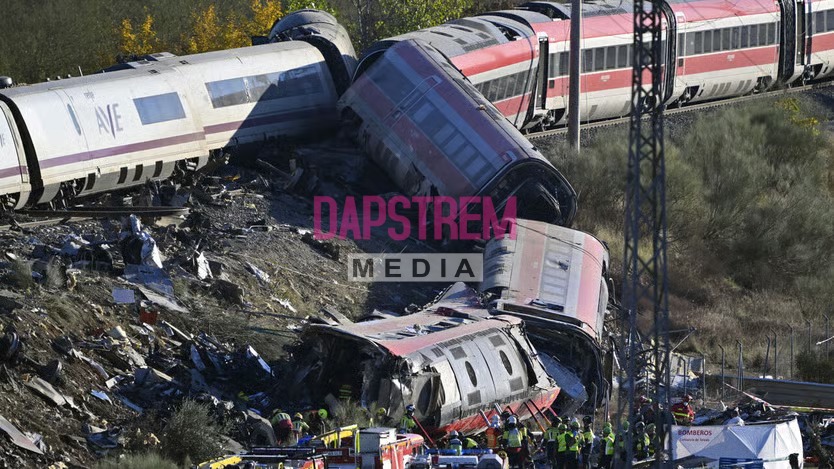
The collision caused several carriages to derail, leaving wreckage scattered around the railway line and creating a difficult rescue operation for emergency teams. Authorities reported that the death toll had reached 68, with the possibility of further casualties as rescuers continued examining the damaged carriages.
The disaster has become one of the most devastating railway accidents in Europe in recent years. It has also renewed public concern about the safety of Spain’s extensive high-speed railway network, particularly because another deadly high-speed train accident occurred in the country earlier this year.
Sánchez Declares Three Days of National Mourning
Prime Minister Sánchez announced that Spain would observe three days of official mourning from October 29 to October 31 in honour of those who lost their lives in the crash.
During the mourning period, the Spanish national flag will fly at half-mast on public buildings and other designated locations. The gesture is intended to honour the victims and demonstrate national solidarity with families whose lives have been devastated by the tragedy.
Speaking after visiting the accident site, Sánchez described the country as being in mourning and acknowledged the immense suffering caused by the crash. He noted that behind every death was a family facing grief, while other families were still desperately seeking information about missing loved ones.
The prime minister said the government’s immediate priority was to support the victims, care for the injured and help families dealing with uncertainty and loss.
He also emphasised the need to provide practical and psychological assistance to those affected. Such support is particularly important after disasters of this scale, when survivors and relatives may experience physical injuries, emotional trauma and prolonged uncertainty.
Sánchez praised emergency workers, Civil Protection teams, local authorities and other institutions that responded to the accident. He credited their cooperation with helping coordinate the rescue and emergency response.
However, he made it clear that the government would also seek answers about the circumstances that led to the collision. He said investigators must establish what happened and determine whether any failures or negligence contributed to the disaster.
The prime minister promised that any confirmed shortcomings in railway safety would be addressed firmly. He also acknowledged that restoring public confidence in the country’s high-speed rail network would be essential following the tragedy.
How the Two High-Speed Trains Collided
Initial reports indicated that the accident occurred on the railway corridor linking Madrid with Seville and other destinations in southern Spain.
The Iryo train was travelling ahead when it came to a stop on the line. A Renfe-operated high-speed train was subsequently authorised to resume normal operations after a technical problem affected the railway’s automatic signalling and safety system.
According to Transport Minister Óscar Puente, the collision occurred after the control centre in Madrid made a decision to allow trains to continue operating despite the system failure.
The minister said the LZB signalling system, which helps regulate train movements and automatically stops trains under certain unsafe conditions, experienced a computer-related malfunction at around 8:30 a.m. local time.
The failure reportedly affected a stretch of approximately 63 kilometres of track and forced several trains to stop. Railway traffic management was then handled by the central control centre.
Puente said the Renfe train was authorised to resume normal running while a stop signal remained active. The train reportedly travelled approximately 25 kilometres before striking the stationary Iryo train at around 8:53 a.m.
The transport minister described the decision to resume normal operations as difficult to explain and said it was now a central focus of the investigation.
He stressed that the exact circumstances surrounding the instructions issued to the trains needed to be established before responsibility could be determined.
Investigators are expected to examine communications between train crews and the control centre, signalling records, technical data and the sequence of decisions made before the collision.
Authorities are also examining the speed of the Renfe train at the time of impact. The railway section permits high speeds, but officials had not established the train’s precise speed when the collision occurred.
These details will be crucial in determining whether established safety procedures were followed and whether the crash could have been prevented.
Although early statements have raised questions about the decisions made at the control centre, the investigation remains essential. The final findings will need to establish the full chain of events rather than rely solely on preliminary accounts.
Rescue Teams Face a Difficult Operation
The scale of the destruction created an urgent challenge for emergency responders who rushed to the scene near Urda.
Images from the accident site showed damaged train carriages, twisted metal, broken panels and wreckage scattered below sections of the railway line. Some carriages had overturned or left the tracks, complicating efforts to reach passengers trapped inside.
Emergency personnel worked to locate survivors, remove injured passengers from the wreckage and transport them to medical facilities. The operation involved coordination among emergency services, healthcare workers, Civil Protection teams and local authorities.
As the rescue effort continued, officials warned that the number of confirmed deaths could change as teams gained access to damaged sections of the trains.
Hospitals received injured passengers, with several requiring urgent treatment. Authorities also reported that a number of people remained in serious condition.
The disaster prompted local communities to assist with the emergency response. In nearby areas, public facilities were repurposed to accommodate people needing medical attention and relatives seeking information about passengers.
The response extended beyond treating physical injuries. Authorities also had to help families establish whether their relatives had survived, identify victims and obtain reliable information about those who remained missing.
Such identification efforts can be difficult after major railway accidents, particularly when passengers are travelling between cities and their relatives may be far from the crash site.
The work of rescue teams therefore remained central to the response even after the initial impact. Officials faced the difficult task of recovering victims, assisting survivors and ensuring that families received information as it became available.
The government has praised those involved in the operation, while promising continued support for the injured and the relatives of those who died.
Railway Safety Under Fresh Scrutiny
The accident has raised serious questions about the safety procedures governing Spain’s high-speed railway network.
Spain has invested heavily in railway infrastructure and developed one of the world’s largest high-speed rail systems. The network is widely used by residents, business travellers and tourists travelling between major cities.
The collision has nevertheless highlighted the importance of reliable signalling systems, effective communication between train crews and control centres, and strict procedures when automated safety equipment fails.
When a signalling system becomes unavailable, railway operators must follow established protocols designed to prevent trains from entering sections of track where their movements cannot be safely coordinated.
The investigation will therefore need to establish whether the technical malfunction alone explains the sequence of events or whether subsequent operational decisions also contributed.
It will also be important to determine whether the railway system had adequate safeguards to prevent a train from approaching another stationary train under the circumstances reported.
Transport Minister Puente has said the decision to permit trains to resume normal operations despite the signalling problem is a key issue under examination. However, the final responsibility of individual workers or institutions has not yet been established.
The findings could influence decisions about staff procedures, system reliability, emergency communication and the circumstances under which trains may continue moving after a technical failure.
For passengers, the most immediate concern is whether they can continue using the railway network with confidence. For the government and railway operators, the challenge will be to demonstrate that the causes have been properly identified and that any necessary changes are implemented.
A transparent investigation will be important in answering those concerns and preventing speculation from replacing verified information.
A Second Deadly High-Speed Rail Disaster in One Year
The tragedy has intensified concern because it is Spain’s second major deadly high-speed railway accident in 2026.
In January, a separate collision involving Renfe and Iryo trains near Adamuz, in the southern region of Andalusia, killed 46 people and injured dozens more.
That earlier disaster had already prompted questions about railway safety and infrastructure management. The new collision has therefore placed renewed pressure on authorities to explain how another major tragedy could occur within the same year.
Sánchez described the occurrence of two deadly high-speed railway accidents in one year as unacceptable for Spain. He said further safety measures would be taken if investigators established that improvements were necessary.
The prime minister also cautioned against assuming that the two accidents had the same cause. He said determining whether they were connected was a matter for the independent accident investigators and judicial authorities.
That distinction is important because separate railway accidents can arise from different combinations of technical failures, infrastructure conditions and operational decisions. The causes of each incident must be established through evidence.
Nevertheless, the two disasters have created a wider debate about the condition and management of Spain’s railway network.
The latest collision is likely to increase demands for stronger safety oversight, closer examination of railway operations and greater transparency about the implementation of recommendations from previous investigations.
It has also renewed questions about how railway authorities balance the need to maintain reliable services with the obligation to stop or restrict operations whenever safety systems are compromised.
For many Spaniards, the concern is no longer limited to the circumstances of one collision. It is also about ensuring that lessons from major accidents lead to practical changes that protect passengers in the future.
Families Await Answers as Investigations Continue
Beyond the official announcements and technical investigations, the tragedy has left families facing profound uncertainty and grief.
Relatives have been seeking information about loved ones who were travelling on the trains. Some have had to wait for confirmation of whether family members survived, while others have begun the painful process of identifying and mourning those who died.
The government has said that supporting victims and their relatives remains its first priority. This includes helping those who have lost loved ones, assisting injured passengers and providing psychological support to people affected by the incident.
The emotional impact of a disaster of this magnitude can continue long after the rescue operation ends. Survivors may need extended medical care and rehabilitation, while families may require financial, practical and psychological assistance.
Authorities will also face the task of providing accurate updates as identification work and investigations progress. Clear communication is particularly important when reports change rapidly and families are waiting for reliable information.
The three days of national mourning provide an opportunity for the country to honour the dead and express solidarity with those affected. However, families will also be looking for answers about how the crash occurred and whether it could have been prevented.
For them, the investigation is not simply a technical exercise. Its findings may help establish accountability, clarify unanswered questions and provide a basis for preventing similar tragedies.
Political Pressure Grows for Accountability
The crash has also placed Spain’s railway management under intense political scrutiny.
Opposition figures have called for a thorough investigation and a wider review of the railway network. They argue that the public deserves clear answers about the state of the country’s infrastructure and the decisions made before the collision.
The government, meanwhile, has pledged to cooperate with investigators and respond firmly if negligence or failures in safety procedures are established.
The challenge for authorities will be to ensure that the investigation remains evidence-based and independent of political pressure. Establishing responsibility requires a careful examination of technical records, operational decisions and the duties of the institutions involved.
The investigation is expected to consider the roles of the railway operators, signalling systems and central traffic management arrangements. Judicial authorities may also examine whether any actions or omissions warrant legal consequences.
For the families of the victims, accountability will be an important part of the response. For the wider public, the process will help determine whether the country’s railway safety arrangements are sufficiently robust.
The government will also be under pressure to explain what measures it intends to take while the investigation is ongoing, particularly if preliminary findings identify immediate risks that require attention.
Any reforms will need to address confirmed weaknesses without drawing premature conclusions about the final cause of the crash.
Impact on Rail Services and Travellers
The collision also disrupted railway services connecting Madrid with parts of southern Spain.
Following the accident, services on the affected high-speed corridor were suspended as authorities dealt with the emergency and assessed the situation. The disruption affected passengers whose journeys were planned along the route and created uncertainty for people travelling between major cities.
Railway operators faced the task of providing information to passengers, managing cancellations and arranging alternatives where possible. Such disruptions can affect commuters, tourists and business travellers, particularly on heavily used intercity routes.
The incident also highlighted the wider consequences of a major railway accident. Beyond the loss of life and injuries, a collision can disrupt transport links, delay travel plans and place additional pressure on emergency and public services.
Authorities and operators must balance the need to restore services with the requirement to ensure that affected infrastructure is safe to use. Investigators may also need access to the site and railway records before normal operations can fully resume.
Passengers will be watching for reliable updates on service restoration and any new safety measures introduced after the crash.
Spain Mourns the Victims
As Spain observes three days of official mourning, attention remains focused on the people whose lives were lost and the families now facing an unimaginable loss.
The tragedy has prompted expressions of sympathy across the country, while public institutions and communities have joined in remembering the victims. Emergency workers have also received recognition for their efforts to rescue passengers and assist those affected.
Yet the most important questions remain unanswered. Investigators must establish precisely why the two trains collided, whether established safety procedures were followed and what changes may be required to prevent another disaster.
Sánchez has pledged that the government will pursue those answers and take firm action if safety failures or negligence are confirmed.
The coming days and weeks will be critical as investigators analyse evidence and authorities determine the next steps. Their findings will shape both the response to the accident and the wider debate about railway safety in Spain.
For now, the country is united in grief for the victims of the Urda crash. The three-day mourning period offers a moment to remember those who died, support survivors and stand with families still coming to terms with the tragedy.
The disaster has also delivered a stark reminder that modern transport systems depend on rigorous safety procedures, reliable technology and sound human decisions. Restoring public confidence will require not only condolences and promises, but also a transparent investigation and meaningful action based on its findings.