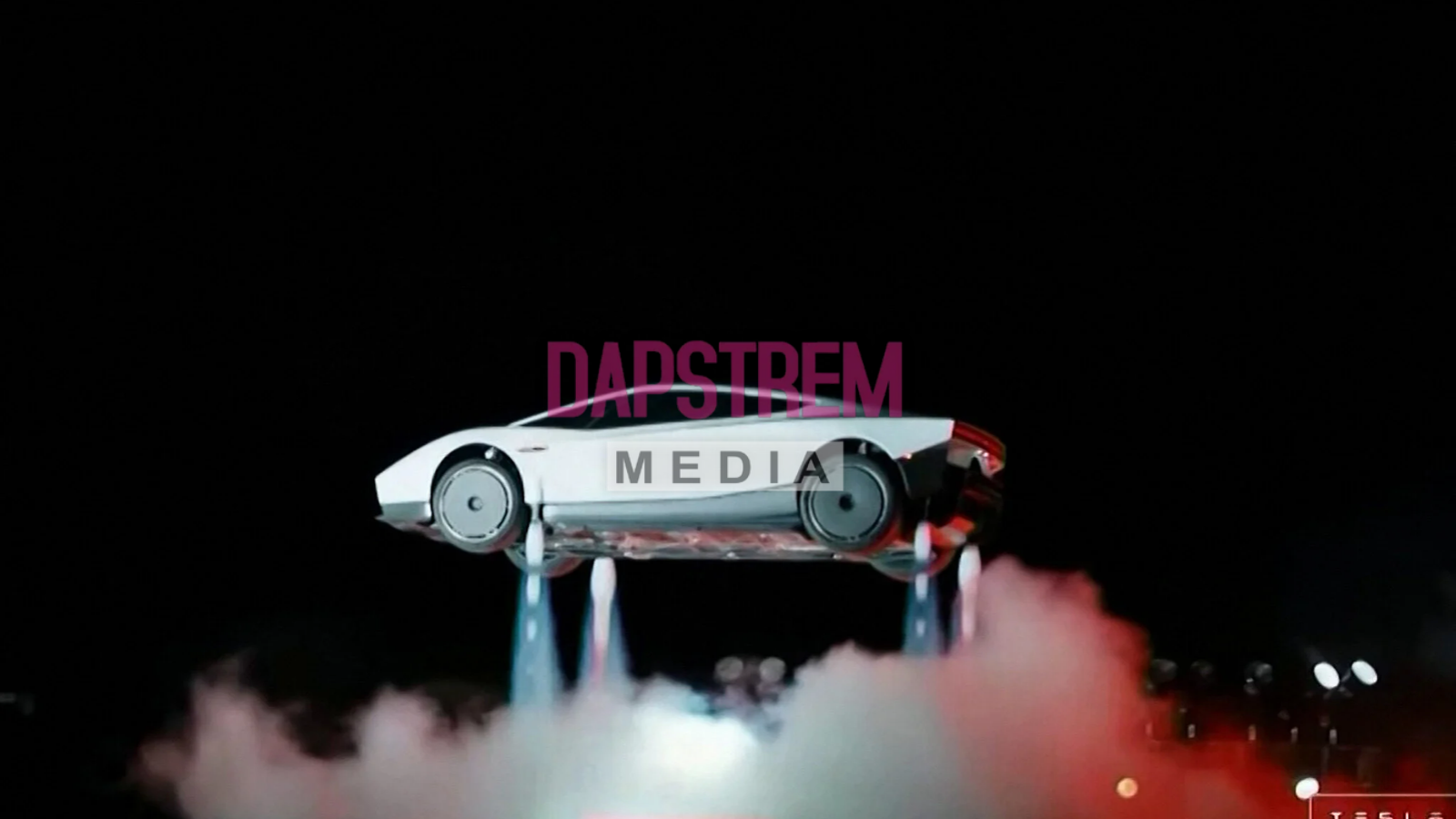
For decades, flying cars have occupied a special place in humanity’s imagination, appearing in science-fiction films, futuristic cities and predictions about the future of transportation. Now, Tesla CEO Elon Musk has brought that vision a step closer to reality with a dramatic demonstration of a rocket-powered electric sports car capable of briefly leaving the ground.
Unveiled on October 15, 2026, at a SpaceX testing facility in Texas, the redesigned Tesla Roadster stunned spectators with airborne manoeuvres, mid-air rotations and a demonstration that blended electric-car engineering with technology inspired by rocketry. The event reignited a familiar question: could flying cars finally become a practical part of everyday life?
Musk presented the vehicle as evidence of what can happen when Tesla’s automotive expertise meets SpaceX’s aerospace technology. However, despite the excitement surrounding the unveiling, the new Roadster is not yet a conventional flying car, and important questions remain about its safety, regulatory approval, affordability and eventual availability to customers.
According to Reuters and the Associated Press, Tesla plans to begin production in 2028, although the vehicle remains under development and the demonstration did not establish that customers will soon be able to fly their cars on public roads.
A Spectacular Demonstration That Captured Global Attention
The unveiling took place at SpaceX’s rocket development and testing facility in McGregor, Texas, where Tesla showcased a redesigned version of its long-awaited second-generation Roadster.
The white sports car performed a series of striking manoeuvres, including travelling upside down along a specially designed curved ramp, launching into the air, rotating mid-flight and landing back on its wheels. During the demonstration, the vehicle also used its propulsion system to leap over other vehicles.
The display was designed to demonstrate the potential of combining automotive engineering with aerospace technology. Rather than relying exclusively on conventional electric motors and wheels, the specially equipped Roadster uses high-pressure gas thrusters developed in collaboration with SpaceX.
The event attracted considerable attention because it appeared to turn one of Musk’s long-standing technological ambitions into a physical demonstration.
In a post on his social media platform, X, Musk declared that the future did indeed have flying cars.
Yet the distinction between an impressive demonstration and a commercially viable transportation system remains significant. The vehicle demonstrated brief airborne manoeuvres under controlled conditions, not sustained flight across cities or the ability to take off and land safely in ordinary traffic.
That difference will be central to determining whether Tesla’s innovation becomes a practical transportation breakthrough or remains an extraordinary showcase of engineering ambition.
How Does Tesla’s Flying Roadster Work?
Unlike conventional electric vehicles, which depend on wheels and road contact for movement, the rocket-equipped Roadster uses a system of cold-gas thrusters to generate brief bursts of propulsion.
The technology involves storing air under extremely high pressure and releasing it through thrusters to produce force. SpaceX’s expertise in propulsion systems and pressure vessels has helped make this unusual automotive application possible.
Tesla has also demonstrated a specialised suction system that allows the vehicle to maintain contact with an inverted ramp during its stunt performance.
The combination of these technologies creates a vehicle that can perform manoeuvres beyond the capabilities of an ordinary road car. However, the thrusters do not turn the Roadster into a conventional aircraft capable of sustained, controlled flight.
The distinction matters because a genuine flying car intended for everyday transport would need to do considerably more than briefly lift off the ground. It would require reliable flight controls, predictable handling, emergency systems, safe landing capabilities and a practical way to operate around buildings, aircraft and other vehicles.
Tesla’s demonstration represents an unusual engineering achievement, but it does not yet answer all these questions.
The Numbers Behind Tesla’s Ambitious Roadster
Tesla has attached extraordinary performance claims to the redesigned sports car, positioning it as a high-performance vehicle rather than a conventional commuter car.
Among the headline specifications reported during the unveiling were:
Acceleration: Tesla claims the Roadster can accelerate from zero to 60 miles per hour in less than one second.
Top speed: The company has cited a top speed exceeding 230 mph, or approximately 370 km/h.
Driving range: Tesla has indicated a range of more than 300 miles, approximately 480 kilometres, on a single charge.
Production target: Production is scheduled to begin in 2028, subject to development progress.
Seating: The redesigned model accommodates two occupants in its standard configurations, while the Rocket version is described as a single-seater.
These figures are manufacturer claims rather than independently established performance results across normal operating conditions. In particular, the sub-one-second acceleration target is exceptionally ambitious, while the flying system introduces additional questions about weight, energy consumption, stability and operating limitations.
The range figure also deserves attention. When Tesla first presented its second-generation Roadster in 2017, it promoted a target of approximately 620 miles on a charge. The latest reported target of more than 300 miles is substantially lower.
This illustrates how the vehicle has evolved over nearly a decade, with its engineering ambitions and specifications changing as the project has developed.
Three Versions, but the Flying Model Is Not for Everyone
Tesla has presented the redesigned Roadster in three configurations, each aimed at a different type of customer.
The Performance version is positioned as a road-focused electric sports car. It features advanced aerodynamics and the specialised suction system, but it is not the full airborne version demonstrated during the event.
The Thrust version adds acceleration thrusters intended to enhance performance. It is aimed at buyers seeking more extreme acceleration and driving characteristics.
The Rocket version is the most ambitious configuration, featuring a full thruster system designed to enable brief airborne manoeuvres. Tesla describes it as an invitation-only model, and it is not approved for public-road use in its current form.
The pricing arrangements also underline the exclusivity of the project. Reuters reported reservation payments of $50,000 for the Performance version and $250,000 for the Thrust version. The Rocket configuration is being offered by invitation, with no comparable publicly disclosed reservation arrangement in the report.
These payments are reservation deposits, not the final purchase prices of the vehicles. Tesla has not established a guaranteed delivery date for every prospective buyer, and its reservation terms do not guarantee delivery.
For most motorists, therefore, the Roadster remains a distant and expensive proposition rather than an immediate alternative to conventional electric cars.
Why the Flying Car Is Not Yet Ready for Everyday Use
The excitement surrounding Tesla’s demonstration should not obscure the technical and regulatory barriers facing any vehicle designed to move between roads and the air.
First, safety is a major concern. A car capable of suddenly lifting off or performing an aerial manoeuvre would introduce risks that conventional road-safety systems were not designed to manage. A propulsion failure, unexpected loss of control or poorly executed landing could endanger passengers and people nearby.
Second, there is the question of regulation. Cars and aircraft are governed by different safety and operating frameworks. A vehicle that combines elements of both raises difficult questions about certification, permitted operating environments and the responsibilities of manufacturers and regulators.
The Federal Aviation Administration told CBS News that the Tesla vehicle does not meet its definition of an aircraft. That statement does not, by itself, establish that every feature of the vehicle is approved for use on public roads. Tesla has specifically indicated that the Rocket version is not approved for public-road use.
Third, practical infrastructure would be necessary if airborne vehicles were ever to become commonplace. Cities would need to consider where such vehicles could safely take off and land, how they would avoid other traffic and what restrictions would apply around airports, residential neighbourhoods and public spaces.
Finally, there is the economic challenge. A highly specialised vehicle requiring complex propulsion hardware is unlikely to be accessible to the mass market without substantial changes in cost, engineering and manufacturing.
These obstacles do not make the technology impossible, but they show why a successful demonstration should not be mistaken for a finished transportation solution.
A Dream Nearly a Decade in the Making
The new Roadster also revives a story of ambition and repeated delays.
Tesla first unveiled its second-generation Roadster in November 2017, presenting it as an electric supercar with extraordinary acceleration and a long driving range. At the time, deliveries were initially expected in 2020.
That deadline passed without the vehicle entering customer production. Subsequent years brought further delays as Tesla concentrated on other projects and the Roadster remained a lower priority.
The latest unveiling represents a major change in the vehicle’s ambitions. What began as an electric sports car has evolved into a showcase for technology associated with the broader Musk business ecosystem, including SpaceX’s propulsion expertise.
The collaboration is significant because it demonstrates how technologies developed for one industry can inspire experimentation in another. However, it also raises questions about whether the added complexity will translate into a product that can be manufactured, certified and delivered reliably.
Tesla now targets 2028 for production, but its history with the Roadster makes it sensible to distinguish between a stated production goal and a confirmed customer delivery schedule.
What Tesla’s Flying Car Could Mean for the Future of Transport
The significance of the Roadster may extend beyond the vehicle itself.
For decades, the idea of flying cars has been pursued by engineers and technology companies seeking to reduce travel times and rethink urban mobility. Other developers have explored electric vertical take-off and landing aircraft, often called eVTOLs, which are designed to transport people through the air without conventional runways.
Tesla’s approach is different. Rather than developing a conventional aircraft that can also operate on roads, it has demonstrated a sports car capable of brief airborne manoeuvres using specialised propulsion technology.
That distinction makes the Roadster a striking experiment, but it does not establish that it is the most practical route towards urban air transport.
If the technology advances, its lessons could influence future work on propulsion systems, lightweight structures, vehicle control and the integration of automotive and aerospace engineering. However, meaningful progress will depend on reliability, safety, affordability and regulatory clarity, not simply on the ability to perform spectacular stunts.
For developing cities, including those facing severe traffic congestion, the appeal of new transportation technologies is understandable. Yet a vehicle that requires specialist hardware and carefully controlled operating conditions is unlikely to solve everyday congestion in the near term.
More immediate improvements in public transport, road infrastructure and conventional electric mobility remain important while advanced transportation systems continue to develop.
Can Tesla’s Flying Car Really Change the World?
Tesla’s new Roadster has captured attention because it offers a glimpse of a future that once seemed confined to science fiction. Its rocket-inspired propulsion system, dramatic demonstration and ambitious performance claims show how far engineers are willing to push the boundaries of electric vehicles.
Nevertheless, the project must still overcome substantial hurdles before its airborne capabilities can be considered a practical transportation option.
The 2028 production target is an important milestone, but production alone would not resolve questions about the Rocket version’s legality, operational safety, flight duration or suitability for ordinary roads.
For Tesla, the Roadster could become a symbol of technological ambition and a demonstration of how automotive and aerospace expertise can intersect. Its commercial significance, however, will depend on whether the company can translate the spectacle into a reliable, deliverable product.
For the public, the most important question is not simply whether a car can leave the ground. It is whether it can do so safely, repeatedly, affordably and within a clear regulatory framework.
The Future Has Taken a Small Step, but the Journey Is Far From Over
Tesla’s rocket-powered Roadster has brought renewed attention to the possibility of flying cars, demonstrating that a road vehicle can perform brief airborne manoeuvres with the help of specialised propulsion technology.
The unveiling marks an intriguing moment in the evolution of electric mobility. Yet it is not proof that flying cars are ready to transform daily travel, nor does it mean motorists will soon be soaring above traffic.
With production targeted for 2028, regulatory questions unresolved and the Rocket version not approved for public-road use, the project remains a work in progress.
Musk’s vision is bold, and the demonstration has given the world something tangible to examine rather than another distant promise. Whether the Roadster becomes a commercially successful innovation or remains a technological showpiece will depend on what happens next.
For now, Tesla has demonstrated that the boundary between cars and aerospace technology can be pushed further than many people imagined. Turning that achievement into a safe and practical mode of transport will be the much harder test.