Elon Musk Unveils Tesla Roadster With Flying Car Features, Capable of Flipping Midair and Landing Safely
Tesla CEO Elon Musk has unveiled a futuristic version of the long-awaited Tesla Roadster, astonishing audiences with a demonstration that appeared to take the electric sports car beyond conventional driving. The vehicle drove upside down along a specially designed ramp, flipped through the air and landed safely, showcasing technology developed in collaboration with engineers from Musk’s aerospace company, SpaceX.
The dramatic demonstration took place on October 15, 2026, at a SpaceX testing facility in Texas, nearly nine years after Tesla first introduced the next-generation Roadster concept in November 2017. The event revived interest in a project that has experienced repeated delays and raised expectations about how far electric-car technology could advance.
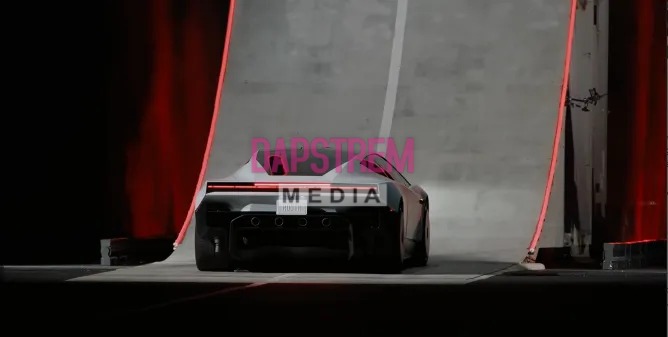
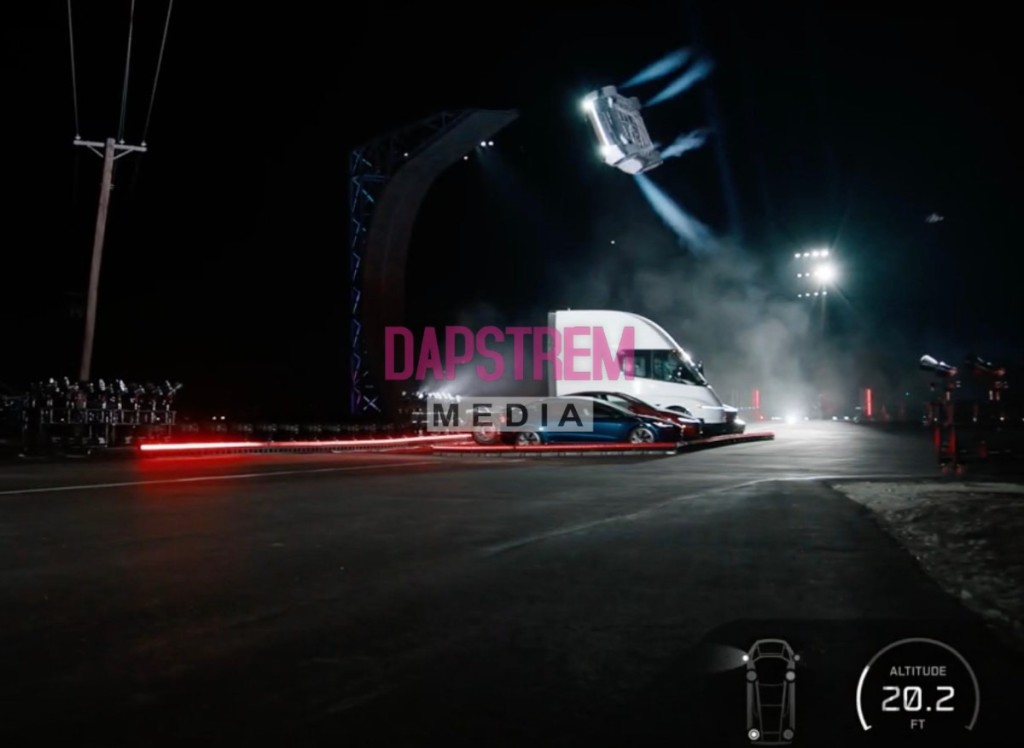
During the presentation, the Roadster demonstrated a series of unusual manoeuvres, including driving along an inverted ramp before launching into the air and completing a midair rotation. The vehicle also appeared to jump over a row of other Tesla models, highlighting the potential of the company’s experimental propulsion and vehicle-control systems.
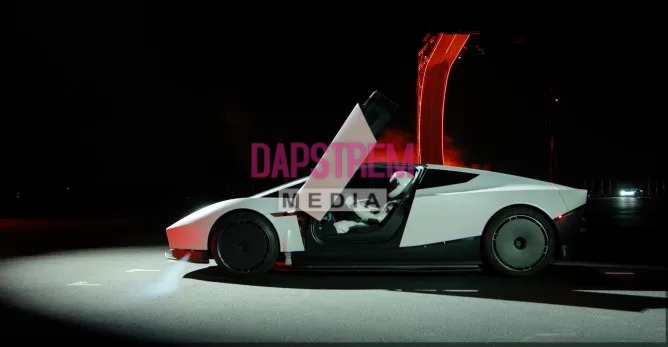
Musk presented the Roadster as a vehicle that could combine the speed of an electric supercar with rocket-inspired technology. He said it featured altitude-control thrusters and rear-mounted main thrusters that could allow it to perform aerial manoeuvres.
The demonstration attracted attention because flying cars have long been associated with science fiction, futuristic transport concepts and ambitious engineering projects. While several companies have explored aircraft that can take off and land vertically, Tesla’s approach seeks to combine an electric sports car with technology that can briefly lift the vehicle off the ground.
However, the unveiling also raised questions about the practical use of such features, the safety of operating a vehicle that can leave the road and whether all the demonstrated capabilities will be available in the final production model.
Tesla has targeted 2028 for production, meaning the vehicle remains a developing project rather than a widely available consumer car. Its final specifications, pricing and regulatory status will be important in determining whether the technology becomes a practical innovation or remains primarily a demonstration of engineering ambition.
How Tesla’s futuristic Roadster performed the midair flip
One of the most striking moments of the unveiling came when the Roadster travelled up a steep, curved ramp and appeared to turn upside down before launching into the air.
The vehicle then rotated during its brief airborne movement and returned to the ground in a controlled landing. The manoeuvre was designed to demonstrate how Tesla could combine specialised vehicle-control technology with propulsion systems inspired by spacecraft engineering.
Tesla’s vehicle engineering vice president, Lars Moravy, explained that the car used a fan-based suction system beneath the vehicle to generate enough force to hold it against the ramp, even when the car was inverted.
According to the explanation given during the presentation, the system could generate suction equivalent to approximately two times the force of gravity under the demonstrated conditions. This would help the vehicle remain attached to the specially designed surface rather than relying entirely on the grip provided by its tyres.
Once the car reached the end of the ramp, the demonstration incorporated technology developed with SpaceX to perform the airborne manoeuvre.
Musk explained that the Roadster featured altitude-control thrusters and main thrusters at the rear. These systems were presented as the technology responsible for enabling the car to lift, rotate and control its movement during the stunt.
The demonstration was particularly notable because ordinary road cars depend on their tyres remaining in contact with the road. Their ability to accelerate, brake and corner is limited by traction, while their suspension and aerodynamic systems are designed primarily for movement on the ground.
A vehicle that can briefly generate its own thrust introduces another set of engineering possibilities. Instead of relying exclusively on tyre grip, it can potentially use directed forces to change its position and orientation.
Nevertheless, the demonstration took place under controlled conditions. It does not establish that the car can safely perform the same manoeuvres on ordinary roads, uneven surfaces or in unpredictable weather.
The engineering challenge will be to make the system reliable, controllable and safe outside a carefully prepared demonstration environment.
SpaceX technology brings rocket-inspired movement to an electric car
The relationship between Tesla and SpaceX is central to the Roadster’s most unusual features.
Tesla specialises in electric vehicles, battery systems, vehicle software and automotive engineering, while SpaceX develops rockets, spacecraft and propulsion technologies. The collaboration seeks to apply selected aerospace engineering principles to a high-performance electric sports car.
Musk first discussed a SpaceX option package for the next-generation Roadster in 2018. He suggested that small rocket-style thrusters could improve acceleration, braking and cornering, and even raised the possibility that they might allow the vehicle to fly.
The latest demonstration represents a significant step in turning that earlier concept into a visible prototype feature.
The thruster technology described in coverage of the unveiling involves highly pressurised gas released through nozzles to generate thrust. This is different from a conventional chemical rocket engine that burns fuel and an oxidiser to produce high-speed exhaust.
The underlying principle is straightforward: when gas is expelled in one direction, it generates a force in the opposite direction. By directing that force appropriately, a system can move or rotate a vehicle.
In principle, thrusters positioned around a car could help control its pitch, roll and vertical movement. Carefully timed bursts could also help stabilise the vehicle as it descends towards the ground.
However, controlling a car in the air is much more complicated than simply making it rise. Engineers must account for the vehicle’s weight, centre of gravity, rotational momentum, air resistance and the precise timing of each thrust.
A failure in one part of the system could cause the car to lose stability or land incorrectly. The technology would therefore require extensive testing and safety systems before it could be considered suitable for regular use.
Compressed-gas systems also have practical limitations. They carry a finite supply of pressurised gas, and the amount of thrust they can generate depends on the system’s pressure, capacity and design.
Tesla will need to demonstrate how the technology performs over repeated manoeuvres and how quickly the system can be replenished if it is intended for practical use.
For now, the unveiling shows the potential of combining electric-car development with aerospace technology, but the full capabilities and limitations of the production vehicle remain to be established.
Tesla claims extraordinary acceleration and high top speeds
Beyond its aerial manoeuvres, the Roadster is being presented as a high-performance electric sports car capable of competing with some of the world’s fastest vehicles.
During the unveiling, Tesla demonstrated acceleration from zero to 60 miles per hour in less than one second. That is approximately 97 kilometres per hour, a remarkable target for a road-going vehicle.
Such acceleration would place the Roadster in an extraordinary performance category. However, the figure is a manufacturer claim associated with the demonstrated vehicle, and its repeatability under normal operating conditions remains to be independently established.
Musk also described a top speed exceeding 230 miles per hour for the Rocket version, equivalent to more than 370 kilometres per hour.
The company has indicated that the new Roadster will offer more than 300 miles of range, although the final range will depend on the configuration and testing standards used.
These figures represent a different emphasis from the original Roadster concept unveiled in 2017. At that time, Tesla advertised a projected range of approximately 620 miles and a top speed above 250 miles per hour.
The latest figures reported for the new version suggest that Tesla has placed greater emphasis on specialised performance features, including the thruster system, although the final production specifications will determine the extent of those trade-offs.
The vehicle’s acceleration claims are especially ambitious because even powerful electric vehicles are limited by tyre traction, battery output and the forces acting on the car as it accelerates.
A thruster system could theoretically generate additional force beyond what the tyres alone can transmit to the road. However, the overall performance would depend on how the propulsion system interacts with the vehicle’s battery, structure, tyres and control software.
Independent testing will be essential to establish whether the advertised acceleration can be achieved consistently, safely and under clearly defined conditions.
The Roadster is therefore not simply being promoted as a car that can fly briefly. Tesla is also attempting to establish it as a flagship performance vehicle capable of showcasing the company’s engineering ambitions.
Three versions of the Roadster are expected
Tesla’s post-unveiling information points to three configurations: Performance, Thrust and Rocket. The versions are intended to offer different combinations of conventional sports-car performance and specialised propulsion technology.
The Performance version is presented as the more conventional road-oriented model, while the Thrust configuration adds rear-mounted compressed-gas thrusters. The Rocket version is the most specialised, with a full flight system described by Tesla and an invitation-only reservation process.
The distinction is important because not every Roadster will necessarily include the same capabilities demonstrated during the event.
The Performance model is expected to focus on high-speed electric driving, while the more advanced versions are designed around increasingly ambitious acceleration and aerial manoeuvres.
Tesla’s reported reservation information has listed a deposit of $50,000 for the Performance configuration and $250,000 for the Thrust version. The Rocket version has been described as invite-only.
These amounts are reservation deposits, not confirmed final purchase prices. Tesla has not provided complete final pricing information for every configuration, and prospective buyers will need to wait for definitive commercial terms.
The Rocket version has also been described as a single-seat vehicle, reflecting the specialised nature of its flight-system configuration. This differs from the more conventional two-seat arrangement associated with the other versions.
The final differences between the models will be important for customers deciding whether they want a high-performance electric car or a more experimental vehicle designed to demonstrate aerospace-inspired capabilities.
Tesla will also need to clarify which features will be available for ordinary road use, which may be limited to controlled environments and whether certain configurations will require special operating conditions.
These distinctions matter because a demonstration vehicle can incorporate technologies that are not suitable for everyday driving or may not satisfy all applicable vehicle regulations.
A project delayed for nearly nine years
The Roadster’s unveiling is also significant because of the long wait between the original concept and the latest demonstration.
Tesla first introduced the next-generation Roadster in November 2017, presenting it as an electric supercar that would push the limits of acceleration, speed and driving range.
At the time, the company expected production to begin in 2020. That target passed without the vehicle reaching customers, and subsequent production timelines were repeatedly postponed.
Tesla had to prioritise other projects, including the Model 3, Model Y and Cybertruck, while continuing to develop its manufacturing capacity and broader electric-vehicle business.
Musk also repeatedly raised expectations about the Roadster’s capabilities, particularly after discussing the possibility of adding SpaceX thrusters.
The ambitious technology created additional engineering challenges beyond those associated with a conventional electric sports car. Developing a vehicle that can accelerate rapidly is one challenge; designing one that can also control its movement in the air is considerably more complicated.
The October 2026 unveiling therefore represents an important milestone, but it does not mean the long development process is complete.
Tesla is now targeting production in 2028. Whether it can meet that timeline will depend on further engineering, testing, manufacturing preparations and the regulatory requirements that apply to the different versions.
The company must also demonstrate that the final product can meet the performance expectations created by years of announcements.
For customers who placed reservations years ago, the latest unveiling may renew excitement while also raising questions about delivery dates, final specifications and whether the finished vehicle will match the original promises.
The history of delays makes it particularly important to distinguish between a public demonstration, a production-ready vehicle and a model that has actually been delivered to customers.
Is Tesla’s Roadster really a flying car?
The Roadster’s demonstration has prompted comparisons with flying cars, but the term needs to be used carefully.
Traditional flying cars are generally designed to provide sustained flight, using wings, rotors or other systems that allow them to remain airborne and travel from one location to another.
The Roadster demonstration instead focused on brief, controlled airborne manoeuvres. The vehicle lifted off the ground, rotated and landed, but this does not establish that it can operate as an aircraft or travel long distances through the air.
The distinction matters because sustained flight requires more than the ability to generate a short burst of upward force. An aircraft must manage lift, stability, propulsion, navigation and landing over a much longer period.
A car equipped with compressed-gas thrusters would also face limitations related to its available gas supply, the amount of thrust it can generate and the energy required to perform repeated manoeuvres.
The Roadster’s suction system is another specialised feature. It was demonstrated on a prepared ramp designed to support the vehicle during the inverted section of the stunt. That does not mean the car can drive upside down on an ordinary road or attach itself to arbitrary surfaces.
For these reasons, the vehicle is better understood as an electric sports car with experimental short-duration flight capabilities than as a fully developed flying car in the conventional sense.
Its significance lies in the possibility of adapting aerospace technology for use in a road vehicle, rather than proving that the everyday car is about to be replaced by an aircraft.
If Tesla can make the system practical, it could open new possibilities for vehicle control and performance. However, the final capabilities will depend on testing and the design of the production version.
Safety and legal questions remain
The Roadster’s unusual capabilities also raise important safety and regulatory questions.
A vehicle that can lift off the ground and perform aerial manoeuvres presents risks that ordinary road cars do not face in the same way. Engineers must consider what happens if a thruster fails, the control system loses stability or the car cannot complete a planned landing.
The demonstration was conducted under controlled conditions, but ordinary roads contain pedestrians, other vehicles, buildings, uneven surfaces and unpredictable hazards. A manoeuvre that appears manageable in a test facility could have serious consequences in a public setting.
Musk himself acknowledged during the presentation that the car was not necessarily safety-optimised for such manoeuvres.
The technology also creates questions about how the vehicle would be regulated if it were capable of leaving the ground. Conventional road vehicles are subject to motor-vehicle safety requirements, while aircraft and other flying machines fall under separate aviation rules.
The precise regulatory treatment would depend on the vehicle’s capabilities, how it is operated and the jurisdictions involved. Tesla would need to clarify which versions are approved for public roads and whether the more advanced configurations can be used only in controlled areas.
The company’s own reservation information has indicated that the Rocket configuration is not approved for public-road use. This reinforces the importance of distinguishing between an engineering demonstration and a vehicle that can legally be driven in everyday traffic.
There are also practical questions involving insurance, maintenance, operator training and liability if a thruster-powered manoeuvre causes damage or injury.
Until these issues are resolved, the Roadster’s most dramatic features should not be interpreted as permission for owners to perform aerial stunts on public roads.
The safety of the technology will be judged not only by whether the car can complete a spectacular demonstration, but also by whether it can operate reliably when something goes wrong.
What the Roadster means for the future of electric vehicles
Tesla’s latest unveiling highlights the continuing evolution of electric vehicles from alternatives to petrol-powered cars into platforms for advanced software, battery technology and experimental engineering.
Early electric cars were often criticised for limited driving range, slow charging and modest performance. Advances in batteries, electric motors and power electronics have helped transform the industry, with modern electric vehicles capable of impressive acceleration and increasingly practical driving ranges.
The Roadster takes that ambition further by combining conventional electric propulsion with specialised systems inspired by spacecraft.
Even if the flying features remain limited to a high-priced performance model, the engineering work could provide insights into vehicle control, compact propulsion systems and the integration of different technologies.
However, the commercial importance of the Roadster is likely to be different from that of Tesla’s mass-market vehicles.
The company sells millions of vehicles across its wider range, while the Roadster is intended to serve as a high-profile flagship showcasing what Tesla believes its engineers can achieve.
Analysts have described it as a halo car, meaning a premium vehicle designed to attract attention to a brand and demonstrate its technological capabilities rather than generate the same sales volumes as mainstream models.
Its contribution to Tesla’s business will therefore depend on more than the number of vehicles sold. It may also influence public perceptions of the company’s engineering ambitions and its relationship with SpaceX.
Nevertheless, technological spectacle does not automatically translate into commercial success. Tesla must still prove that the vehicle can be manufactured reliably, delivered on schedule and sold at a price that customers are willing to pay.
The Roadster also arrives as Tesla expands its focus on autonomous driving, artificial intelligence and robotics. The unveiling provides a reminder that the company is pursuing several technological ambitions beyond its established electric-car lineup.
What happens next?
The next major milestone is the planned start of production in 2028.
Before that happens, Tesla will need to finalise the vehicle’s design, validate the propulsion and control systems, establish manufacturing processes and clarify the capabilities available in each configuration.
Potential buyers will be watching for confirmed prices, delivery schedules, production specifications and details about the restrictions governing the more advanced models.
Independent testing will also be important. It can establish whether the advertised acceleration, driving range and aerial manoeuvres can be reproduced consistently and under clearly defined conditions.
The company will need to demonstrate that the Roadster’s unusual technology can operate safely and that the production vehicle meets the relevant legal requirements in the markets where it will be sold.
The repeated delays that have marked the project make the production timeline an important test of Tesla’s ability to turn an ambitious prototype into a commercial product.
For now, the unveiling has achieved one objective: it has brought the Roadster back into the spotlight with a demonstration that few conventional cars could match.
Whether the vehicle ultimately changes the wider automotive industry remains uncertain. Its most dramatic features may appeal primarily to enthusiasts and collectors, while the company’s mass-market vehicles continue to have a more direct impact on everyday transport.
Conclusion
Elon Musk’s unveiling of the next-generation Tesla Roadster has introduced one of the most unusual demonstrations in the electric-car industry, featuring upside-down driving, a midair flip and a controlled landing using technology developed alongside SpaceX.
The vehicle combines electric-car engineering with a suction system and rocket-inspired thrusters, while Tesla has also advertised extraordinary acceleration and high top speeds for its most advanced configuration.
However, the Roadster remains a developing project, with production targeted for 2028. Its final capabilities, safety systems, pricing and regulatory status have yet to be fully established.
The demonstration does not make the Roadster a conventional flying car capable of sustained aircraft-like travel. Instead, it shows how aerospace technology might be adapted to allow a road vehicle to perform brief, controlled airborne manoeuvres.
For Tesla, the challenge now is to turn the spectacle into a practical product. The company must prove that the technology can be manufactured, operated safely and delivered to customers while meeting the ambitious expectations created by years of promises.
If successful, the Roadster could become a distinctive example of how electric vehicles continue to evolve. If its most extraordinary features remain too expensive, impractical or restricted for ordinary use, the project may ultimately serve mainly as a showcase of engineering ambition.
Either way, the unveiling has reignited the debate about the future of transport and how far automakers can push the boundaries between cars, aircraft and spacecraft-inspired technology.