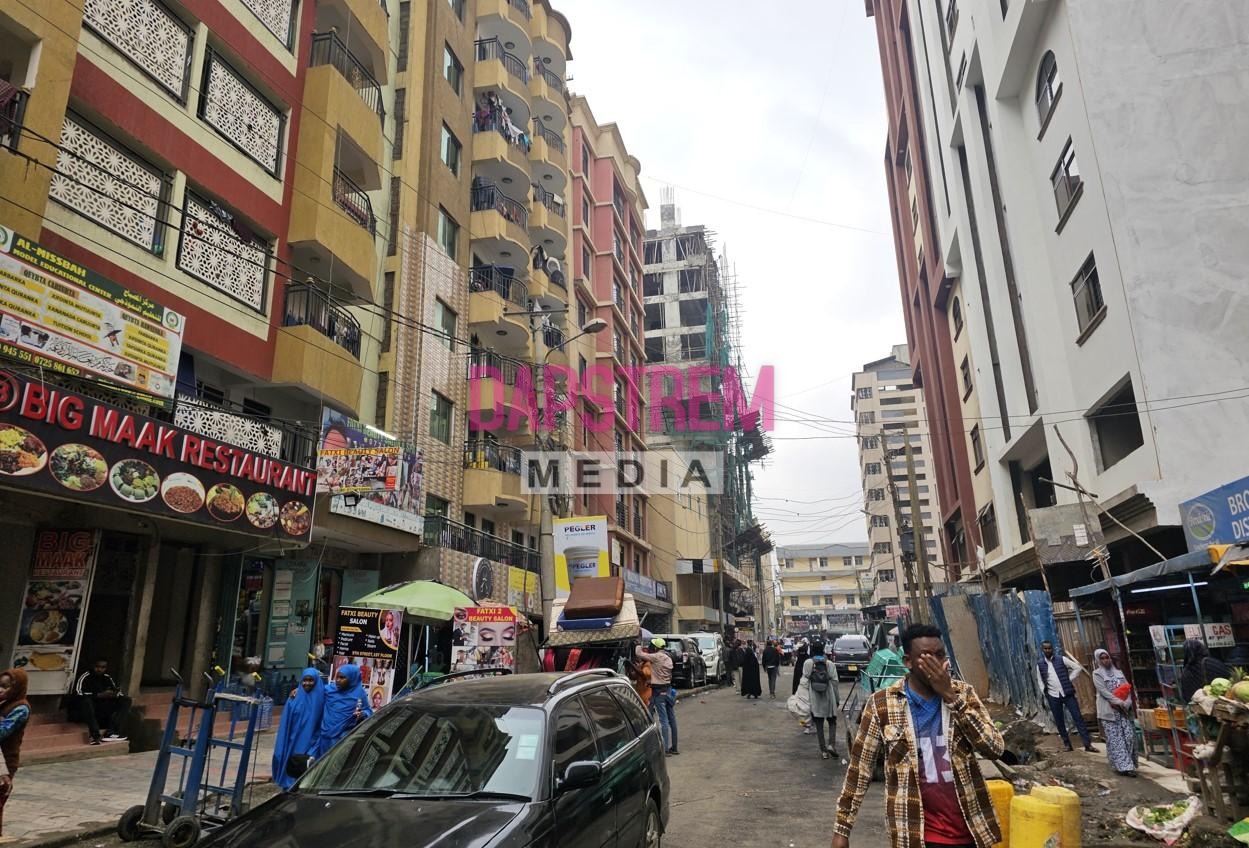
Normalcy Returns to Eastleigh’s 9th Street as Road Reopens After Building Collapse
Normalcy is gradually returning to Nairobi’s Eastleigh neighbourhood after authorities reopened the road along 9th Street, bringing relief to traders, residents and motorists affected by the deadly building collapse that disrupted activities in the busy commercial area for more than two weeks.
The reopening follows the conclusion of a 15-day search and recovery operation at the site of an 18-storey building that collapsed on October 23, 2026, killing eight people and leaving several others trapped beneath tonnes of concrete and debris.
The disaster forced authorities to close sections of the surrounding area to facilitate rescue operations, secure the damaged structure and allow emergency response teams to work without interference. The restrictions significantly disrupted movement and business activities in one of Nairobi’s busiest trading neighbourhoods.
With the recovery operation officially ending on November 6, authorities announced plans to reopen the affected access road, allowing traders to return to their businesses and motorists to resume using the previously restricted route.
However, the return of normal activities has not immediately erased the economic consequences of the tragedy. Several business owners are now counting losses after spending approximately 15 days without operating, while others have returned to find damaged premises and merchandise.
The reopening marks an important step towards restoring activities in Eastleigh, although the affected traders face the difficult task of rebuilding their businesses and recovering income lost during the prolonged closure.
The incident has also renewed discussions about emergency response preparedness, construction safety standards and the need for stronger enforcement of building regulations in Nairobi.
Traders Resume Business After More Than Two Weeks of Disruption
For traders operating along 9th Street, the reopening of the road has brought much-needed relief after days of uncertainty and financial difficulties.
Many business owners depend on daily sales to support their families, pay rent, settle supplier debts and meet other financial obligations. The closure therefore presented a major challenge, particularly for small-scale traders who rely on consistent customer traffic to sustain their operations.
Some traders had expected the affected area to reopen within approximately one week. However, the complexity of the rescue operation meant that restrictions remained in place for considerably longer.
Ali Abdi, one of the traders who narrowly escaped the building collapse, said he had gone 15 days without operating his business because of the emergency restrictions.
Although he was grateful to have survived the disaster, returning to work presented another challenge as he discovered that parts of his business premises had been damaged.
Abdi said his shop’s roof had sustained damage, allowing rainwater to enter the premises whenever it rained. Some of his merchandise had also been affected, leaving him with additional expenses as he worked to restore the business.
His experience reflects the difficulties facing several traders whose businesses were affected either directly by the collapse or indirectly by the closure of the surrounding area.
For many of them, reopening their shops is only the beginning of a longer recovery process. They must now repair damaged structures, replace lost merchandise and rebuild customer confidence after weeks of interrupted operations.
The situation also highlights the vulnerability of small businesses during emergencies, particularly those operating in densely populated commercial areas where access restrictions can affect hundreds of traders simultaneously.
Traders Count Financial Losses Following the Closure
The economic impact of the Eastleigh building collapse has become increasingly visible as business owners return to assess the damage caused by the incident.
Christine Wambua, another trader affected by the disaster, revealed that she lost merchandise worth approximately Sh10,000 after leaving her stock at her business premises on the day the building collapsed.
The closure prevented her from accessing her business for an extended period, while the damaged or lost stock added to the financial pressure facing her household.
She explained that the disruption had made life difficult because her business was an important source of income for supporting her family.
For traders operating small businesses, losing access to their premises for two weeks can have serious consequences. Unlike larger companies with financial reserves and alternative operating locations, many small-scale businesses depend on daily earnings to remain operational.
The losses extend beyond merchandise and missed sales. Traders may still be required to pay rent, meet loan obligations, settle supplier payments and cover household expenses despite having generated little or no income during the closure.
Muhidin Abdi, another trader, also raised concerns about the financial pressure created by the 15-day interruption, particularly regarding rent payments. He appealed for landlords to consider giving affected businesses additional time to settle their obligations.
Such concerns demonstrate that the consequences of the building collapse extend beyond the immediate loss of lives and physical destruction.
The disaster has affected livelihoods, disrupted commercial activities and placed additional financial pressure on families whose incomes depend on businesses operating along the affected streets.
For many traders, the road reopening represents an opportunity to resume earning, but rebuilding their financial position could take considerably longer.
People Daily+1
Rescue and Recovery Operation Officially Ends After 15 Days
The reopening of the affected road followed the official conclusion of the search and recovery operation, which lasted 15 days following the October 23 disaster.
The multi-agency operation brought together several government institutions and emergency response organisations, including the Kenya Defence Forces, the National Disaster Management Unit, the National Disaster Operations Centre, Nairobi City County Government and the Kenya Red Cross.
The teams worked under difficult conditions as they attempted to access different sections of the collapsed structure and locate people believed to be trapped beneath the debris.
The operation involved removing tonnes of concrete, navigating confined spaces and accessing basement sections where some of the missing people were believed to have been trapped.
Operations Commander William Sifuna announced on November 6 that the search and recovery exercise had been called off after authorities completed the planned searches and accounted for the people they had been looking for at the site.
By the conclusion of the operation, eight bodies had been recovered from the rubble, while four people had been rescued alive.
However, the Kenya Red Cross reported that three individuals initially listed as missing remained unaccounted for, with police continuing investigations to establish their whereabouts.
Authorities indicated that the recovery teams had reached all accessible basement compartments and had no further expected recoveries from the site.
The conclusion of the operation marked an important moment for families who had spent days waiting for information about their loved ones.
For those who lost relatives, however, the end of the rescue mission represented the beginning of another difficult process involving identification of victims, burial arrangements and demands for accountability.
Post-mortem examinations and DNA profiling were initiated to help establish the identities of some of the recovered remains, particularly where visual identification was difficult.
The Nairobi County Government also indicated that it would support affected families through assistance with burial arrangements and related expenses.
People Daily+1
Road Reopening Brings Relief to Motorists and Residents
The closure of the road following the building collapse had affected more than traders operating near the disaster scene.
Eastleigh is one of Nairobi’s busiest commercial neighbourhoods, attracting thousands of shoppers, traders, transport operators and residents daily.
The affected route serves an important role in connecting different parts of the neighbourhood, making its closure a significant inconvenience for people who depend on it for their daily activities.
During the recovery operation, motorists were forced to use alternative routes, increasing pressure on roads that were already experiencing heavy traffic.
General Wariungi Street, Second Avenue and Muratina Street were among the routes that experienced increased congestion as vehicles diverted from the affected area.
Taxi drivers complained about spending additional hours in traffic, while boda boda operators said congestion had made it increasingly difficult to navigate through the neighbourhood.
The situation also affected public transport operators and customers travelling to Eastleigh for shopping and other commercial activities.
The increased traffic created additional challenges for businesses located along alternative routes, as customers struggled to access shops and other establishments.
Second Avenue also experienced worsening road conditions following the increased traffic. Motorists reported difficulties navigating potholes, while pedestrians complained about muddy sections that became particularly challenging during rainy weather.
The reopening of the affected road is therefore expected to ease some of the pressure that had built up across the neighbourhood during the emergency operation.
It should also improve access to businesses, reduce unnecessary diversions and support the gradual restoration of normal movement within Eastleigh.
Nevertheless, residents and motorists continue to face broader infrastructure challenges, including congestion and deteriorating road conditions that require attention from the relevant authorities.
The Eastleigh Voice+2
Authorities Move to Secure the Collapsed Building Site
Although the rescue operation has ended and the road has reopened, authorities have maintained restrictions around the collapsed building to prevent unauthorised access.
Operations Commander William Sifuna said the owner of the affected property would be required to fence off the site using iron sheets to improve security and prevent members of the public from entering the dangerous area.
The measure is particularly important because the remaining debris and damaged structural components could pose risks to people who attempt to access the site without authorisation.
Authorities also indicated that the site would remain under security supervision as investigations continued and arrangements were made for debris clearance.
The reopening of the road does not mean that the collapsed structure has been declared safe or that all risks associated with the incident have been eliminated.
Instead, it marks a transition from emergency rescue operations to site management, investigations and the process of establishing accountability.
Engineers and physical planning experts have also been involved in assessing neighbouring buildings whose structural integrity raised concerns following the collapse.
Their assessments are expected to help determine whether nearby structures sustained damage and whether additional safety measures or restrictions are necessary.
This process is particularly important in Eastleigh, where commercial buildings are often closely situated, with businesses, residential premises and construction projects operating within densely populated streets.
Ensuring that surrounding structures are safe will be essential in restoring confidence among residents, traders and property owners.
Building Collapse Raises Questions About Construction Safety
The Eastleigh disaster has renewed public concern over the enforcement of building regulations and the responsibility of authorities to ensure that construction projects comply with approved standards.
The collapsed structure was still under construction when it came down on October 23, triggering one of the major rescue operations witnessed in Nairobi in recent years.
The incident raised questions about the approvals granted to the project, the professionals responsible for overseeing construction and the effectiveness of inspections conducted by relevant authorities.
Nairobi Governor Johnson Sakaja previously raised concerns about the building’s regulatory compliance, including the absence of the required occupancy certificate for the premises.
Investigations have since uncovered further questions surrounding the professionals and documentation associated with the project.
In a development reported on November 7, the structural engineer listed in connection with the project told police that he had disengaged from the construction in August 2024 following a payment dispute.
He questioned how his details were subsequently used in registering the project with the National Construction Authority in 2025.
Investigators are also examining concerns surrounding an Environmental Impact Assessment licence reportedly submitted in connection with the development. The National Environment Management Authority has questioned the authenticity of the document, according to reports.
These developments have intensified calls for a thorough investigation to establish how the project was approved, who was responsible for supervising construction and whether any regulatory failures contributed to the collapse.
The investigation is expected to examine the responsibilities of developers, contractors, construction professionals and public officials involved in the approval and oversight process.
The findings will be important in determining whether the disaster resulted from structural failures, professional negligence, regulatory shortcomings or a combination of factors.
Citizen Digital+1
Traders Appeal for Faster Government Response During Emergencies
As business activities gradually resume, traders affected by the incident have urged the government to improve emergency response mechanisms to minimise disruptions during similar incidents in the future.
Some business owners argued that the closure lasted longer than they had anticipated, leaving them struggling to meet financial obligations despite having no direct involvement in the building collapse.
They acknowledged the importance of allowing emergency teams sufficient time to conduct rescue operations safely but maintained that authorities should explore ways of protecting businesses that are not directly affected by such disasters.
Their concerns reflect the difficult balance between public safety and economic activities during emergencies.
Eastleigh is a major commercial centre where thousands of people depend on daily business activities for their livelihoods. Prolonged restrictions can therefore affect not only traders but also suppliers, transport operators, casual workers and customers.
The traders have called for improved coordination between emergency response agencies and local authorities to ensure that future incidents are handled more efficiently.
They have also urged the government to consider support mechanisms for small businesses that suffer financial losses because of emergency restrictions.
Such interventions could help affected traders recover faster and reduce the economic consequences of disasters.
The reopening of Eastleigh’s 9th Street marks an important step towards restoring normal activities following the deadly building collapse that claimed eight lives and disrupted businesses for more than two weeks.
While traders have welcomed the return of movement and business operations, many are still struggling with damaged premises, lost merchandise and financial difficulties caused by the prolonged closure.
The conclusion of the 15-day rescue operation has also shifted attention towards investigations, accountability and the need to strengthen construction safety regulations.
As authorities continue examining the circumstances surrounding the collapse, residents and business owners will be looking for concrete measures to prevent similar tragedies.
The incident has demonstrated how a single building disaster can affect an entire commercial neighbourhood, disrupting livelihoods, transport networks and economic activities.
For Eastleigh traders, reopening the road is an encouraging development, but the real recovery will depend on their ability to rebuild their businesses and regain the income lost during the closure.
Ultimately, the tragedy should serve as a reminder that public safety, responsible construction practices and effective emergency response systems must remain priorities in Nairobi’s rapidly growing urban environment.