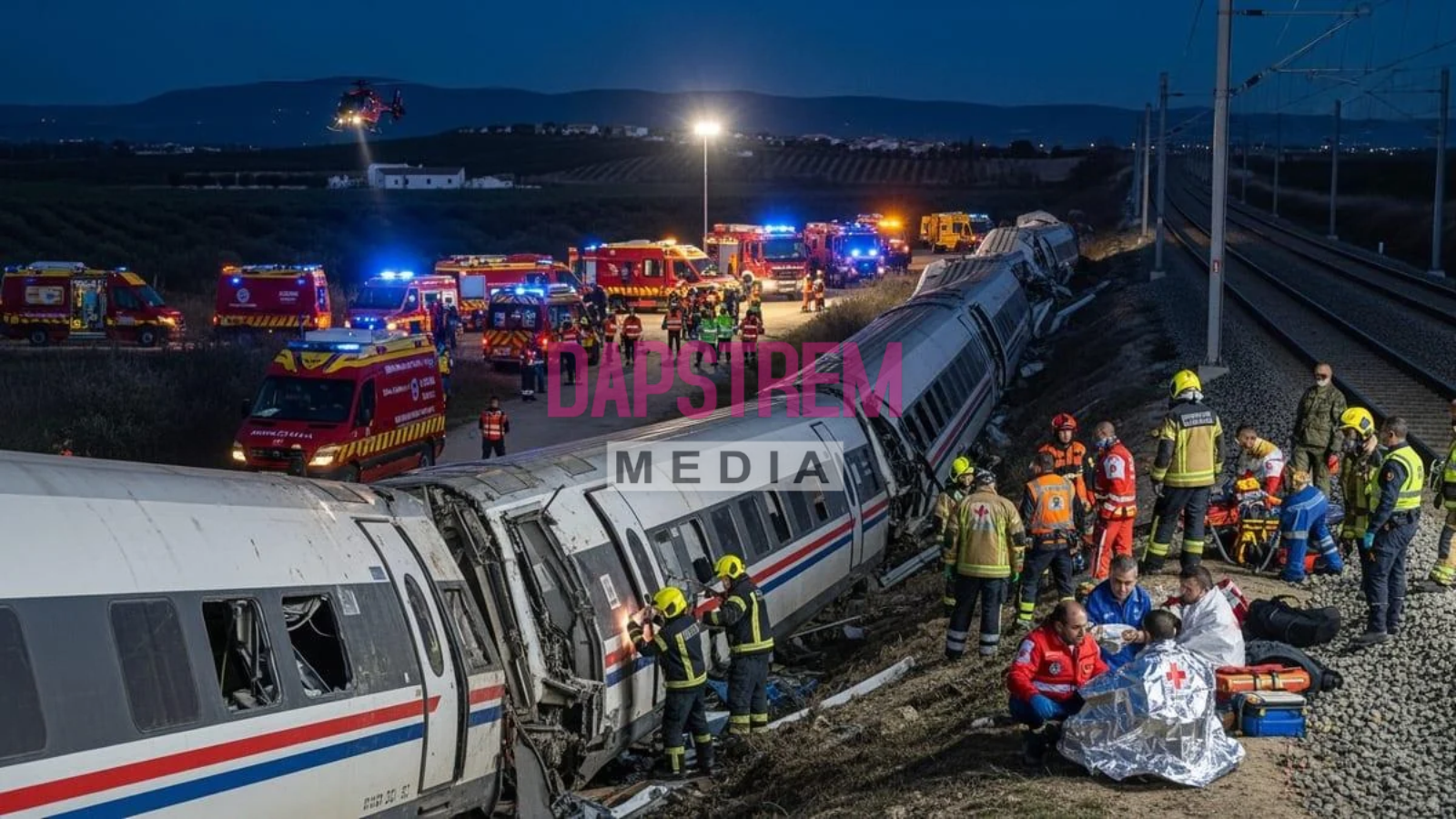
At least 10 people have been killed after two high-speed passenger trains collided in central Spain, triggering a major emergency response and the suspension of rail services linking Madrid with the southern region of Andalusia.
The crash occurred on Wednesday morning, October 28, near Urda in the province of Toledo, when a Renfe-operated AVE train collided with an Iryo passenger train that had reportedly stopped on the tracks. Two carriages derailed and plunged down an embankment, leaving passengers injured and prompting fears that the death toll could rise as rescue operations continued.
Authorities in the Castilla-La Mancha region confirmed the initial death toll, warning that the number of fatalities could increase as emergency crews searched the wreckage and assessed the full extent of the disaster. The precise number of injured passengers was still being established in early reports.
The collision has once again drawn attention to railway safety in Spain, a country with one of Europe’s most extensive high-speed rail networks, less than a year after another deadly train disaster shocked the nation.
How the collision happened
According to Spain’s rail infrastructure administrator, Adif, the accident occurred at approximately 8:54 a.m. local time on the high-speed railway corridor connecting Madrid and Seville.
Initial reports indicate that the Renfe train struck the rear of the Iryo train, which was stationary on the tracks. The impact derailed two carriages of the Iryo train, sending them down an embankment and complicating rescue efforts.
The two trains were travelling in the direction of Seville, according to regional authorities cited by the Associated Press. This detail is significant because early accounts initially described the incident more generally as a collision between two high-speed trains.
The exact sequence of events leading to the collision had not been conclusively established in the initial reports. Investigators will need to determine why the Iryo train stopped, how the Renfe train approached it and whether signalling, operational decisions or other technical factors contributed to the crash.
Authorities have not yet published a final account of what caused the collision. Any early explanations should therefore be treated as preliminary rather than definitive findings.
Rescue teams race to assist passengers
Emergency services were deployed to the crash site, with firefighters, Civil Guard officers, medical personnel and Civil Protection teams participating in the response.
Regional authorities activated emergency assistance procedures as the scale of the collision became clearer. Manuel Galán, the mayor of nearby Urda, said emergency services had asked the municipality to prepare a local sports facility to accommodate injured passengers if necessary.
The damaged carriages and the embankment complicated access to the wreckage. Emergency teams faced the task of locating injured passengers, evacuating survivors and checking whether anyone remained trapped.
Spain’s national leadership also responded to the incident. Prime Minister Pedro Sánchez said he was in contact with the transport minister and the president of Castilla-La Mancha as emergency operations continued. He expressed solidarity with the victims and their families.
The authorities’ immediate priorities were to provide medical assistance, account for passengers and secure the crash site while investigators began examining the circumstances surrounding the collision.
Madrid–Andalusia rail services suspended
The collision forced the suspension of high-speed rail traffic on the Madrid–Andalusia corridor, disrupting journeys between the Spanish capital and destinations in the south.
Adif confirmed the suspension following the rear-end collision. Renfe also announced that affected passengers travelling between Madrid, Ciudad Real and Andalusia could request changes or cancellations without charge.
The disruption affects an important transport connection used by passengers travelling between Madrid and major southern destinations, including Seville. The suspension also creates challenges for travellers who must make alternative arrangements while the damaged section of railway is assessed.
The duration of the interruption will depend on emergency operations, the investigation and the work required to restore safe rail services.
Spain still reeling from January’s deadly train disaster
The latest collision comes less than a year after a catastrophic railway accident near Adamuz, in the southern province of Córdoba, on January 18, 2026.
That accident killed 45 people and injured more than 150 after an Iryo high-speed train derailed and collided with an oncoming Renfe train. It became Spain’s deadliest railway disaster in more than a decade.
The January crash prompted questions about track conditions, railway infrastructure and the effectiveness of safety systems. Investigators examined possible technical failures, including concerns involving rail components, while officials stressed that the cause had to be established through a formal investigation.
The two accidents are distinct incidents, and there is no established evidence that they share a common cause. Nevertheless, the latest collision is likely to renew public scrutiny of the safety and management of Spain’s high-speed railway network.
Spain has invested heavily in high-speed rail, which connects major cities and provides an alternative to domestic air travel. The network’s scale and importance make reliable safety systems, maintenance and effective traffic control essential.
Investigation to establish the cause
The immediate focus remains on determining why the collision occurred and whether any failures contributed to the loss of life.
Investigators will need to examine the trains’ movements, signalling records, communications between railway control staff and train crews, and the technical condition of the infrastructure. These are areas that can help establish how the trains came to occupy the same stretch of track and whether established safety procedures were followed.
Although early reports have raised questions about a possible operational error, authorities have not yet established a definitive cause. Responsibility should not be assigned before investigators have examined the available evidence.
The investigation will also need to establish the full number of casualties and document the extent of the damage before the affected railway section can return to normal operation.