Woman Found Dead as Eastleigh Building Collapse Rescue Mission Enters Eighth Day
The search for survivors following the devastating building collapse in Nairobi’s Eastleigh estate has taken a tragic turn after rescue teams recovered the body of a woman on the eighth day of the operation.
The discovery has renewed grief among families who have spent more than a week waiting anxiously for information about their missing relatives. It has also raised fresh concerns about the possibility of more casualties as emergency responders continue searching through tonnes of concrete and debris.
The multi-storey building, which was still under construction, collapsed along 9th Street in Eastleigh on Friday, October 23, 2026. The incident trapped several people beneath the wreckage, triggering an extensive rescue operation involving government agencies, security personnel and humanitarian organisations.
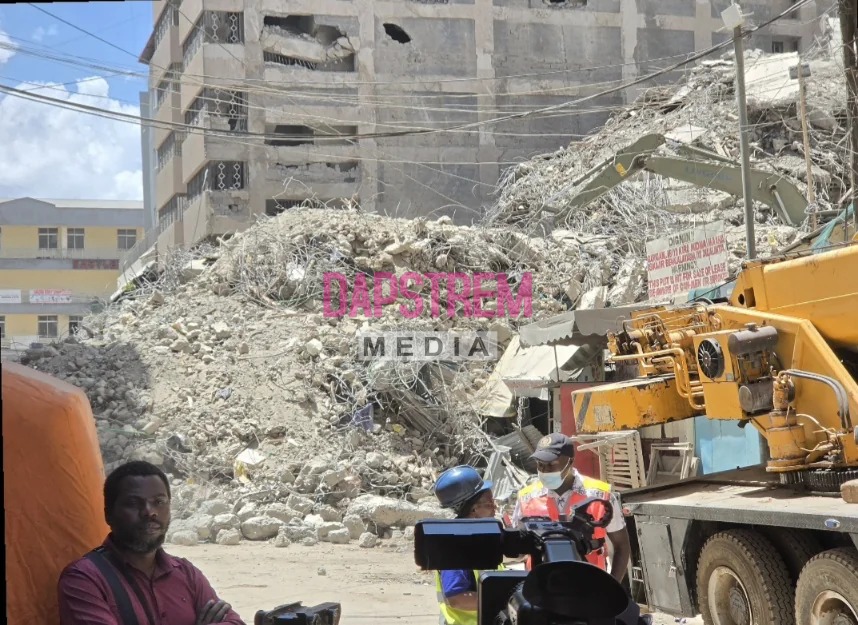
Since the disaster, rescue teams have worked around the clock to locate people who may still be trapped. The operation has involved excavators, specialised rescue equipment and technical teams attempting to reach sections of the structure that remain buried beneath the debris.
The recovery of the woman’s body marks a painful development in an operation that had initially generated hopes of finding more survivors. Although earlier rescues offered encouragement to families, the latest discovery has highlighted the devastating human cost of the collapse.
Authorities have continued to maintain that the search must be completed carefully, particularly because some of the missing people could still be trapped in the lower sections of the building.
Rescue Teams Continue Searching Through the Rubble
According to Nairobi North County Commissioner Simon Osumba, approximately 16 people remained unaccounted for following a verification exercise conducted by the Kenya Red Cross Society and the Directorate of Criminal Investigations.
The verification process was aimed at establishing the actual number of people who may have been inside the building when it collapsed.
Authorities have also been relying on mobile phone data to help trace missing individuals. Information obtained from telecommunications providers indicated that nine of the missing people were at the building shortly before the collapse.
Investigators were still seeking information in four other cases, while three families had yet to provide phone numbers required to support the tracing exercise.
The use of phone records has become an important part of the search because it helps authorities establish the last known locations of people whose whereabouts remain uncertain.
However, identifying a phone’s last known location does not automatically establish whether its owner survived or was trapped inside the building. Investigators must combine telecommunications information with family reports and other available evidence.
Meanwhile, rescue teams have reportedly cleared approximately 80 per cent of the debris. Their attention has been directed towards the remaining sections, particularly the lower parts of the structure where some missing people are suspected to be trapped.
The basement has emerged as one of the most challenging areas of the operation because of the extensive damage and the difficulty of accessing the spaces beneath the collapsed floors.
Rescuers have had to remove debris carefully while assessing the stability of the remaining structure. Any careless movement could create additional hazards for emergency personnel and potentially affect spaces where survivors may be trapped.
The recovery of the woman’s body is therefore expected to add urgency to the operation as teams continue working to establish the fate of everyone reported missing.
Hopes of Finding More Survivors Remain Despite the Tragedy
Before the latest recovery, the operation had offered several moments of hope after rescue teams successfully pulled people alive from the wreckage.
The survivors were taken to hospital for medical attention, with their rescue providing encouragement to relatives who had remained at the scene waiting for news.
One of the survivors, Victor Onyango, previously recounted how he spent almost 24 hours trapped beneath the debris. He was working in his tailoring shop in the basement when the building suddenly collapsed.
According to his account, the falling structure threw him into a corner as concrete and other materials crashed into the room. He gradually made his way through the rubble before rescuers eventually located him.
He also described encountering a woman trapped near him during the ordeal. His experience demonstrated the difficult conditions people faced inside the collapsed structure.
The rescue of survivors after extended periods beneath rubble has encouraged emergency responders to continue searching even as the operation enters another day.
Specialised rescue equipment had earlier detected possible signs of life beneath the debris. National Disaster Management Unit Director Dr Duncan Ochieng said teams were working to reach the locations where the signals had been detected.
Such equipment can help rescuers identify possible human presence in spaces that are difficult to access through conventional excavation.
However, the detection of possible signs of life must be followed by physical confirmation. Rescue teams still have to navigate unstable debris and identify safe routes before reaching suspected survivors.
The latest recovery of a woman’s body has therefore not brought the entire operation to an end. Authorities must still establish the whereabouts of the remaining missing people and determine whether anyone else could be alive beneath the wreckage.
Families Continue to Face an Agonising Wait
For families affected by the Eastleigh building collapse, the past eight days have been marked by fear, uncertainty and emotional exhaustion.
Relatives have continued following developments at the scene, hoping that rescue teams will provide information about their loved ones.
The situation has been particularly difficult for families who have not received confirmation about whether their relatives were inside the building when it collapsed.
Some people were reportedly working in businesses located within the building, while others could have been visiting the premises or conducting activities in the surrounding area.
The verification exercise has helped reduce uncertainty by identifying people whose whereabouts have been established. However, the families of those still missing continue to wait for definitive answers.
The recovery of the woman’s body is likely to deepen the pain among relatives as they consider the possibility that more missing people could be found dead.
For families, every development at the scene carries enormous emotional significance. A successful rescue could bring relief after days of uncertainty, while the recovery of a body could confirm the worst fears of those waiting.
The tragedy has also demonstrated the importance of providing psychological and emotional support to affected families. Beyond the immediate rescue operation, relatives may require assistance in dealing with bereavement, financial losses and the long-term consequences of the disaster.
Authorities and humanitarian organisations will therefore need to ensure that affected families receive timely information and appropriate support throughout the process.
Investigations Turn to Developers and Construction Officials
As rescue operations continue, attention has increasingly shifted towards establishing what caused the building to collapse.
The incident has raised serious questions about construction standards, regulatory approvals and the supervision of buildings in Nairobi.
The structure was still under construction when it collapsed, leaving investigators with the responsibility of examining the circumstances surrounding the project.
Detectives have reportedly questioned one of the developers alongside officials from Nairobi County, the National Building Inspectorate and the National Construction Authority.
The investigations are expected to establish whether the building complied with the required construction standards and whether the relevant authorities conducted the necessary inspections.
The Director of Public Prosecutions has also instructed the Directorate of Criminal Investigations to investigate possible negligence or omissions by public officials, developers and construction professionals connected to the project.
This directive places greater emphasis on determining whether individuals or institutions failed to perform their responsibilities during the approval, construction and supervision of the building.
Investigators may need to examine architectural and structural plans, construction permits, inspection records and the materials used during the development.
They will also need to establish whether the building was being constructed in accordance with approved designs and whether any warnings about its structural condition had been raised before the collapse.
At this stage, the definitive cause of the collapse has not been established. Any individual or institution suspected of wrongdoing should therefore be treated in accordance with the ongoing investigations and the legal process.
Nevertheless, the public will expect authorities to provide clear answers about how such a devastating incident occurred and whether it could have been prevented.
Eastleigh Building Collapse Renews Concerns Over Construction Safety
The tragedy has once again brought the issue of building safety in Nairobi into the national conversation.
Eastleigh is among the city’s busiest commercial neighbourhoods, with numerous businesses, residential properties, shops and construction projects operating within a relatively small area.
The high concentration of commercial and residential activities means that structural failures can have devastating consequences for workers, traders, residents and pedestrians.
A building collapse can also disrupt surrounding businesses, damage neighbouring properties and expose emergency responders to serious risks.
Kenya has established construction regulations intended to ensure that buildings meet appropriate safety standards. These requirements cover planning approvals, structural designs, construction materials, professional supervision and inspections.
However, the effectiveness of these regulations depends heavily on consistent enforcement.
Questions have repeatedly emerged over whether developers follow approved construction plans and whether county authorities have sufficient personnel to inspect projects throughout their development.
The Eastleigh incident has renewed calls for stronger oversight, particularly in areas experiencing rapid urban development.
Building inspections should not simply be conducted when developers apply for permits. Authorities need to ensure that construction continues to follow approved designs and that any structural concerns are addressed before people occupy or work within the premises.
The disaster also highlights the importance of professional accountability. Architects, engineers, contractors and construction supervisors all have responsibilities in ensuring that buildings are safe.
Where negligence or violations are established, appropriate action should follow.
Businesses and Residents Count the Cost of the Disaster
Beyond the immediate loss of life, the collapse has disrupted economic activities in Eastleigh.
The neighbourhood supports thousands of traders, employees, transport operators and small businesses whose livelihoods depend on daily commercial activities.
The rescue operation has required restrictions around the affected area to allow emergency teams and heavy machinery to work safely.
These restrictions have affected movement and business operations, particularly for traders and transport operators who depend on access to the surrounding streets.
Some businesses have faced reduced customer traffic, while others have been unable to operate normally because of safety concerns and restricted access.
The financial consequences could extend beyond businesses located inside the collapsed structure. Traders operating nearby may also experience losses due to disrupted movement and reduced commercial activity.
For people who lost their workplaces and belongings in the disaster, rebuilding their livelihoods could become another difficult challenge.
The experience of survivors such as Victor Onyango illustrates how the consequences of a building collapse can continue long after a person has been rescued.
Surviving the physical disaster does not automatically restore a person’s business, income or possessions.
This makes it important for authorities and relevant stakeholders to consider how affected workers, traders and families can receive assistance as the rescue operation progresses.
What Happens Next as the Search Enters Another Day?
With the recovery of the woman’s body, attention remains firmly focused on the remaining sections of the collapsed building.
Rescue teams must continue working to establish the whereabouts of the people who remain unaccounted for. The operation will also require careful coordination between emergency responders, investigators and families searching for missing relatives.
Authorities will need to provide regular updates on the number of people recovered, those still missing and any further developments at the scene.
The investigations into the collapse will also be crucial in determining whether construction failures or regulatory shortcomings contributed to the disaster.
The public will expect the findings to go beyond identifying the immediate cause of the collapse. They should also establish whether any individuals or institutions failed to fulfil their legal and professional responsibilities.
The incident should further prompt a comprehensive review of building safety in Eastleigh and other rapidly developing parts of Nairobi.
For families waiting for answers, however, the immediate concern remains the fate of their loved ones.
The recovery of the woman’s body has brought another painful moment to a rescue operation already filled with uncertainty and grief. As emergency teams continue searching through the remaining rubble, relatives are left hoping that authorities will soon establish what happened to everyone reported missing.
The Eastleigh building collapse is no longer simply a rescue operation. It has become a major test of emergency response, public safety oversight and accountability in Kenya.
As the country mourns those affected, the tragedy should serve as a serious warning about the importance of enforcing construction regulations and protecting people from preventable disasters.