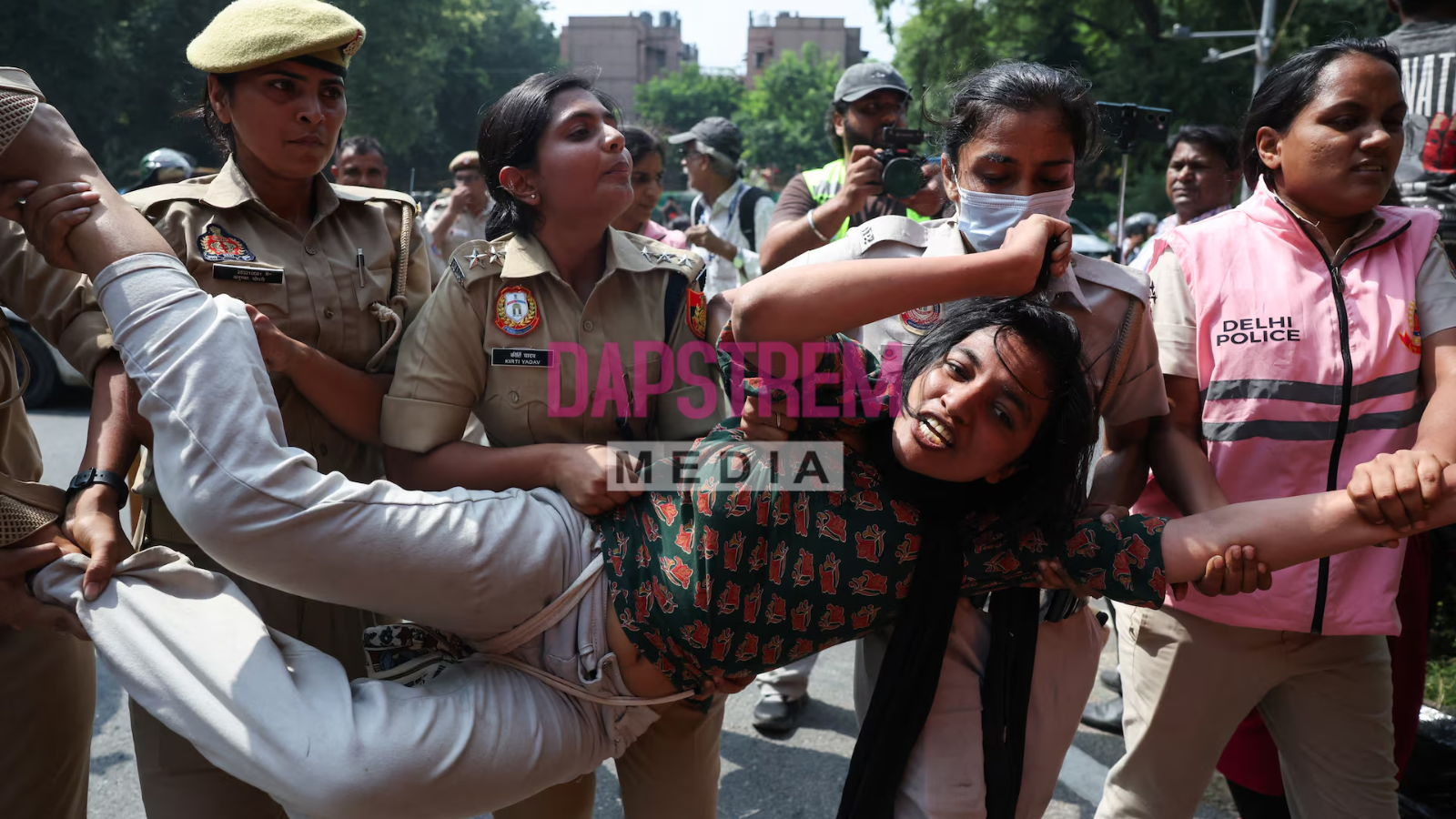
From Batman masks and face paint to offline maps and volunteer-run digital networks, young protesters in India are adopting unconventional tactics to sustain demonstrations as authorities intensify a crackdown on rallies challenging the country’s election authorities.
The protests, centred in New Delhi, have exposed a growing confrontation between a digitally connected youth movement and security forces determined to prevent large gatherings at key locations in the capital. Despite mass detentions, internet restrictions and heavy police deployments, demonstrators have continued organising smaller, spontaneous rallies across the city.
At the centre of the unrest is the demand for the resignation of Chief Election Commissioner Gyanesh Kumar over controversial revisions to India’s electoral rolls. Opposition parties and activists allege that the changes unfairly benefit Prime Minister Narendra Modi’s ruling Bharatiya Janata Party (BJP), an accusation rejected by both the party and the Election Commission.
Youth turn to unconventional protest tactics
With security forces blocking access to Jantar Mantar, a prominent protest site in central New Delhi, young demonstrators have increasingly relied on quick, decentralised gatherings to avoid being intercepted before reaching their destinations.
According to reporting by Agence France-Presse (AFP), some protesters have worn Batman masks to make identification more difficult, while others have experimented with face paint and makeup in response to concerns about surveillance cameras and facial-recognition technology.
Indian actress Richa Chadha also drew attention to the issue by sharing a video of herself applying makeup, suggesting that protesters consider ways to protect their identities when filmed without consent.
The tactics illustrate how visual culture, social media and grassroots organising are intersecting in a protest movement led in significant part by young people.
However, disguises and makeup should not be assumed to defeat facial-recognition systems reliably. Their use reflects protesters’ concerns about surveillance rather than proof that such measures can guarantee anonymity.
Mass detentions intensify tensions
The demonstrations escalated over the weekend as authorities moved to prevent a major rally organised by the youth-led Cockroach Janta Party (CJP).
Reuters reported that more than 2,000 people were detained in Delhi on October 10 as police and paramilitary forces sealed off access routes, established checkpoints and deployed security personnel around the planned demonstration. Many detainees were subsequently released.
Authorities also suspended mobile internet services in parts of central Delhi, while dozens of metro stations and markets were shut amid the security operation. The measures disrupted movement through the capital and made conventional protest coordination more difficult.
The United Nations human rights office expressed concern about the mass detentions and called on Indian authorities to respect the right to peaceful assembly and engage in meaningful dialogue with demonstrators.
India rejected the UN criticism, maintaining that peaceful assembly is constitutionally protected but subject to reasonable restrictions in the interests of public order.
The crackdown has not ended the protests. Instead, demonstrations have continued at alternative locations, presenting police with the challenge of responding to gatherings that can emerge quickly and disperse before security forces fully mobilise.
Digital networks become a protest lifeline
Beyond the streets, volunteers have developed informal systems to help protesters who are detained or need assistance.
Meghnad S., a 36-year-old content creator, told AFP that a network of approximately 170 volunteers had spent the weekend tracking police vehicles and helping locate detainees.
Information about where people had been taken was fed into a digital dashboard, allowing volunteers to coordinate transport and assistance. WhatsApp groups helped match volunteer drivers with detainees who needed collection, food, water or medical attention.
Some drivers were accompanied by doctors who could assist people during the journey.
The effort demonstrates how digital tools can serve purposes beyond mobilising crowds: they can also support detainee tracking, transport coordination and emergency assistance when conventional arrangements are disrupted.
Offline maps have also become part of the wider set of tactics associated with the protests, reflecting the importance of navigating the city when mobile connectivity is unreliable or unavailable.
Yet the reliance on digital networks carries risks. Communications can be interrupted, information can be inaccurate, and shared details about detainees may expose vulnerable people if handled carelessly.
Dispute over voter lists fuels the unrest
The protests stem from a wider dispute over revisions to India’s electoral rolls under a process known as the Special Intensive Revision (SIR).
Opposition parties have questioned whether the exercise could disenfranchise eligible voters, particularly among communities they believe are less likely to support the ruling BJP.
Reuters reported that approximately 130 million voter entries were removed during the verification exercise. Election Commission data cited in the report attributed the removals to different circumstances, including around 28 million entries associated with people who had died, 63 million people reported to have relocated and 30 million people who could not be traced.
These figures do not establish that 130 million eligible voters were unlawfully removed. The Election Commission says eligible voters whose names were incorrectly deleted can seek re-enrolment, while the BJP rejects claims that the revisions were designed to influence electoral outcomes.
Nevertheless, the scale of the changes has intensified political scrutiny and raised questions about the transparency of voter registration, the treatment of vulnerable communities and public confidence in electoral institutions.
For protesters, the dispute is not simply administrative. It concerns whether every eligible citizen can exercise the right to vote and whether electoral procedures are applied fairly.
A movement facing a critical test
The youth-led mobilisation has developed into a wider challenge for the government, building on earlier protests over issues including education, examination irregularities and employment.
The CJP gained prominence through campaigns that helped sustain public pressure over government accountability. Its supporters now face a different test: maintaining momentum when leaders are detained, protest sites are restricted and ordinary routes of communication are disrupted.
On October 13, Reuters reported that police detained leading members of the movement after they entered the grounds of Jantar Mantar, which Delhi Police had recently removed from its list of designated protest sites.
The latest detentions underline the continuing confrontation between demonstrators seeking access to public spaces and authorities imposing restrictions on where gatherings may take place.
For the movement, the challenge is to maintain a broad coalition without losing its central demand for accountability over the electoral-roll revisions. For the government, the issue raises questions about how public order can be maintained while protecting the constitutional rights of peaceful demonstrators.
The coming days will show whether the protests can sustain pressure on election authorities or whether continued restrictions will weaken their ability to mobilise.
For now, Batman masks, offline maps, volunteer drivers and digital coordination networks have become symbols of a broader struggle over public space, political participation and trust in democratic institutions.
The central question is no longer simply whether young protesters can gather in Delhi. It is whether their concerns about electoral fairness will receive a response capable of restoring public confidence.