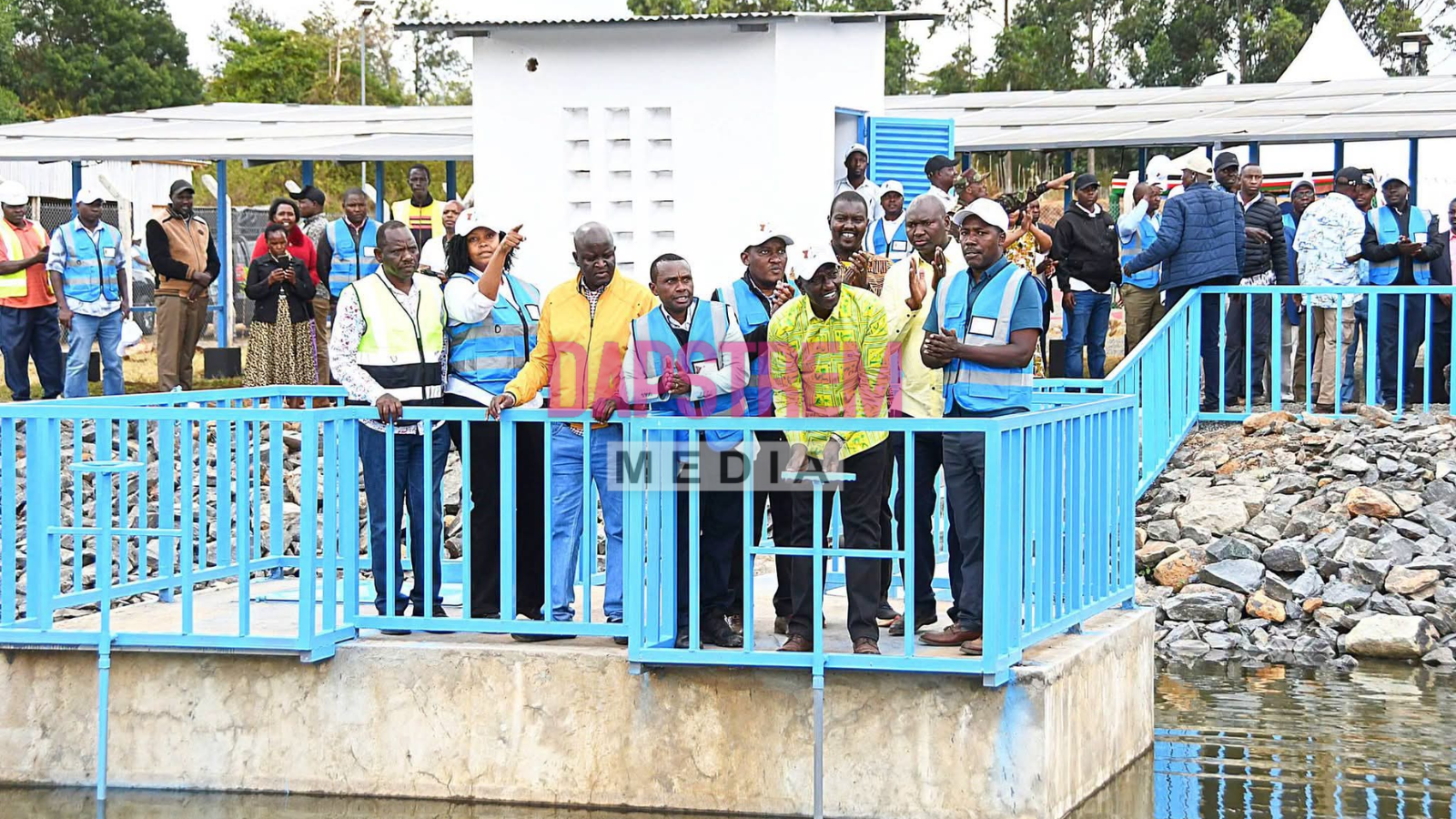
President William Ruto has commissioned the Ziwa 2 Earth Dam Irrigation Project in Uasin Gishu County, a government initiative expected to bring 500 acres of farmland under irrigation and support 1,000 farming households.
The project, located in Sirikwa Location, Soy Constituency, is intended to reduce farmers’ dependence on rain-fed agriculture, improve crop production and strengthen food security in the North Rift region.
According to the National Irrigation Authority (NIA), rehabilitation works began in June 2025 and have substantially been completed. However, some farmer connections and fencing works remain outstanding and are expected to be completed by the end of November 2026.
The commissioning took place on Monday, October 12, during Ruto’s development tour of the North Rift region, which also includes infrastructure, electricity connectivity, healthcare and education projects.
Dam rehabilitation boosts water storage
The rehabilitation works involved desilting the dam and reconstructing its embankment, increasing its water storage capacity to approximately one million cubic metres.
Two solar-powered pumping systems have also been installed to supply water to farms, reducing dependence on conventional energy sources and helping farmers access irrigation water more reliably.
The National Irrigation Authority says the project is expected to directly benefit 1,000 people, while another 5,000 people could benefit indirectly through employment and related economic activities.
The dam is part of wider government efforts to expand irrigation infrastructure, promote agricultural commercialisation and reduce the vulnerability of farmers to changing rainfall patterns.
Although Uasin Gishu is widely associated with maize and other cereal production, reliable irrigation could allow farmers to diversify into horticulture and other higher-value crops.
Farmers eye higher incomes from irrigation
Under the scheme, farmers are expected to cultivate maize and beans alongside horticultural crops such as spinach, kale, tomatoes, onions and passion fruit. Coffee is also among the crops identified for production.
The NIA projects that participating households could earn an average of KSh200,000 per acre annually, based on two cropping seasons.
However, the projected earnings will depend on factors including crop selection, yields, production costs, access to markets and prevailing farm-gate prices. The figure is a government projection rather than a guaranteed income for participating farmers.
Access to reliable water could enable farmers to plan planting seasons more effectively, improve production consistency and reduce losses associated with inadequate rainfall.
The scheme is also expected to support employment across the agricultural value chain, including farm labour, transport, produce aggregation and marketing.
To support implementation, the State Department for Irrigation and the NIA plan to help farmers establish and strengthen an Irrigation Water Users Association. The initiative is intended to improve coordination in water distribution, provide training in farming as a business and facilitate access to markets.
Government plans expansion to 2,000 more acres
The Ziwa 2 project forms part of a broader irrigation development programme targeting several locations in Uasin Gishu County.
A second phase is planned to extend irrigation to an additional 2,000 acres and serve a further 4,000 households, potentially increasing the project’s reach beyond its initial target.
The NIA has previously identified Ziwa 2 alongside the Kimuri, Kerita and Sugutek earth dams as part of its efforts to expand irrigation and strengthen drought resilience across the county.
In March 2026, the authority reported that Ziwa 2 was still progressing towards completion, with the project targeting 500 acres and 1,000 farmers. The subsequent commissioning marks a significant milestone, although the remaining connections and fencing works indicate that some implementation tasks are yet to be finalised.
The proposed expansion will depend on the implementation of the next phase and the infrastructure required to distribute water to additional farms.
Irrigation investment targets food security
Kenya continues to face the challenge of increasing agricultural productivity while protecting farmers against increasingly unpredictable weather conditions.
Rain-fed farming remains vulnerable to delayed rains, prolonged dry spells and changing seasonal patterns. Irrigation can help reduce those risks, although its effectiveness depends on adequate water storage, sound management and the availability of affordable farm inputs.
The Ziwa 2 investment is therefore significant not only for the number of acres targeted but also for its potential to help farmers move towards more reliable and commercially oriented production.
Its long-term success will depend on whether the water supply remains dependable, distribution systems are completed and farmers can access markets that offer viable returns.
The proposed farmers’ association will also be important in managing water use and ensuring that the infrastructure serves participating households fairly and sustainably.
Beyond irrigation, the project illustrates the government’s wider strategy of investing in infrastructure intended to raise rural incomes and stimulate economic activity.
For farmers in Soy Constituency, the immediate priority will be translating the newly commissioned infrastructure into dependable water access, higher yields and improved household earnings.