KNH Strike Enters Third Day Despite First Phase of Staff Payments as Healthcare Crisis Deepens
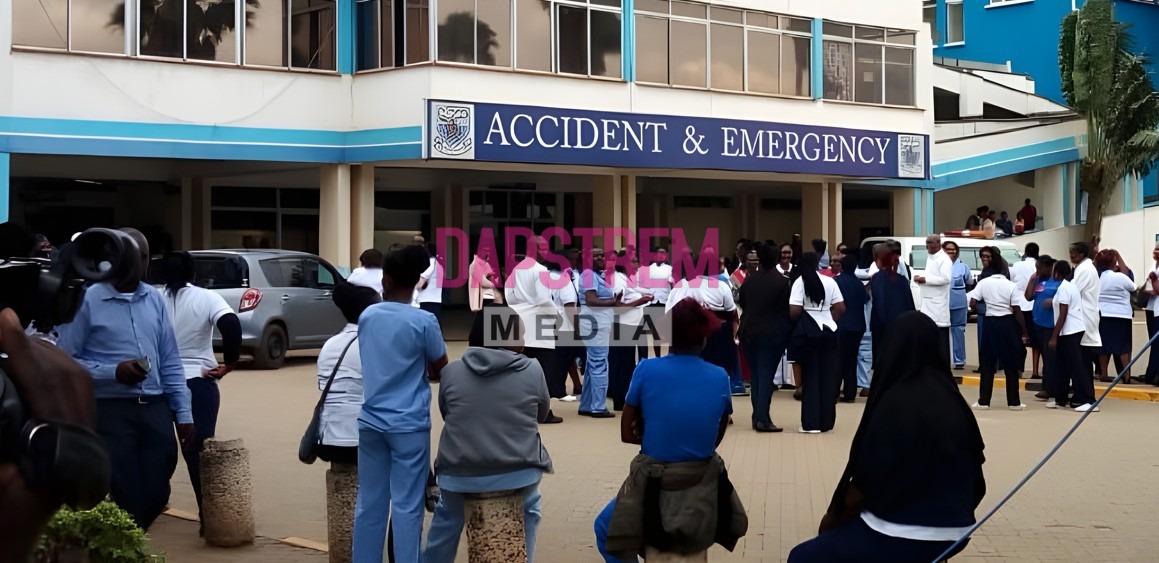
The industrial action at Kenyatta National Hospital (KNH) has entered its third day despite management confirming that the first phase of outstanding staff payments has been implemented. Healthcare workers remain dissatisfied over delayed salaries, unremitted statutory deductions, pension contributions and other welfare concerns, raising fears of prolonged disruption at the country’s largest referral hospital.
The ongoing industrial action at Kenyatta National Hospital has entered its third day, with efforts by hospital management to resolve the dispute yet to convince striking healthcare workers to resume normal duties.
The latest development comes after the hospital announced that it had implemented the first phase of payments owed to employees, following growing pressure from workers and their unions over delayed salaries and failure to remit money deducted from their earnings.
In an update issued on Thursday, November 26, 2026, KNH management confirmed that the first phase of outstanding payments had been implemented as promised. The hospital also announced that the second phase would be completed on December 8, 2026, or earlier.
Additionally, management committed to paying employees their November salaries by Monday, November 30, 2026.
Despite these developments, the industrial dispute remains unresolved, with workers maintaining pressure on management to address the broader financial and employment concerns that triggered the protests.
The strike has exposed serious concerns about employee welfare within one of Kenya’s most important public healthcare institutions. It has also raised questions about the financial challenges facing major referral hospitals and their ability to meet obligations to employees while maintaining essential medical services.
For thousands of patients who depend on KNH for specialised treatment, the continued industrial action presents another worrying development in an already strained public healthcare system.
First Phase of Payments Fails to End the Strike
The announcement of the first phase of payments had raised expectations that the hospital could make progress towards resolving the dispute.
However, the confirmation has not immediately restored normal operations, as healthcare workers continue demanding a comprehensive solution to their grievances.
Acting KNH Chief Executive Officer Dr Joel Lessan confirmed that management had begun implementing its payment plan and was committed to clearing the outstanding dues in phases.
The first payment had initially been scheduled for Friday, November 27, but management subsequently confirmed on Thursday that the first phase had already been implemented.
The second phase is scheduled for December 8, although the hospital indicated that the payment could be made earlier.
Management also gave employees an assurance that their November salaries would be paid by November 30, providing another commitment aimed at addressing concerns over delayed remuneration.
The hospital has maintained that it recognises the difficulties facing its employees and remains committed to addressing their financial and professional welfare.
However, the payment announcement appears insufficient to resolve the entire dispute because workers are demanding more than partial settlements.
Their concerns extend to the remittance of statutory deductions, pension contributions, insurance premiums, loan repayments and other financial obligations that have reportedly remained unsettled for several months.
Employees want management to demonstrate that all money deducted from their salaries will reach the intended institutions and that outstanding penalties and interest arising from the delays will be addressed.
The unions are also seeking assurances that the problems will not continue recurring after the current payment arrangements are completed.
This has made the dispute more complicated than an ordinary disagreement over delayed salaries.
Unremitted Deductions at the Centre of the Dispute
One of the biggest issues behind the industrial action is the alleged failure by KNH management to forward money deducted from employees’ salaries to the relevant institutions.
Workers have complained that deductions appearing on their payslips have not consistently reached banks, Savings and Credit Cooperative Organisations (SACCOs), insurance providers and pension schemes.
The situation has reportedly exposed employees to financial difficulties despite the money already having been deducted from their earnings.
For workers with bank loans, delayed remittances could result in missed repayment obligations, additional interest charges and possible negative records with credit reference bureaus.
Employees who contribute towards medical insurance have also expressed concerns about the possibility of losing access to benefits despite having deductions made from their salaries.
The pension issue has raised further questions about the financial security of employees approaching retirement and those who depend on pension contributions for their future.
Healthcare workers argue that employers have a responsibility to ensure that authorised deductions are forwarded to the intended beneficiaries within the required timelines.
The failure to do so places workers in an unfair position because they are expected to meet financial obligations even when the institutions responsible for processing their payments have not received the money.
The unions have therefore insisted that management must provide a clear explanation of the outstanding amounts and establish a reliable plan for settling them.
KMPDU Deputy National Chairperson Dr Kahura Mundia previously estimated that unremitted deductions had accumulated to approximately Sh3.5 billion.
The figure highlights the scale of the concerns raised by healthcare workers, although management has not provided a detailed breakdown confirming the amount to be settled through the two payment phases.
The unions have also questioned who will bear the additional penalties and interest arising from delayed remittances, arguing that employees should not be punished for administrative and financial failures beyond their control.
Doctors Warn of Possible Industrial Action
The dispute has also created the possibility of a wider confrontation involving doctors at the hospital.
The Kenya Medical Practitioners, Pharmacists and Dentists Union (KMPDU) has raised concerns over delayed salaries and unremitted deductions, warning that doctors could join the industrial action if management fails to address their grievances.
KMPDU Nairobi Branch Secretary General Dr Maureen Wanjiru previously accused the hospital of failing to pay doctors their full salaries for nearly six months.
She explained that some doctors had reportedly received only partial payments during that period, while others had gone for up to two months without receiving their salaries.
According to Wanjiru, the financial challenges have forced some healthcare workers into difficult circumstances, with some borrowing money from colleagues to meet their daily needs.
The union has argued that doctors should not be forced to struggle financially while continuing to provide essential medical services to thousands of patients.
Wanjiru also raised concerns about deductions intended for bank loans, insurance premiums, SACCO contributions and pension schemes.
She maintained that the delays have exposed doctors to possible loan defaults, loss of insurance coverage and uncertainty surrounding their retirement benefits.
The union has cited Article 41 of the Constitution, which guarantees workers the right to fair labour practices and fair remuneration.
It has also referred to provisions of the Employment Act requiring employers to remit authorised deductions to their intended beneficiaries.
KMPDU Deputy National Chairperson Dr Kahura Mundia has similarly maintained that employers cannot escape responsibility for deductions made directly from employees’ salaries.
The union’s position is that the hospital must address the outstanding obligations rather than relying entirely on promises of future payments.
The possibility of doctors joining their colleagues has raised concerns about further disruption at KNH, particularly because doctors play a central role in specialised treatment, surgeries, emergency care and other critical medical services.
A wider strike involving different categories of healthcare professionals could make it increasingly difficult for the hospital to maintain normal operations.
Workers Demand More Than Salary Payments
Beyond delayed salaries and unremitted deductions, the ongoing dispute has also brought broader employee welfare concerns into focus.
Healthcare workers want management to address issues affecting their working conditions, professional development and long-term employment security.
Some employees have raised concerns about delayed promotions and the conversion of workers serving on contractual arrangements to permanent and pensionable terms.
These matters have contributed to growing dissatisfaction among sections of the workforce.
For employees who have served the hospital for years, career progression and employment security are important considerations.
Delayed promotions can affect salaries, professional recognition and opportunities for advancement.
Similarly, workers seeking permanent and pensionable employment want greater certainty about their future and access to benefits associated with more secure employment arrangements.
The unions are therefore pushing for a broader solution that addresses the different issues affecting healthcare workers.
Their argument is that resolving only the immediate payment concerns without addressing the underlying welfare challenges could create conditions for another industrial dispute in the future.
Management will consequently need to engage the unions on all outstanding matters and establish clear timelines for implementing agreed resolutions.
Patients Bear the Greatest Burden
As the strike continues, patients remain among the most affected groups.
Kenyatta National Hospital serves thousands of people from Nairobi and other parts of the country, including patients referred from county hospitals for specialised medical attention.
The institution handles complicated medical conditions and provides services that are not readily available in many smaller healthcare facilities.
Its role makes uninterrupted operations particularly important for patients requiring emergency treatment, specialised consultations, surgical procedures and other essential medical services.
When healthcare workers down their tools, patients who have already travelled long distances can find themselves facing uncertainty over their appointments and treatment schedules.
Those requiring regular medical attention may also experience difficulties accessing the services they depend on.
The situation can be particularly challenging for patients with serious illnesses who cannot easily postpone treatment or seek alternatives elsewhere.
Families may also face additional financial pressure when forced to look for private healthcare services or make repeated trips to the hospital.
The strike therefore goes beyond an employment disagreement between hospital management and workers. It directly affects access to healthcare for ordinary Kenyans.
Management has repeatedly appealed to employees to resume duty, emphasising the importance of protecting patients who depend on the facility.
In his latest appeal, Dr Lessan urged workers to return to work as discussions continue, noting that many patients are in pain and urgently require medical attention.
However, the unions maintain that workers’ concerns must be addressed to ensure sustainable healthcare delivery.
The situation demonstrates the difficult balance between protecting employees’ rights and maintaining access to essential public services.
Concerns Over Funding of Major Referral Hospitals
The KNH strike has also revived a wider debate about the financial sustainability of major public referral hospitals.
Union officials have linked some of the challenges facing healthcare workers to funding constraints affecting public health institutions.
Kenya National Union of Nurses and Midwives Secretary General Seth Panyako has previously raised concerns about budget reductions affecting major referral hospitals.
He argued that reducing institutional budgets without adequately considering their operational responsibilities could make it difficult for facilities to meet their financial obligations.
According to Panyako, major referral hospitals require sufficient resources to pay employees, purchase medical supplies, maintain equipment and provide specialised services.
He has also warned that financial challenges affecting KNH could extend to other major institutions, including Moi Teaching and Referral Hospital and Kenyatta University Teaching, Referral and Research Hospital.
The argument raises important questions about how public referral facilities are funded and whether their allocations are sufficient to support their growing responsibilities.
Hospitals depend on predictable funding to plan their operations and meet obligations to employees and suppliers.
When payments from government sources are delayed or institutional budgets become inadequate, the consequences can extend beyond administrative operations.
Employees may experience delayed salaries, suppliers may struggle to receive payments and patients may eventually face disruptions in service delivery.
The government and relevant health authorities therefore face pressure to examine the financial arrangements supporting major referral hospitals.
The ongoing dispute at KNH could serve as an important warning about the need to strengthen funding mechanisms and improve financial accountability within public healthcare institutions.
Unions Insist on a Lasting Solution
The unions representing healthcare workers have maintained that the dispute requires more than temporary financial arrangements.
Their concern is that phased payments may provide short-term relief without addressing the administrative and financial problems responsible for the accumulated arrears.
Workers want management to provide specific details about the amounts owed, the institutions awaiting remittances and the timelines for settling outstanding obligations.
They also want clarity on the treatment of interest, penalties and other charges that may have accumulated because of delayed payments.
The involvement of different unions has further demonstrated that the concerns extend across several professional groups within the healthcare sector.
KMPDU has highlighted doctors’ salary and deduction concerns, while the Kenya Union of Clinical Officers and the nurses’ union have also raised wider questions about workers’ welfare and the financial stability of public healthcare facilities.
The unions have warned that continued failure to address employment grievances could lead to further industrial action.
Their position reflects growing frustration among healthcare professionals who believe that their financial rights and working conditions should not be compromised.
For management, the challenge will be to turn its latest payment commitments into measurable progress while ensuring that negotiations produce an agreement acceptable to the affected employees.
What Happens Next?
The implementation of the first phase of payments represents an important development, but it does not automatically bring the industrial dispute to an end.
KNH has committed to completing the second phase on December 8, 2026, or earlier, and paying November salaries by November 30.
These commitments will be closely watched by employees and their unions as they assess whether management is making genuine progress.
The hospital must also provide clarity on the outstanding deductions and address the other employment concerns that have contributed to the strike.
The possibility of doctors joining the industrial action further increases the urgency of negotiations.
If the disagreement continues, patients could face additional challenges accessing essential services at a time when the hospital remains a critical part of Kenya’s healthcare system.
The government also has an important role to play in addressing funding concerns and ensuring that public referral hospitals have sufficient resources to meet their responsibilities.
A sustainable solution will require cooperation between hospital management, healthcare workers, unions and the relevant government institutions.
The third day of the KNH strike, despite confirmation that the first phase of staff payments has been implemented, demonstrates the depth of the disagreement between healthcare workers and hospital management.
The dispute is no longer limited to delayed salaries. It has expanded into concerns over unremitted deductions, pension contributions, insurance coverage, loan repayments, promotions and long-term employment security.
While the hospital has announced additional payment commitments and appealed to employees to resume work, the unions continue demanding a comprehensive solution that addresses the underlying problems.
For patients, the greatest concern remains the possibility of prolonged disruption at one of the country’s most important referral facilities.
The situation also highlights the need for stronger financial management and reliable funding within public healthcare institutions.
Ultimately, the success of the negotiations will depend on whether management can honour its commitments and provide workers with confidence that their financial and professional concerns are being addressed.
As the country watches the developments at KNH, the priority should be finding a lasting agreement that protects healthcare workers’ rights while ensuring that patients continue receiving the medical services they urgently need.