Lake Victoria’s Biggest Ship Hits Huge Rock, Sparking Investigation in Tanzania
A dramatic maritime incident involving Lake Victoria’s biggest passenger and cargo vessel has attracted widespread attention after the newly built MV New Mwanza struck the famous Bismarck Rock near Mwanza, Tanzania.
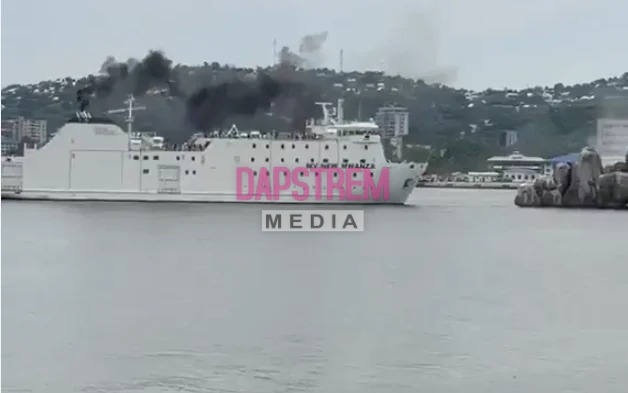
The incident occurred on Wednesday, November 18, 2026, at approximately 10:30 am, while the vessel was undergoing technical trials ahead of its planned return to passenger and cargo operations. The collision startled residents and people watching from the shores after footage emerged showing the massive white ship approaching the rocky formation before making contact.
Thick black smoke was also seen coming from the vessel’s funnels shortly after the impact, raising questions about its mechanical condition and the possible damage caused by the collision.
Despite the alarming scenes, Tanzanian authorities indicated that no deaths or injuries had been reported. Initial assessments by technical experts also suggested that the vessel remained safe, although the government ordered a comprehensive investigation to establish what exactly happened.
The incident has nevertheless raised fresh questions about maritime safety, navigation procedures and the management of major passenger vessels operating on Lake Victoria, one of Africa’s most important inland waterways.
According to preliminary accounts, the ship’s captain may have been attempting to avoid colliding with another passenger ferry approaching from the direction of Sengerema. The reported emergency manoeuvre allegedly resulted in the vessel striking the massive rock formation.
However, investigators are expected to establish the actual circumstances surrounding the collision rather than rely on eyewitness accounts and videos circulating online.
How the Incident Happened
The collision happened near Mwanza Port, where Bismarck Rock stands as one of the most recognisable landmarks along the Tanzanian side of Lake Victoria.
According to preliminary reports, MV New Mwanza was navigating the lake during a technical trial when another passenger ferry reportedly appeared along its route from Sengerema.
The captain is said to have attempted to avoid a possible collision between the two vessels. However, the manoeuvre reportedly brought the massive ship dangerously close to Bismarck Rock, which it eventually struck.
A witness identified as Bakari Mwigela described the moments leading to the incident, suggesting that the captain’s quick reaction may have prevented a more serious accident involving the two vessels.
Mwigela explained that the ship was approaching another passenger ferry when its operator reportedly reversed in an attempt to avoid a direct collision. The manoeuvre, however, ended with MV New Mwanza hitting the rock.
He suggested that without the captain’s intervention, the vessel could have struck more than one rock formation, potentially resulting in a more serious incident.
The collision sent fragments of rock into the water, while footage captured by people watching from the shore showed the vessel making contact with the rocky outcrop.
The appearance of thick black smoke shortly after the impact further attracted public attention, with many people questioning whether the ship had suffered mechanical or structural damage.
Nevertheless, the precise sequence of events remains subject to official investigation. Authorities have not yet established whether the collision resulted from navigational challenges, human error, mechanical problems or other circumstances.
The incident has therefore become an important test for the technical and operational teams responsible for ensuring the vessel’s safety before it resumes normal services.
No Deaths or Injuries Reported as Government Moves In
Although the collision created alarming scenes, the incident did not result in reported deaths or injuries.
Tanzanian authorities moved to reassure the public following the circulation of videos showing the ship striking the rock. Mwanza Regional Commissioner Salum Hamduni confirmed that initial technical assessments had found the vessel safe.
He explained that the government had already communicated with the Ministry of Transport and that relevant experts would undertake a detailed assessment to establish the actual condition of the ship.
Importantly, MV New Mwanza was not carrying ordinary fare-paying passengers at the time of the accident. Instead, it had transport-sector stakeholders, Ministry of Transport officials and Tanzania Shipping Corporation (TASHICO) personnel on board.
The group was participating in activities connected to the 19th Joint Transport Sector Review Meeting, which was taking place in Mwanza.
The distinction is significant because the vessel is designed to transport as many as 1,200 passengers once it begins regular operations.
The fact that the incident happened during technical trials rather than a normal commercial journey also raises questions about the readiness of the vessel and the procedures followed during its testing.
Authorities will therefore need to establish whether all necessary safety precautions were followed and whether the ship had been cleared to undertake the particular trial voyage.
While the initial assessment offered some reassurance, the government has not treated the matter as one that can simply be dismissed. A comprehensive technical investigation remains necessary before the vessel’s operational status can be determined.
People Daily+1
Tanzania Orders a 14-Day Investigation
Following the incident, the Tanzanian government moved to establish a special investigation team to determine the circumstances that led to the collision.
Mwanza Regional Commissioner Salum Hamduni announced that the team would bring together experts from the Ministry of Transport, security agencies and other relevant government institutions.
The investigators have been given a maximum of 14 days to complete their work and submit their findings.
Their primary responsibility will be to establish the exact cause of the collision and determine whether the ship sustained any structural, mechanical or other technical damage.
The investigation is also expected to provide clarity on the reported attempt to avoid another passenger ferry and whether the manoeuvre contributed to the vessel striking Bismarck Rock.
The appearance of black smoke following the impact is another issue that may require technical examination. Authorities will need to establish whether it was connected to the collision or another operational factor.
The findings will be particularly important because MV New Mwanza represents a significant public investment and is expected to play an important role in improving transportation across Lake Victoria.
The government will also face the responsibility of communicating its findings to the public, especially considering the widespread interest generated by the incident.
For now, authorities have urged residents to remain calm and avoid relying on unverified information circulating on social media.
The 14-day deadline means the public could receive a clearer explanation of what happened and the extent of the damage once the investigation is complete.
Inside MV New Mwanza, Africa’s Largest Freshwater Passenger Vessel
Beyond the collision, MV New Mwanza has attracted considerable attention because of its size, design and ambitious role in transforming transportation on Lake Victoria.
The vessel is among the largest freshwater passenger ships in Africa and was developed to strengthen the transportation of people, vehicles and cargo across the lake.
Measuring approximately 92.6 metres in length and 17 metres in width, the ship has a displacement of about 3,500 tonnes.
Its passenger capacity stands at approximately 1,200 people, while its cargo facilities can accommodate up to 400 tonnes of goods.
The vessel can also transport approximately 20 vehicles, including three trucks, making it an important investment for communities and businesses that depend on water transport.
Unlike smaller passenger boats that mainly transport people, MV New Mwanza was designed to combine passenger services with the transportation of vehicles and commercial goods.
Its facilities include different passenger accommodation categories, ranging from economy to business, first class, VIP and VVIP sections.
The ship also features passenger lounges, kitchens, a medical clinic and a lift. Specialised facilities have been incorporated to improve the experience of pregnant and breastfeeding women.
These features were intended to make journeys across the lake more comfortable while providing a modern alternative to existing transportation options.
The vessel can reach speeds of up to 16 knots, equivalent to approximately 30 kilometres per hour.
Its capacity and facilities demonstrate the scale of Tanzania’s ambitions for modernising maritime transport and strengthening economic connections between communities surrounding Lake Victoria.
However, the latest collision has placed its operational safety under public scrutiny, particularly because the vessel had only recently been introduced as a major national investment.
The Sh6.1 Billion Investment Behind the Ship
The collision has also attracted attention because of the enormous amount of public money invested in the construction of MV New Mwanza.
The vessel reportedly cost more than 120 billion Tanzanian shillings, equivalent to approximately KSh6.1 billion.
The project was part of Tanzania’s broader efforts to improve maritime infrastructure and strengthen transportation across Lake Victoria.
Prime Minister Mwigulu Nchemba officially launched the vessel at Mwanza South Port on January 23, 2026.
Its construction involved South Korean companies Gas Entec Ship-Building Engineering and Kang Nam Corporation, working alongside Tanzanian partners.
The project was undertaken at Mwanza South Port Shipyard, with construction work having started several years earlier.
The investment was expected to provide a modern transportation facility capable of handling large numbers of passengers, vehicles and commercial goods.
For Tanzania, the ship represented more than a new addition to its maritime fleet. It was also a statement of ambition regarding the country’s commitment to improving transportation infrastructure and supporting economic development.
Lake Victoria serves millions of people across Tanzania, Kenya and Uganda. Many communities depend on the lake for fishing, transportation, trade and other economic activities.
A vessel with the capacity of MV New Mwanza could therefore make a significant contribution to the movement of people and goods, particularly between lakeside communities that rely on water transport.
The ship was also expected to strengthen connections between major destinations around the lake and improve the efficiency of transporting commercial products.
This explains why the collision has attracted so much attention. An accident involving such a major investment inevitably raises questions about the safety measures, technical standards and operational preparedness surrounding the project.
Bismarck Rock: The Famous Landmark Behind the Collision
The collision happened at Bismarck Rock, a prominent natural rock formation near Mwanza Port.
The landmark is among the recognisable features of Mwanza’s waterfront and attracts the attention of residents and visitors exploring the lakeside city.
Its position in the lake makes it an important consideration for vessels navigating the surrounding waters.
The incident has consequently renewed attention on the importance of navigation planning, particularly around rocky formations and other potential hazards.
Lake Victoria is an extensive freshwater body with numerous islands, ports, landing sites and fishing communities. Its waters support different types of vessels, ranging from small fishing boats to large passenger and cargo ships.
As a result, safe navigation requires careful coordination, proper communication between vessels and a clear understanding of the routes being used.
The latest incident demonstrates how quickly a routine journey or technical trial can turn into a potentially dangerous situation when vessels encounter unexpected navigational challenges.
Although the reported attempt to avoid another ferry may explain how the collision happened, investigators will need to determine whether the ship maintained an adequate distance from the rocky formation and whether the navigation procedures were properly followed.
The incident could also encourage maritime authorities to review safety arrangements around busy sections of the lake, especially areas close to ports and recognised natural obstacles.
For residents of Mwanza, the collision was particularly concerning because it involved a vessel that had been presented as a major achievement in the country’s transportation sector.
The investigation will therefore be important not only for determining the ship’s condition but also for restoring confidence in maritime operations around the region.
Renewed Questions About Safety on Lake Victoria
The accident has brought maritime safety on Lake Victoria back into the spotlight, particularly regarding the movement of large passenger vessels in waters shared by Tanzania, Kenya and Uganda.
Lake Victoria remains one of the most important economic and transportation resources in East Africa. Thousands of people depend on it for their livelihoods, while businesses use its waters to transport goods between different destinations.
Passenger ferries, cargo vessels and fishing boats operate across different sections of the lake, making navigation safety a major responsibility for maritime authorities.
The latest incident highlights the importance of ensuring that vessels have properly trained crews, reliable navigation equipment and effective communication systems.
It also raises questions about how vessels respond when approaching one another, particularly in areas where available navigation space may be limited by islands, rocks and other natural obstacles.
For a vessel designed to carry 1,200 passengers, even a relatively minor collision could have serious consequences if it happened during normal commercial operations.
This makes it necessary for authorities to establish whether the incident exposed any weaknesses in the ship’s navigation systems, crew preparedness or operational procedures.
The investigation could also provide an opportunity to review existing maritime safety arrangements and strengthen measures intended to prevent similar accidents.
Lake Victoria has experienced devastating maritime disasters in the past, including the September 2018 ferry disaster that claimed more than 200 lives. Such tragedies demonstrate why passenger safety must remain a priority for governments and operators across the region.
Although the latest incident did not involve a reported loss of life, it serves as a reminder that maritime accidents can have serious consequences and should never be taken lightly.
What Happens to MV New Mwanza After the Accident?
The immediate priority for Tanzanian authorities is to establish the full condition of the vessel and determine whether it can safely resume operations.
Although initial technical assessments reportedly found the ship safe, the government is expected to rely on the comprehensive investigation before making further decisions.
The technical team will need to establish whether the collision affected the ship’s hull, propulsion systems or other critical components.
It will also be important to understand what caused the vessel to approach the rock and whether any adjustments are necessary before it returns to service.
The government has not announced a definitive date for the vessel’s return to normal operations.
Its future deployment will largely depend on the findings of the investigation and any repairs or additional safety checks considered necessary by maritime experts.
For Tanzania, ensuring that the vessel is fully operational and safe will be particularly important given the considerable public resources invested in its construction.
The government will also need to demonstrate that the incident has been properly investigated and that appropriate measures have been taken to prevent a recurrence.
The public will be watching closely as authorities work towards completing the investigation within the 14-day deadline.
Ultimately, the collision should serve as an opportunity to strengthen maritime safety rather than simply become another incident that attracts temporary attention before being forgotten.
The collision involving MV New Mwanza at Bismarck Rock has raised important questions about maritime safety and the preparedness of one of Tanzania’s most ambitious transportation projects.
While the absence of reported deaths and injuries offers some relief, the incident remains significant because of the vessel’s size, capacity and enormous construction cost.
The government now faces the responsibility of establishing exactly what happened, assessing the damage and ensuring that the ship meets all necessary safety requirements before resuming operations.
For communities that depend on Lake Victoria, the incident is a reminder that modern transportation infrastructure must be accompanied by strong safety standards, proper navigation and effective supervision.
The outcome of the 14-day investigation will therefore be important in determining the future of MV New Mwanza and restoring public confidence in Tanzania’s maritime transport sector.