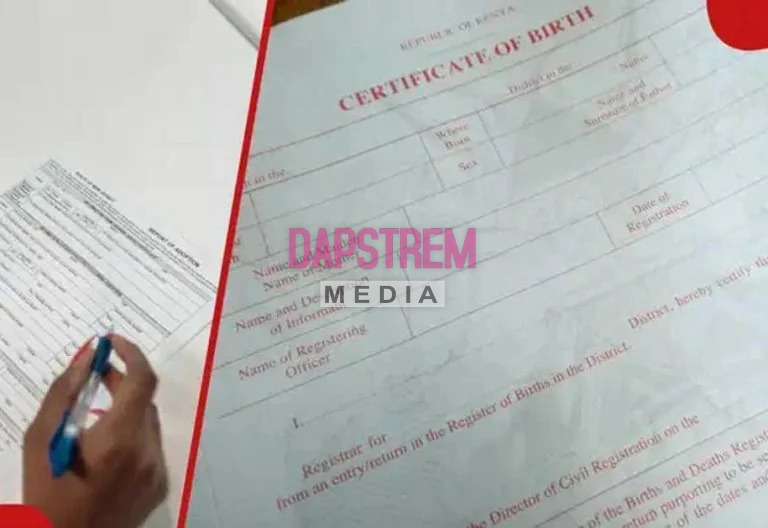
Govt Warns Mothers Against Omitting Fathers’ Names From Children’s Birth Certificates, Issues New Guidelines
The Kenyan government has issued fresh guidance to mothers registering their children’s births, warning them against making decisions that could complicate their children’s official identity records in the future. The advisory, communicated through Huduma Kenya, focuses on the importance of providing accurate parental information when applying for birth certificates, particularly among teenage mothers and parents experiencing difficult family circumstances.
The clarification comes amid growing concerns over mistakes made during birth registration, including the omission of biological fathers’ details and the use of grandparents’ names instead of the actual parents. Authorities have warned that some of these decisions may appear convenient at the time but could create serious legal and administrative challenges when families later attempt to correct the records.
In a public engagement with Kenyans on Wednesday, November 18, 2026, Huduma Kenya officials explained the procedures available to underage mothers who want to register their children but do not have national identity cards.
The agency clarified that girls below the age of 18 do not need to possess national identity cards before initiating the birth registration process. Instead, they can provide their actual names to the medical personnel responsible for recording the birth.
The clarification is particularly important because some teenage mothers may feel pressured to use their parents’ identification details when registering their children. Others may decide to provide different names, believing they can correct the information once they become adults.
However, Huduma Kenya warned that using grandparents’ details in place of the biological parents could create complications that may eventually require court intervention.
The government wants parents to understand that a birth certificate is an important legal document that establishes a child’s identity and records essential information about their birth and parentage.
The advisory has therefore renewed discussions about responsible birth registration, parental responsibilities and the need to protect children’s rights regardless of the circumstances surrounding their birth.
Underage Mothers Do Not Need National Identity Cards to Register Children
One of the most important clarifications from Huduma Kenya concerns teenage mothers who have not attained the age of 18 and therefore do not possess national identity cards.
In Kenya, national identity cards are generally issued when citizens reach the age of 18. This requirement has sometimes created confusion among young mothers who want to obtain official birth documents for their children.
Some may believe that without an identity card, they cannot register their children using their actual names. Others may turn to their parents for assistance and end up providing their grandparents’ information instead.
Huduma Kenya has now clarified that this is unnecessary.
According to the agency, an underage mother only needs to provide her actual name to the nurse or doctor handling the birth registration information.
The mother can also provide the biological father’s details if she wishes to have them included in the registration process.
Once she attains the age of 18 and obtains her national identity card, she can proceed with the application for her child’s birth certificate using the appropriate documentation.
This guidance is intended to prevent young mothers from making decisions that could permanently complicate their children’s official records.
The government has emphasised that being below the legal age for obtaining a national identity card does not mean a girl should use another person’s identity when registering her child.
The clarification also recognises the challenges faced by teenage mothers, many of whom may be navigating parenthood, education and family responsibilities without sufficient financial or social support.
By allowing them to register births using their actual names, the government is providing a more straightforward route towards securing official identification documents for their children.
Why the Government Is Warning Against Using Grandparents’ Names
Another major concern raised by Huduma Kenya involves mothers who use their own parents’ details when registering their children.
In some families, teenage pregnancies can create difficult circumstances, particularly when young mothers fear criticism, rejection or embarrassment from relatives and the wider community.
Some may therefore decide to use their parents’ information when completing birth registration documents, believing that the arrangement can be changed once they become older or financially independent.
However, the government has warned against this practice because it could result in grandparents being officially recorded as the child’s biological parents.
Such an arrangement creates an inaccurate legal record that may affect the child’s identity and future documentation.
For example, a child whose grandmother is registered as the mother may later encounter difficulties when applying for other official documents or establishing their biological family relationships.
The same problem can arise when a grandfather is recorded as the biological father instead of the child’s actual father.
Huduma Kenya explained that correcting such information is not always a straightforward administrative exercise. Depending on the circumstances, the affected family may be required to seek a court order before the records can be amended.
This can involve legal expenses, additional documentation and lengthy procedures.
The agency therefore wants parents to avoid creating problems that could be prevented by providing accurate information from the beginning.
The warning is especially important for young mothers who may not fully understand the long-term consequences of the information entered during birth registration.
A birth certificate is not simply a document required for school admission. It forms part of a child’s permanent identity record, making accuracy essential from the beginning.
Mothers Can Leave the Father’s Details Blank if They Are Not Ready to Provide Them
While the government has encouraged accurate parental information, Huduma Kenya has also clarified that mothers are not necessarily required to provide the father’s details when registering a child’s birth.
This is an important distinction, particularly for women who may be dealing with separation, uncertainty over paternity or difficult relationships with the child’s father.
According to the agency, mothers who are unsure about providing the father’s information can leave that section blank during registration.
Where the father’s details are not provided, the relevant section on the printed birth certificate will appear as ‘xxxx’.
This arrangement allows mothers to obtain birth certificates for their children without being forced to provide information they are not ready or able to confirm.
It also provides an opportunity to add the father’s details later through the appropriate registration process.
The clarification is particularly relevant for teenage mothers who may not be in a stable relationship with the biological father or may not have access to his personal information.
However, leaving the father’s section blank should not be confused with deliberately providing false information or using another person’s details.
The government’s central message is that parents should provide accurate information and avoid using names that do not reflect the child’s actual biological identity.
The arrangement also demonstrates that birth registration should not be delayed simply because the mother cannot provide every detail about the father.
Instead, the child can still obtain official documentation while the missing information is addressed through the appropriate procedures when necessary.
Government Warns That Incorrect Birth Records Could Lead to Court Proceedings
Huduma Kenya has particularly emphasised the potential legal consequences of providing incorrect parental information during birth registration.
According to the agency, correcting mistakes involving the identity of a child’s biological parents may require more than visiting a government office and requesting a change.
In some circumstances, families may have to pursue a court process to establish the correct information and obtain permission for amendments.
Such proceedings can be expensive and time-consuming, especially for parents who are already struggling financially.
The problem becomes more complicated when the child has grown older and has already used the birth certificate to obtain other official documents.
This is why the government is encouraging parents to take birth registration seriously and ensure that the information provided is accurate.
A decision made during a difficult family situation should not create unnecessary challenges for a child many years later.
The warning also highlights the importance of understanding the difference between correcting an administrative mistake and changing information that was deliberately entered incorrectly.
Where a parent has provided false details, the process of correcting the record may involve additional legal requirements.
Huduma Kenya’s advice is therefore intended to prevent parents from making decisions that could create long-term complications for their children.
Birth Certificates Play an Important Role in Children’s Future
The renewed government advisory has also highlighted the importance of birth certificates in accessing essential services and establishing a person’s legal identity.
In Kenya, a birth certificate is one of the most important documents a child can possess.
It records essential information, including the child’s name, date and place of birth, as well as parental details where provided.
As children grow older, the document becomes important when accessing several government and private services.
It is commonly required during school admission, national examination registration and applications for national identity cards.
It can also be important when applying for passports, scholarships and other opportunities that require proof of identity.
Accurate parental information may also become relevant in matters involving inheritance, family relationships and legal responsibilities.
When incorrect information is entered into the birth register, the consequences may extend beyond the immediate process of obtaining the certificate.
For example, a child whose biological parent is incorrectly recorded may later face difficulties establishing family relationships when handling legal or administrative matters.
Such challenges can become particularly difficult when the people whose details were incorrectly recorded are no longer alive or available to assist with the correction process.
This makes accurate birth registration an important responsibility for parents and government officials.
The government is therefore urging families to consider the long-term interests of children rather than making decisions based solely on temporary family circumstances.
Previous Court Ruling Highlights the Importance of Biological Identity
The government’s latest advisory comes against the background of previous court disputes involving parental information recorded on children’s birth certificates.
In one notable case, the High Court allowed a Kisumu man to have his name removed from a child’s birth certificate after two independent DNA tests established that he was not the biological father.
The case involved a nine-year-old child whose mother had initially registered the man’s name as the father.
The man later questioned his paternity and sought legal intervention after obtaining DNA results showing that he was not biologically related to the child.
Justice Roselyn Aburili ruled that the man’s name should be removed from the birth certificate and directed the relevant authorities to issue a corrected document.
In her ruling, the judge emphasised that children have a right to know their biological parents and that decisions concerning their identity must prioritise their welfare.
The court also highlighted the importance of ensuring that information recorded in official documents is truthful and accurate.
The case demonstrated that disputes involving parental identity can have serious legal consequences for both parents and children.
It also reinforced the principle that a birth certificate should not contain misleading information about a child’s biological parentage.
The judgment is particularly relevant to the latest Huduma Kenya advisory because it demonstrates why parents should exercise caution when providing information during birth registration.
Kenya Law+1
Teenage Pregnancy Remains a Concern in Kenya
The government guidance also comes amid continuing concerns about teenage pregnancies and the challenges faced by young mothers across the country.
According to figures cited in the recent reports, approximately 11.9 per cent of girls aged between 15 and 19 had experienced pregnancy as of November 2026.
Teenage pregnancy continues to raise concerns about education, healthcare, economic opportunities and the protection of young girls.
For some teenage mothers, giving birth comes with additional difficulties, including family rejection, financial dependence and uncertainty about the future.
Others may face complicated relationships with the biological fathers of their children, making decisions about birth registration particularly challenging.
Some young mothers may also lack the necessary information about government registration procedures and the legal consequences of providing incorrect details.
The latest clarification from Huduma Kenya is therefore important because it addresses some of the practical challenges experienced by underage mothers.
By confirming that girls below 18 can register their children using their actual names without national identity cards, the government has provided an important clarification.
It also sends a message that teenage mothers should not be forced to use their parents’ identities or delay registering their children because they lack identification documents.
However, addressing birth registration challenges alone will not solve the wider problem of teenage pregnancy.
There is still a need for stronger support systems, access to reproductive health information, protection of young girls and opportunities for teenage mothers to continue their education.
The government and relevant institutions must ensure that young mothers receive the assistance they need while protecting the rights and identities of their children.
What Parents Should Do When They Need to Correct Birth Certificate Details
Huduma Kenya’s clarification has also renewed attention on the procedures available to parents who discover mistakes or missing information in their children’s birth records.
Parents who want to include a father’s name that was previously omitted can approach the relevant birth registrar for assistance.
In a separate clarification issued on November 16, 2026, Huduma Kenya explained that both parents are at liberty to visit the birth registrar at the Deputy County Commissioner’s or chief’s office to have missing paternal details added.
However, the agency did not provide a complete list of documents, applicable charges or the procedure where one parent refuses to cooperate.
Parents are therefore encouraged to seek guidance from the relevant civil registration office before beginning the amendment process.
Where the issue involves incorrect parental identities or disputed paternity, additional evidence and legal procedures may be necessary.
The most important consideration is ensuring that the information eventually entered into the official record is accurate and supported by the required documentation.
The government’s latest warning highlights the importance of accurate birth registration and the long-term consequences of providing incorrect parental information.
Through Huduma Kenya, authorities have clarified that teenage mothers do not need national identity cards to register their children and should use their actual names instead of those of their parents.
The agency has also explained that mothers can leave the father’s details blank where necessary, with an opportunity to add the information later through the appropriate process.
The central message is that parents should avoid making decisions that could complicate their children’s legal identity and future documentation.
As Kenya continues improving access to government services, ensuring accurate birth records remains an important responsibility.
Ultimately, children should not have to face unnecessary legal and administrative challenges because of decisions made during difficult family circumstances.