Machakos University Lecturers Resume Strike Over Seven-Year CBA Dispute, Threaten Legal Action
Lecturers at Machakos University have resumed protests over a long-running dispute with the institution’s management, accusing the administration of failing to address employment grievances linked to a Collective Bargaining Agreement (CBA) covering the 2017–2021 period.
The renewed industrial action has intensified pressure on the university’s leadership to address concerns over delayed CBA implementation, staff allowances, alleged unequal treatment of employees and working conditions. The lecturers have warned that they could pursue legal action if the issues remain unresolved.
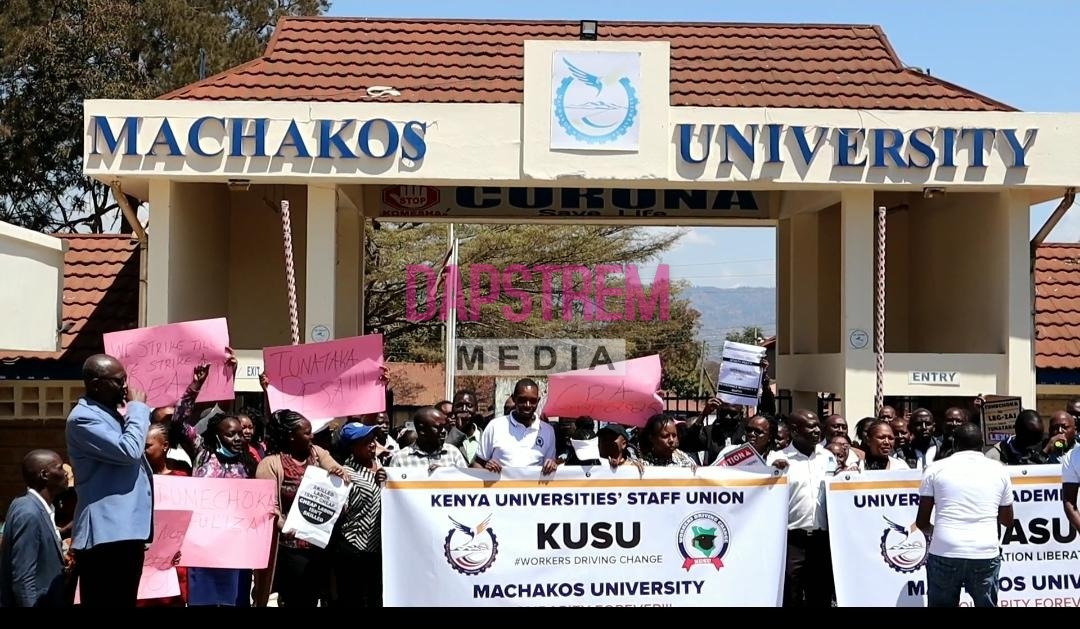
The protests, held on Thursday, October 22, 2026, were led by members of the Universities Academic Staff Union (UASU), Machakos University chapter, who say their concerns have persisted for years without a satisfactory resolution.
At the centre of the dispute is the implementation and conclusion of negotiations surrounding the university’s local CBA for 2017–2021. Union officials argue that staff signed the institution’s first internal agreement in 2018 after being assured that outstanding concerns would be addressed later.
However, the lecturers say the anticipated discussions did not produce the results they expected, leaving them frustrated over the handling of their employment terms.
UASU Machakos branch Secretary-General Martin Kasina accused the university of paying different responsibility allowances to employees performing similar duties. He argued that staff members with comparable job descriptions should receive fair and consistent compensation.
The union has called on the university’s management to intervene urgently, warning that continued delays could force lecturers to seek legal remedies.
The dispute adds to the pressure facing Kenya’s public universities, where lecturers and other academic staff have raised concerns over outstanding employment agreements, remuneration and the financial arrangements governing higher education.
The latest protests also come amid a wider nationwide lecturers’ strike over the 2025–2029 CBA and other outstanding commitments. Although the national dispute and the local Machakos University agreement are separate matters, both have contributed to uncertainty across the higher education sector.
For students, the renewed protests raise concerns about the continuity of lectures, academic schedules and the completion of university programmes. For lecturers, the dispute has become a question of whether agreements made with institutional management will be implemented and whether employees performing similar responsibilities will receive equitable treatment.
Lecturers question seven-year delay in resolving the local CBA
The history of the dispute dates back to the introduction of Machakos University’s first internal Collective Bargaining Agreement.
According to UASU Machakos branch coordinating secretary Mary Amajuang, the agreement was signed in 2018 after staff were asked to accept the initial arrangement without raising substantial concerns, on the understanding that unresolved matters would be discussed at a later stage.
Amajuang said lecturers believed management would provide an opportunity to revisit the outstanding issues affecting the 2017–2021 agreement.
She explained that employees accepted the initial arrangement because they understood it to be the institution’s first internal CBA and expected further engagement to address matters that had not been fully negotiated.
However, the union maintains that the promised discussions did not materialise as expected. The lecturers now want management to address the outstanding matters and bring the dispute to a conclusion.
The seven-year period referenced in the dispute reflects the 2017–2021 agreement and the prolonged concerns surrounding its implementation and resolution. It does not mean that the same agreement covers the university’s current employment arrangements in their entirety.
The disagreement highlights the importance of clear communication and follow-through when employers negotiate agreements with their staff. Collective bargaining is intended to provide a structured process through which employees and management can agree on working conditions, remuneration and other employment-related matters.
When outstanding issues remain unresolved, employees may lose confidence in the negotiation process. This can create tension between workers and management, particularly when staff believe they have waited for years for commitments to be honoured.
For the lecturers, the central concern is that matters they expected to be addressed after the 2018 agreement remain unresolved. They want the university to provide clarity on the status of the local CBA and establish a credible path towards resolving the outstanding grievances.
The university’s administration will therefore face pressure to explain how the agreement has been handled, which matters remain outstanding and what steps can be taken to reach a settlement.
A structured engagement involving management and union representatives could help identify the areas of disagreement and establish a timetable for addressing them. Such discussions would also provide an opportunity to clarify which issues require financial commitments, administrative changes or further negotiations.
The dispute demonstrates how unresolved workplace matters can persist when the parties do not reach a mutually acceptable conclusion. It also underscores the importance of ensuring that agreements are followed by practical implementation rather than being left open to prolonged disagreement.
Unequal allowances emerge as a major point of contention
Differences in responsibility allowances have emerged as one of the most prominent grievances raised by the lecturers.
During Thursday’s protests, Kasina questioned why Heads of Departments (HoDs) carrying out similar duties and operating under comparable job descriptions were allegedly receiving different responsibility allowances.
The union argues that employees undertaking equivalent responsibilities should be treated fairly and that the university should explain any differences in compensation.
Responsibility allowances are payments associated with particular duties or additional responsibilities assigned to an employee. In a university setting, such responsibilities may include overseeing academic departments, coordinating teaching activities, managing staff and students, and handling administrative tasks beyond ordinary teaching duties.
The lecturers’ concern is that differences in these payments may not adequately reflect the responsibilities being performed. They want management to review the arrangements and address what they consider unequal treatment.
The allegations have placed salary administration and internal employment policies at the centre of the dispute. However, the claims remain the union’s position, and a detailed public explanation from the university establishing the basis for the differences had not been provided in the report.
Resolving the matter would require the university to examine the relevant employment terms, the duties assigned to individual staff members and the criteria used to determine responsibility allowances.
Management may also need to clarify whether differences arise from variations in job responsibilities, contractual arrangements or other recognised considerations. Transparent explanations could help determine whether the differences are justified or require adjustment.
For lecturers, the issue extends beyond the actual amount paid. It also concerns fairness, consistency and confidence in the institution’s employment policies.
Employees are more likely to trust workplace systems when compensation arrangements are clearly explained and consistently applied. Where staff believe comparable work attracts different benefits without a satisfactory explanation, dissatisfaction can spread and undermine working relationships.
The union’s demand for action therefore places an obligation on management to engage with the concerns rather than allow the dispute to deepen.
If the parties can agree on transparent criteria for determining responsibility allowances, the outcome could help prevent similar disputes in the future. Clear policies would also provide staff with a basis for understanding how their duties and compensation relate to one another.
Union warns management could face legal action
The lecturers have warned that they may pursue legal action if the university fails to address their grievances.
The warning signals an escalation in the dispute, moving pressure beyond protests and into the possibility of formal legal proceedings.
UASU representatives have called for urgent intervention from the university’s leadership, arguing that the outstanding matters cannot continue indefinitely without a clear resolution.
Kenya Universities Staff Union (KUSU) Machakos branch secretary Sylvanus Mukai also urged the administration to address the concerns raised by employees. He warned that continued inaction could worsen the situation.
The unions’ position is that management needs to engage directly with the affected staff and provide a meaningful response to the issues they have presented.
Legal action could provide a formal avenue for determining the parties’ obligations if negotiations fail. However, the lecturers’ warning does not mean a court case has already been filed or that a court has ruled in their favour.
Any proceedings would depend on the specific claims presented, the relevant employment agreements and the legal remedies sought by the union or affected employees.
Before such a stage, the university and union representatives still have an opportunity to pursue dialogue. A negotiated settlement could help address the concerns while limiting further disruption to university operations.
The administration’s response will therefore be important in determining whether the dispute moves towards a negotiated agreement or becomes a more prolonged legal and industrial relations battle.
The university has acknowledged receiving a petition from the union in a related report published on October 21. The administration said the matters raised would receive attention through established university governance structures and appealed for patience as it reviewed the concerns.
That response provides an indication that the petition has reached the institution, although the lecturers’ renewed protests show that the dispute remains unresolved.
Staff workload adds to concerns over working conditions
The local CBA dispute has also been accompanied by broader concerns about the working conditions of academic staff at Machakos University.
In a related petition reported on October 21, the UASU chapter raised concerns about what it described as a shortage of academic staff and excessive workloads. The union claimed that some lecturers were handling classes with between 200 and 800 students per unit without adequate teaching assistants or marking support.
The union argued that these conditions were placing significant pressure on lecturers and called for additional recruitment to address staffing gaps.
It also raised concerns about adherence to student-to-lecturer ratios prescribed by the Commission for University Education.
These claims are separate from the dispute over the 2017–2021 local CBA, but they illustrate the wider employment concerns being raised by the union at the institution.
Large classes can increase the demands placed on lecturers, particularly when they must prepare lessons, deliver instruction, mark assignments, assess examinations and provide academic guidance to students.
Where teaching assistants and other support staff are limited, lecturers may have less time to provide individual feedback or attend to students who require additional assistance.
The union says addressing staffing levels is necessary to improve working conditions and support the delivery of quality university education.
Recruiting additional academic staff, where justified by enrolment and workload assessments, could help distribute teaching responsibilities more evenly. Providing appropriate marking and administrative support could also ease pressure on existing employees.
However, recruitment and staffing decisions require financial planning and compliance with institutional procedures. The university would need to assess its staffing needs, available resources and the academic requirements of different departments.
The concerns highlight the connection between staff welfare and students’ learning experiences. Employment disputes may begin with questions about remuneration or contractual obligations, but unresolved working conditions can also affect the broader environment in which teaching and learning take place.
For this reason, the university’s response will need to consider the different concerns raised by staff rather than treating the dispute as a disagreement over allowances alone.
Dispute unfolds amid nationwide lecturers’ strike
The renewed protests at Machakos University come during a wider dispute involving university lecturers and the government over the 2025–2029 Collective Bargaining Agreement.
Lecturers represented by UASU and other unions began nationwide industrial action on October 2, 2026, following disagreements over the implementation and financing of the new agreement.
The national dispute includes concerns about remuneration, allowances and other employment benefits. Union officials have argued that the proposed financial allocation is insufficient to meet the terms they are seeking, while the government has called for an agreement that universities can sustain financially.
The Higher Education Principal Secretary, Beatrice Inyangala, urged lecturers to return to class on October 17 as negotiations continued. She said the government had paid KSh18.6 billion over two years towards obligations inherited from previous administrations and maintained that it remained committed to dialogue.
Inyangala also argued that any agreement needed to balance lecturers’ welfare with the financial capacity of universities and the government.
The nationwide dispute and the local Machakos University disagreement should not be confused. The 2025–2029 CBA is a separate agreement from the institution’s 2017–2021 local CBA, although both disputes involve concerns about employment terms and the implementation of agreements.
Their overlap, however, creates additional pressure on university management and national education authorities. Institutions must address local employment grievances while the wider sector continues to negotiate the financial and administrative arrangements governing academic staff.
The situation also raises questions about how universities can maintain stable academic programmes when industrial disputes remain unresolved.
A lasting solution will require clear communication between the government, university managements and staff unions. Each party will need to explain its position, identify areas of agreement and establish a practical process for resolving outstanding matters.
For Machakos University, the immediate challenge is to address the grievances raised by its lecturers while navigating the broader uncertainty affecting public universities.
Students face uncertainty as the dispute continues
The renewed protests have raised concerns about the potential impact on students enrolled at Machakos University.
University students depend on regular teaching schedules to complete coursework, undertake assessments and progress through their academic programmes. When lecturers withdraw their services, students may face uncertainty over lectures, examination dates and other academic activities.
The effects can be particularly difficult for students approaching the end of their programmes. Delays may affect their plans for graduation, job applications, internships and other opportunities that depend on completing their studies within a particular period.
Students who live away from their families may also face additional accommodation, food and transport expenses if academic calendars are disrupted.
However, the extent of the impact on Machakos University’s academic schedule will depend on how the renewed protests affect teaching and how quickly the dispute is resolved. The available report does not establish a comprehensive list of cancelled classes or examinations.
The situation nevertheless highlights why industrial disputes in higher education require timely attention. Lecturers have a legitimate interest in fair employment conditions, while students need reliable access to the education for which they have enrolled.
These interests do not necessarily have to conflict. Resolving employment grievances can help create a more stable teaching environment, while effective communication can help students understand what to expect during periods of uncertainty.
University management and student representatives may need to communicate any changes to academic activities clearly and provide updated information about the resumption of normal teaching.
Students should also follow official university communications rather than rely solely on rumours about the strike or the status of examinations.
Ultimately, students are among those most directly affected when negotiations between staff and management fail to produce a timely settlement. Their concerns make it even more important for the parties to pursue a credible resolution.
What happens next?
The next phase of the Machakos University dispute will depend on how management responds to the lecturers’ demands and whether the parties can agree on a process for addressing the outstanding issues.
The university will need to consider the concerns surrounding the 2017–2021 local CBA, responsibility allowances, staff welfare and alleged unequal treatment. It will also face calls to respond to the staffing and workload concerns raised in the union’s related petition.
A clear timetable for engagement could help restore confidence in the process. The parties could identify the issues requiring immediate attention, determine which matters need further negotiation and establish how progress will be communicated to employees.
Where financial commitments are involved, management may need to assess the resources available and explain the steps required to implement any agreed changes. Where the dispute concerns employment policies or differences in allowances, a transparent review could help establish the facts and identify appropriate remedies.
The threat of legal action adds urgency to the negotiations. If the union concludes that internal engagement has failed, it may seek formal intervention through the appropriate legal channels. For now, however, the central demand remains that the university address the grievances and provide a meaningful response.
The administration’s acknowledgement of the petition suggests that the issues have entered the institution’s formal governance process. The challenge will be to translate that acknowledgement into substantive engagement and a settlement acceptable to the parties.
The renewed protests also serve as a reminder that collective bargaining agreements require more than signatures. They depend on clear commitments, effective implementation and mechanisms for resolving disagreements when they arise.
For lecturers, the dispute concerns the treatment of staff and the fulfilment of employment commitments. For university management, it presents an opportunity to demonstrate how institutional grievances can be handled transparently and through established procedures. For students, a resolution could help reduce uncertainty surrounding their academic programmes.
As pressure mounts, the priority will be to prevent the disagreement from becoming more prolonged. A negotiated solution would offer the parties a path towards restoring working relations and strengthening confidence in the university’s employment processes.
Machakos University lecturers have made clear that they want the longstanding CBA dispute and related workplace grievances addressed. Whether the matter ends through dialogue or proceeds to legal action will depend on the response from management and the willingness of both sides to reach a practical agreement.
For now, the dispute remains unresolved, leaving the university’s leadership under pressure to respond as Kenya’s wider public university sector continues to grapple with industrial unrest.