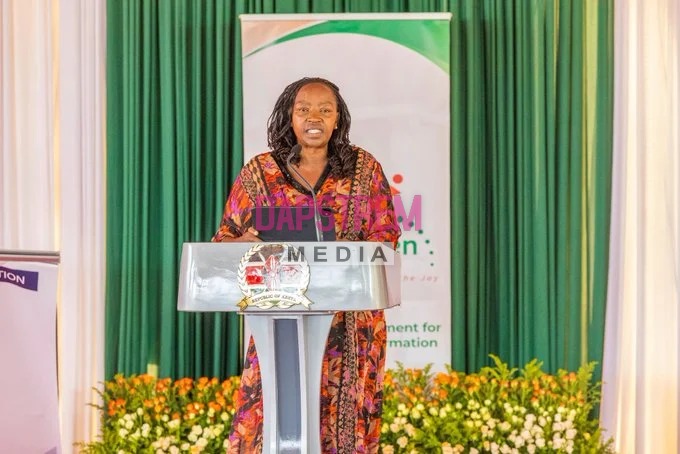
Kiharu Member of Parliament and People’s Party of Kenya leader Ndindi Nyoro has renewed his criticism of the government’s handling of Kenya Pipeline Company (KPC) shares, alleging that a transaction involving state-linked institutions exposed pensioners’ money to avoidable losses while benefiting a private investor.
In a statement issued on Wednesday, October 21, 2026, Nyoro alleged that senior executives of public institutions were pressured to purchase shares during KPC’s initial public offering (IPO) before being instructed to sell their holdings to an unidentified investor.
The legislator claimed that the institutions collectively disposed of approximately 4.5 billion shares for between KSh9.02 and KSh9.36 per share, raising about KSh42 billion.
He further alleged that the shares were sold with dividend entitlements attached, potentially increasing the benefits accruing to the buyer. He argued that brokerage fees and the opportunity cost of holding the investments meant that the public institutions could have earned better returns elsewhere.
The allegations have placed renewed scrutiny on the management of public pension investments, the identity of KPC’s major shareholders and the government’s wider privatisation programme.
However, the claims of political interference, forged board minutes and links between the unidentified investor and President William Ruto remain allegations that require independent verification. The financial impact on the institutions concerned must also be established through transaction records and investment performance data.
How the KPC share transaction unfolded
The controversy centres on a major ownership transfer involving Kenya’s state-linked petroleum pipeline operator, Kenya Pipeline Company.
KPC launched its IPO on January 19, 2026, offering 1.8 billion shares at KSh9 each. The offer closed on February 24, and the company began trading on the Nairobi Securities Exchange (NSE) on March 9. The government reported that the IPO attracted applications for 12.49 billion shares, representing an oversubscription rate of 105.7 per cent.
The initial sale was part of the government’s broader plan to reduce its direct ownership of state enterprises and raise money for infrastructure development.
However, the IPO subsequently became controversial over the role played by public institutions in purchasing shares and the extent to which private investors participated.
A report by Business Daily published on October 19 said unidentified investors had transferred 4.5 billion KPC shares worth KSh42.5 billion, equivalent to 24.76 per cent of the company’s issued share capital. A follow-up report published on October 20 said at least eight state-linked institutions had sold shares to a foreign institutional investor.
The size of the transfer has raised questions about how the ownership of a recently listed strategic company changed so quickly after its IPO.
The transaction also falls just below the 25 per cent threshold that, according to the published reports, would have triggered Capital Markets Authority approval. That detail has intensified calls for clarity on the transaction’s structure, the parties involved and the applicable disclosure requirements.
Pension funds at the centre of the dispute
Nyoro’s principal concern is the involvement of public institutions responsible for managing savings and other assets on behalf of workers, retirees and public beneficiaries.
Among the institutions identified in reporting on the IPO are the National Social Security Fund (NSSF), the Public Service Superannuation Scheme, the County Workers Pension Fund and the Unclaimed Financial Assets Authority.
Business Daily reported in August that NSSF had invested approximately KSh38.5 billion in the IPO, while the Public Service Pension Scheme invested about KSh13 billion. The County Workers Pension Fund and the Unclaimed Financial Assets Authority also participated.
These investments are significant because pension funds are expected to manage beneficiaries’ money in accordance with their investment mandates, risk limits and long-term financial objectives.
Nyoro alleges that executives were pressured into making the initial investments despite professional advice against them. He further claims that board minutes were forged or backdated to justify the purchases.
Those are serious allegations. Publicly available reporting establishes that the institutions participated in the IPO and that a large block of shares subsequently changed hands. It does not, by itself, establish that individual executives were coerced, that minutes were falsified or that the investments breached the institutions’ legal obligations.
Resolving the dispute would require examining board records, investment committee recommendations, internal risk assessments, transaction instructions and the institutions’ subsequent financial returns.
Did the pension funds actually make a loss?
The question of whether pensioners lost money is central to the dispute, but it requires a closer examination of the numbers.
Nyoro says the institutions sold their shares at prices ranging from KSh9.02 to KSh9.36, compared with the IPO price of KSh9. The MP argues that brokerage charges of about 1.5 per cent, inflation and the time value of money should be included when calculating the returns.
On the face of these figures, the shares were sold above their original KSh9 IPO price. That does not automatically establish that the funds made an adequate return, but neither does it establish an accounting loss.
The distinction matters because an investment can generate a nominal profit while delivering a weak inflation-adjusted return. However, opportunity cost is not the same as a realised financial loss, and a comparison with bank deposits would require evidence of the returns that could actually have been earned over the same period.
The reported KPC figures also indicate that the company declared a dividend of KSh0.32 per share for the financial year ended June 2026, with eligibility based on the shareholder register in November. Whether the institutions involved in the transaction were entitled to that dividend depends on the precise transaction terms and relevant dates.
Consequently, a conclusive assessment would require institution-by-institution calculations covering purchase costs, sale proceeds, brokerage fees, dividends and holding periods.
Why the identity of the buyer matters
The transaction’s reported size has also raised questions about beneficial ownership.
Although the share transfer was reported as involving a foreign institutional investor, the buyer’s ultimate identity was not publicly established in the initial reporting. Business Daily noted that market participants had struggled to identify the parties behind the transaction.
Nyoro alleges that the buyer has private interests linked to President Ruto and has questioned the investment bank involved in executing the transaction.
These allegations have not been independently established by the available reporting. No conclusion should be drawn about the buyer’s ownership or any relationship with the President without documentary evidence.
The transaction was reportedly executed through Rock Investment Bank, with KCB Investment Bank representing a client. These are distinct roles in a securities transaction and do not, on their own, establish who ultimately owns the shares or who benefits financially from the purchase.
Government defends the transaction
President Ruto has defended the transfer as evidence of growing investor confidence in Kenya’s capital markets and a step towards mobilising private capital for strategic infrastructure.
Speaking during the Mashujaa Day celebrations in Eldoret on October 20, the President said private investors had acquired a 25 per cent stake in KPC from public entities. He argued that the development would strengthen the energy sector, attract investment and create economic opportunities.
The government’s broader privatisation programme is intended to unlock capital tied up in state-owned assets and reduce reliance on conventional borrowing and taxation to finance infrastructure.
The original KPC IPO raised approximately KSh106 billion, with the proceeds directed towards the government’s infrastructure-financing plans. Official figures showed that the government retained a 35 per cent stake in the company following the IPO.
From the government’s perspective, the subsequent transfer of shares to private investors represents a change in ownership rather than necessarily a loss to the public.
However, the government’s defence of private investment does not resolve Nyoro’s specific allegations about how public institutions were directed to invest or whether the subsequent sales delivered appropriate returns.
Those questions require separate scrutiny from the broader policy debate over privatisation.
Nyoro’s earlier suspension from Parliament
The dispute has already spilled into Parliament.
On October 7, National Assembly Speaker Moses Wetang’ula suspended Nyoro from the precincts of Parliament for five sitting days after the legislator declined to apologise or withdraw his claims that public institutions had been pressured to invest in the KPC IPO.
During the parliamentary proceedings, lawmakers demanded that Nyoro substantiate his allegations. Majority Leader Kimani Ichung’wah cited figures which he said showed that the Public Service Pension Scheme had recorded a 5.1 per cent gain on its KPC investment as of June 30, 2026.
Nyoro rejected calls to apologise, maintaining that he was raising legitimate concerns about the management of pensioners’ money and political interference in public institutions.
The reported gain cited in Parliament is relevant, but it does not necessarily settle the question of the institutions’ returns on shares sold later. The calculation would need to account for the relevant dates, the shares sold, any dividends and the actual proceeds received.
The episode highlights the tension between parliamentary accountability and the requirement that serious allegations made in the House be supported by evidence.
Ndindi Nyoro’s allegations have placed the KPC share transfer at the centre of a wider debate over public accountability, pension security and the government’s privatisation agenda.
The reported sale of 4.5 billion shares worth approximately KSh42.5 billion is a substantial ownership transfer involving a strategic national infrastructure company. Its scale makes transparency about the parties, the transaction terms and the institutions’ financial outcomes important.
But the distinction between an allegation and an established finding remains essential. The available reporting supports the existence of the share transfer and confirms the participation of public institutions in the earlier IPO. It does not independently prove that pensioners suffered a realised loss, that executives were coerced or that the buyer was linked to the President.
The central issue now is whether the transaction can withstand independent financial and regulatory scrutiny. Clear documentation of the institutions’ investment decisions, sale proceeds, fees, dividends and the buyer’s beneficial ownership would allow Kenyans to assess the claims on evidence rather than political assertions.