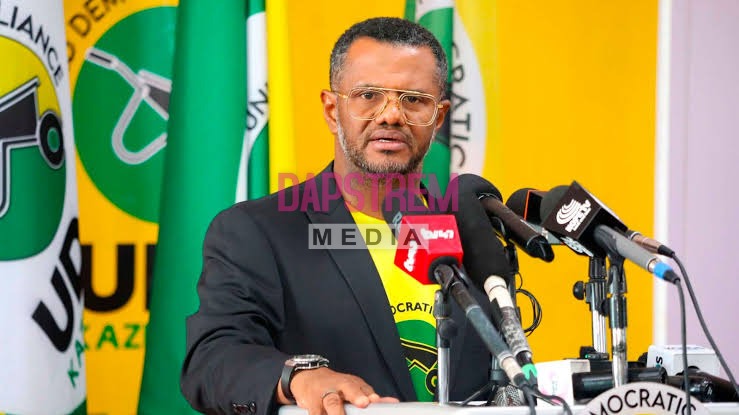
The son of controversial Kenyan preacher Paul Nthenge Mackenzie has recounted a childhood marked by forced fasting, physical abuse and strict religious control, revealing the personal experiences that led him to distance himself from his father’s religious movement.
Dan Mackenzie made the revelations following the conviction of his father and 28 co-accused over the deaths of 191 people in the Shakahola tragedy, describing himself as a victim of the teachings that preceded one of Kenya’s most devastating cases of religious extremism.
Speaking outside the Mombasa High Court on Monday, October 19, Dan recalled being forced to go without food for an entire week when he was 12 years old. He also alleged that church members beat him for nearly three hours after he refused to attend a religious service.
“I was forced when I was young, when I was 12, to fast for a whole week,” he said, according to Citizen Digital and Daily Nation.
Dan said the punishment was part of the pressure he experienced while growing up within the Good News International Church, the religious movement led by his father.
His account offers a personal perspective on the environment surrounding Mackenzie’s movement, which became the focus of national and international attention after hundreds of bodies were discovered in Shakahola Forest in Kilifi County in 2023.
A childhood shaped by religious control
Dan said his experiences began when he was still a child and expected to comply with the church’s teachings and demands.
He recalled resisting the requirement to attend religious services and being punished by members of the church for refusing to obey.
According to his account, the beating lasted almost three hours. He also said he was stripped naked during the incident, describing treatment that went far beyond what he considered acceptable religious discipline.
Dan identified Smart Mwakalama, a senior figure associated with Mackenzie’s ministry, among those he alleged participated in the beating.
The allegations were reported following the court judgment but are distinct from the murder convictions delivered against Mackenzie and his co-accused.
His account highlights the experiences of children raised within the movement and the consequences, as he describes them, of challenging its rules.
The forced fasting he recalls also echoes one of the central issues in the Shakahola murder trial: the use of extreme religious teachings to persuade followers to abstain from food until they died.
However, Dan’s personal account should be distinguished from the specific evidence and findings considered by the court in determining criminal responsibility for the deaths.
Falling out with his father
Dan said his refusal to follow the church’s teachings eventually damaged his relationship with his father.
Rather than continue trying to persuade him to conform, Mackenzie eventually told him he was on his own, according to his account.
The breakdown in their relationship left Dan to find a way to support himself while still young. He said he left school in Class Seven and turned to motorcycle taxi riding in Malindi to earn a living.
The experience marked a turning point in his life, taking him away from the religious environment in which he had grown up.
Dan said he remained in Malindi, where he continues to earn a living as a boda boda rider.
His decision to distance himself from the movement also shaped his reaction to the criminal case against his father. Rather than viewing the conviction simply through the lens of family ties, he said he felt relief for the victims and their relatives.
“I have been a victim too of what my father has been doing over there in Shakahola,” he said.
He added that he was glad he had not ended up in the forest, saying he had become tired of the teachings and practices associated with the movement.
Relief after the Shakahola convictions
Dan spoke after Justice Diana Kavedza-Mochache convicted Mackenzie and 28 co-accused of 191 counts of murder at the Mombasa Law Courts on October 19.
The convictions concerned the deaths of 190 children and one adult.
The court found that Mackenzie’s religious teachings had been used to organise and sustain a system in which followers were instructed to starve themselves and their children in the belief that they would meet Jesus.
Prosecutors presented evidence concerning the treatment of children, the role of those enforcing the fasting directives and efforts to prevent followers from escaping the system.
The court’s findings marked a major development in a case that began attracting nationwide attention in 2023, when authorities uncovered mass graves in Shakahola Forest.
More than 400 bodies have been exhumed from the wider site, although the murder convictions delivered on October 19 concerned the 191 victims covered by the charges in that case.
Mackenzie denied the murder charges during the proceedings. His conviction followed the court’s assessment of the evidence presented by the prosecution.
For Dan, the judgment represented relief after years of painful experiences associated with his father’s movement.
He said the ruling brought a measure of justice to families who had lost relatives and expressed sympathy for those affected by the tragedy.
“It’s a relief… justice has happened to the victims,” he said, according to Citizen Digital.
Five younger siblings rescued
Dan also revealed that five of his younger siblings had been rescued and placed in a children’s rescue centre.
The development is particularly significant because it shows that concerns about the treatment of children connected to the movement continued even after the Shakahola deaths came to light.
In a report published on October 20, the BBC, carried by The Star, reported that Dan had alerted police to concerns about children staying at his grandmother’s home.
He said eight children, including his five younger siblings, were rescued after he raised the alarm.
Dan further alleged that some of the children had recently been denied food for nearly three days as part of enforced fasting.
The account raises concerns about the continuing vulnerability of children who may remain exposed to extreme religious practices outside the original Shakahola site.
Dan said he hoped his younger siblings would be able to rebuild their lives away from the environment in which they had grown up.
He also described the difficult decision to report family members when he believed the children were at risk.
His actions illustrate the complicated position of relatives who must choose between family loyalty and seeking intervention to protect children.
The rescue of the minors places renewed attention on the need for child-protection authorities to investigate reports of forced fasting, neglect and abuse, particularly where children may be unable to seek help independently.
A painful break from the past
Despite his relationship with Mackenzie, Dan said he did not feel sadness over his father’s conviction. He maintained that he had not participated in the crimes and welcomed the judgment as a step towards justice.
He also recalled that his father had accused him of betrayal, a claim Dan said he did not understand.
His position reflects the complicated experience of relatives whose family relationships have been overtaken by a criminal case involving mass loss of life.
While Mackenzie’s conviction addresses criminal responsibility for the 191 deaths before the court, Dan’s account draws attention to the experiences of those who left the movement or survived its teachings.
The case also raises questions about the support available to children who have been exposed to prolonged fasting, physical punishment, educational deprivation and family separation.
For Dan, the court ruling was a moment of relief, but his concerns now extend to the future of his younger siblings and the families still dealing with the consequences of Shakahola.
As the case moves towards sentencing, his testimony offers a reminder that the tragedy’s impact is not limited to those who died in the forest. It also lives on in the experiences of survivors, children who were rescued and families attempting to recover from the loss and suffering associated with the movement.