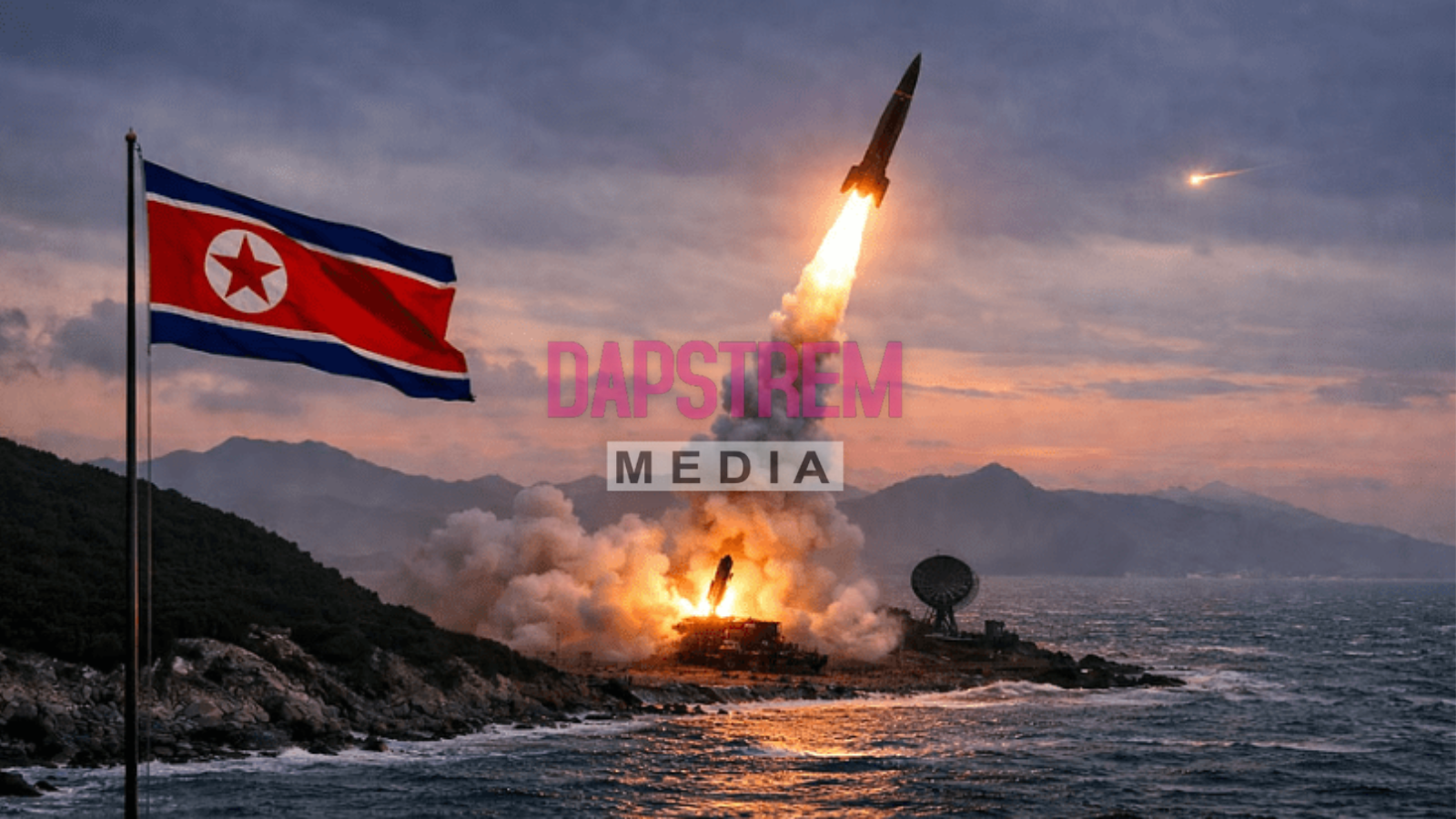
North Korea fired several ballistic missiles towards the Sea of Japan on Monday, prompting heightened military surveillance in South Korea and renewed concern over security in East Asia, as tensions between Pyongyang and Seoul continue to rise over competing weapons tests and a disputed landmine incident along their heavily fortified border.
South Korea’s Joint Chiefs of Staff (JCS) said it detected multiple ballistic missiles launched from the area around the North Korean capital, Pyongyang, at approximately 9:20 a.m. local time. At least one missile travelled more than 900 kilometres (559 miles) before landing in the sea, according to South Korean military officials.
Japan separately confirmed that it had detected at least two suspected ballistic missiles launched from North Korea. Japanese officials said the projectiles landed in waters outside the country’s exclusive economic zone, with no immediate reports of damage to aircraft or vessels.
The launches mark another episode in North Korea’s accelerating weapons-testing programme and come amid a prolonged diplomatic stalemate over its nuclear arsenal. They also follow a recent South Korean test of a domestically developed hypersonic weapon, raising concerns that military competition between the two Koreas is entering a more technologically advanced phase.
According to the Associated Press and other news reports, South Korean authorities have increased surveillance for possible additional launches and are sharing information with the United States and Japan. Seoul’s presidential security office has also called on Pyongyang to halt its repeated missile launches, describing them as violations of United Nations Security Council resolutions.
Missile launches raise fresh security concerns
Details released by Japanese authorities suggest that at least two missiles were fired approximately 17 minutes apart.
Japan’s Defence Ministry reported that the first missile travelled about 220 kilometres, while the second flew more than 910 kilometres. The second projectile reportedly followed an irregular flight path, a characteristic that Japanese officials are examining as part of a joint assessment with the United States and South Korea.
South Korea has not publicly specified the total number of missiles detected or released a complete assessment of their technical characteristics. Officials are continuing to analyse the launches to establish the types of weapons involved, their flight trajectories and their potential operational significance.
The difference in the reported flight distances suggests that the launches may have involved missiles with different performance characteristics. However, the available information does not establish conclusively whether they represented a coordinated test of different missile systems or served another military purpose.
The absence of reported damage does not eliminate the security implications. Repeated launches provide North Korea with opportunities to assess missile performance, refine targeting capabilities and examine how neighbouring countries detect and respond to its weapons.
Japan’s government instructed officials to gather and analyse information, communicate findings to the public and take precautions to protect aircraft, vessels and other assets. Tokyo also lodged a protest against Pyongyang through diplomatic channels in Beijing, according to reports published on Monday.
A possible response to South Korea’s hypersonic missile test
The latest North Korean launches come only days after South Korea publicly demonstrated its own developing hypersonic weapons capability.
On October 8, South Korean President Lee Jae Myung oversaw the country’s first test-firing of a domestically developed hypersonic missile. His administration described the programme as an important step towards strengthening South Korea’s independent defence capabilities.
Hypersonic weapons generally refer to systems capable of travelling at speeds of at least Mach 5, or five times the speed of sound. Some are designed to manoeuvre during flight, potentially making their trajectories more difficult for conventional missile-defence systems to predict and intercept.
North Korea has also been pursuing weapons intended to complicate regional missile defences. On October 3, Pyongyang tested what it described as a hypersonic intermediate-range missile designed to evade defensive systems in South Korea and Japan.
South Korean military spokesperson Jang Do-young said the latest launches could have been intended partly as a response to Seoul’s hypersonic weapons test, while also advancing North Korea’s missile technology.
The timing has fuelled concerns that the two countries are increasingly using weapons demonstrations to signal resolve and discourage potential military action by their rivals.
Nevertheless, the precise motivation behind Monday’s launches remains uncertain. Although the sequence of tests supports the possibility of reciprocal signalling, it does not establish that South Korea’s demonstration was the sole reason for North Korea’s actions.
The developments highlight a broader challenge for regional security: as both sides invest in more sophisticated weapons, each may feel compelled to strengthen its capabilities in response to the other, potentially creating a cycle of military competition.
Landmine incident adds to the dispute between the two Koreas
The missile launches have also occurred against a backdrop of deteriorating relations following a landmine explosion near the Demilitarised Zone (DMZ), the heavily fortified border separating North and South Korea.
Three South Korean soldiers were injured in landmine explosions in September. A joint investigation by South Korean authorities and the United Nations Command concluded that two mines had been planted by North Korean forces approximately a year earlier.
Pyongyang has rejected the accusations and denied responsibility, accusing Seoul of attempting to blame it for an incident it did not cause.
The disagreement has intensified an already fragile security environment along the border, where even relatively small incidents can generate wider political and military consequences.
South Korea has demanded an apology, while North Korean officials have criticised Seoul’s statements and warned against what they regard as provocative conduct. The two governments remain deeply divided over responsibility for the incident and the conditions required to improve bilateral relations.
The latest missile tests therefore carry significance beyond their immediate military purpose. They demonstrate how disputes over border security, weapons development and political recognition are becoming intertwined, leaving fewer opportunities for confidence-building measures.
United States and Japan remain central to regional deterrence
South Korea’s security relationship with the United States remains central to its response to North Korea’s weapons programme. Washington maintains a military presence in South Korea and works with Seoul to strengthen deterrence against a potential attack.
Japan is also a critical part of the regional security equation. Its proximity to North Korea makes it vulnerable to missile threats, while its military and intelligence cooperation with Washington and Seoul provides an important mechanism for tracking launches and coordinating responses.
Information-sharing among the three countries is particularly important when missiles travel on unusual trajectories or display characteristics that could complicate interception.
North Korea’s weapons programme has long been a source of international concern because the country is developing both nuclear warheads and the ballistic missiles that could potentially deliver them. Its continued missile activity has drawn condemnation from governments and international institutions, with United Nations Security Council resolutions restricting North Korea’s ballistic missile-related activities.
However, translating international condemnation into effective pressure has proved difficult. Differences among major powers over sanctions, diplomacy and regional security have complicated efforts to achieve a unified approach towards Pyongyang.
North Korea, meanwhile, has continued to portray its military development as essential to national defence and deterrence against what it describes as hostile policies by the United States and its allies.
Nuclear diplomacy remains stalled
Monday’s launches come amid a prolonged breakdown in negotiations aimed at limiting North Korea’s nuclear weapons programme.
Diplomatic efforts between North Korean leader Kim Jong Un and US President Donald Trump collapsed in 2019, when a summit in Hanoi ended without an agreement on sanctions relief and denuclearisation.
Since then, North Korea has continued expanding and diversifying its military capabilities while taking an increasingly confrontational position towards South Korea.
Kim’s government has resisted renewed diplomatic initiatives from Washington and Seoul, insisting that the United States abandon what Pyongyang describes as its hostile policy. North Korea has also rejected denuclearisation as a precondition for negotiations.
For South Korean President Lee, who has expressed interest in restoring dialogue, the situation presents a difficult balancing act. His administration must maintain military readiness and reassure the public about national security while seeking opportunities to reduce tensions.
The challenge is that efforts to strengthen conventional defences can be interpreted by Pyongyang as hostile, while attempts at diplomatic engagement may produce limited results without a willingness to compromise on fundamental disagreements.
The latest missile launches offer no immediate indication that either side is prepared to change course.
What the launches mean for regional stability
North Korea’s latest weapons demonstration underscores three major concerns for East Asian security.
First, continued missile development could improve Pyongyang’s ability to threaten targets across the region. Longer-range systems and weapons capable of manoeuvring during flight may complicate the calculations of neighbouring countries and increase the demands placed on their missile-defence networks.
Second, reciprocal weapons tests risk reinforcing a cycle of military competition. As North Korea develops new capabilities, South Korea and its allies have incentives to improve their own systems, potentially prompting further demonstrations by Pyongyang.
Third, the absence of sustained diplomatic engagement increases the risk that military incidents will be interpreted through the lens of mutual suspicion. Without reliable communication channels, even a test intended primarily as a political signal could contribute to a more serious confrontation if it coincides with a border incident or heightened military alert.
These risks do not mean that conflict is inevitable. Missile launches can serve several purposes, including weapons development, military training and political signalling. Determining their precise significance requires technical assessments and consideration of the wider political context.
Nevertheless, the combination of North Korea’s expanding arsenal, South Korea’s countermeasures and the continuing breakdown in diplomacy creates a persistent source of instability.
International attention turns to Pyongyang’s next move
As South Korean, Japanese and American officials continue examining Monday’s launches, attention is likely to focus on whether North Korea conducts additional tests and whether Pyongyang provides further information about the weapons involved.
South Korea has said it is maintaining heightened military readiness and strengthening surveillance against possible additional launches. Japan has similarly emphasised monitoring and precautionary measures to protect civilian and military assets.
For now, there are no confirmed reports of damage from the missiles, and the available evidence does not establish that the launches were intended to initiate a military confrontation.
The wider implications, however, remain significant. Each test adds to the pressure on regional governments to improve their defences while preserving the possibility of diplomacy.
North Korea’s latest launches illustrate the difficulty of managing a security environment in which military deterrence and political mistrust increasingly reinforce each other. Unless the parties find ways to restore meaningful communication, the Korean Peninsula is likely to remain vulnerable to further weapons demonstrations and recurring periods of heightened tension.
The immediate question is whether Monday’s launches will remain an isolated episode in the ongoing competition between the two Koreas or become another step in a broader escalation that makes diplomatic engagement even harder to achieve.