Liverpool’s meeting with Manchester City at Anfield on Sunday, 11 October 2026, ended in a commanding 3–0 victory for City a result that handed the visitors an emphatic statement win and left Liverpool searching for answers after a difficult afternoon at home.
The scoreline tells a clear story of City’s success, but the wider significance lies in the psychological and tactical implications of such a decisive result between two clubs whose rivalry has helped define the modern Premier League. At Anfield, Liverpool are accustomed to turning home support into an advantage. This time, however, City left with all three points and a clean sheet.
A contest transformed by one controversial decision
For much of the first hour, the match was far more competitive than the final score suggests. Liverpool and City traded spells of possession, and Liverpool showed enough attacking intent to suggest that the contest could go either way.
City had the greater share of the ball, eventually recording 63 per cent possession, but Liverpool also created opportunities. The home side registered six shots on target compared with City’s four, according to The Guardian’s match statistics. That contrast helps explain why the scoreline was not simply a reflection of one team dominating every phase of play.
The match’s decisive moment arrived in the 62nd minute.
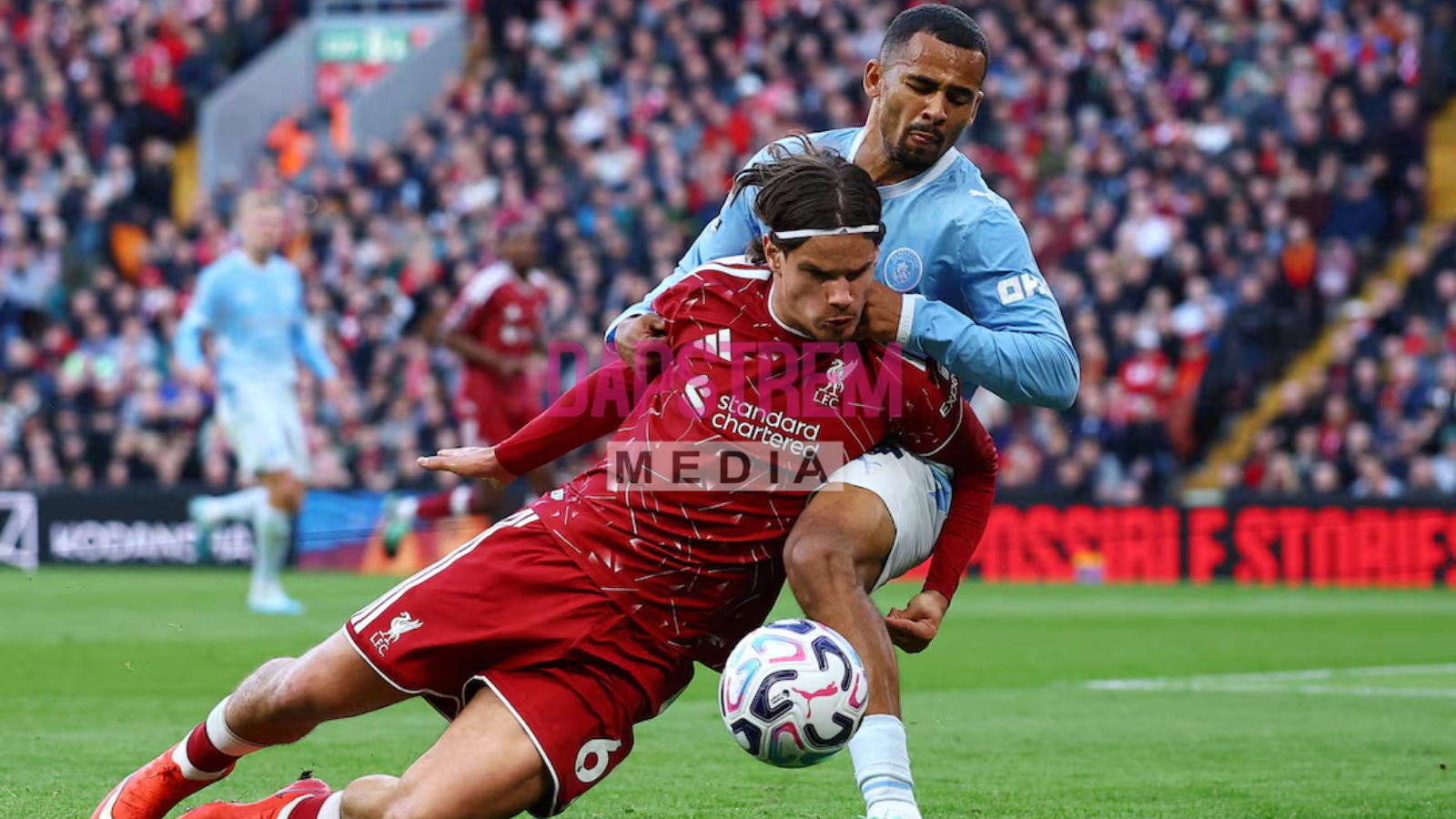
Liverpool midfielder Ryan Gravenberch, who had impressed during the contest, received a second yellow card for a challenge on Jérémy Doku. Referee Chris Kavanagh sent him off, leaving Liverpool to face the league leaders with ten men.
The decision immediately changed the balance of the game. Liverpool lost a midfielder who had helped them compete in the centre of the pitch, while City gained the space and numerical advantage they needed to take control.
The dismissal also became one of the match’s major talking points. Former Liverpool defender Jamie Carragher criticised the decision, describing the sending-off as a shocking call in his analysis for Sky Sports. Other observers questioned the bookings, ensuring that the referee’s intervention would remain part of the post-match debate.
Haaland strikes, and City take command
The breakthrough came just three minutes after Gravenberch’s dismissal. Doku helped drive the attack forward, and Antoine Semenyo’s involvement created the opening for Haaland to finish decisively past Alisson. The Norwegian striker gave City the lead at the moment Liverpool could least afford to concede.
The goal was more than a change on the scoreboard. It rewarded City’s patience and showed how quickly a finely balanced match can turn when one side has an extra player.
Before the dismissal, Liverpool had been able to disrupt City’s rhythm and threaten when opportunities appeared. Afterwards, the visitors could stretch the pitch, move the ball more freely and force Liverpool’s remaining players into increasingly difficult defensive decisions.
For Haaland, the goal underlined his value as City’s central attacking threat. He did not need a succession of chances to change the match; he needed one clear opening.
Cherki adds a spectacular finish
City completed the scoring with a superbly constructed team move. Josko Gvardiol’s back-heel helped release Cherki, who created space against the recovering Liverpool defence before finishing.
Cherki’s goal was the perfect conclusion to City’s afternoon. Rather than settling for a controlled victory, the visitors produced another attack that combined clever movement with individual quality.
At 3–0, the result was beyond doubt. The goal also demonstrated that City’s success was not solely about exploiting the extra man: their attacking players continued to execute with confidence and imagination when opportunities presented themselves.
The three goals arrived within 13 minutes of one another, turning a contest that had been goalless at half-time into a comprehensive away victory.
Beyond the scoreline: a victory played under intense scrutiny
City’s victory carried significance beyond the three points. The match was their first since an independent commission delivered guilty verdicts against the club on more than 100 charges relating to Premier League financial-rule breaches. Manchester City maintain their innocence and have appealed the verdicts, according to The Guardian’s match report.
The issue followed the visitors to Anfield, where sections of the home crowd directed chants and taunts at City. Yet the visitors appeared able to shut out the hostility and concentrate on the football.
That composure became a defining feature of the afternoon. City had to navigate a tense atmosphere and a competitive opening period before capitalising on the decisive moment. Their response suggested a team comfortable with the pressure surrounding the club, at least on the pitch.
For Liverpool, the circumstances were different. Manager Andoni Iraola was without several important attacking options, including Alexander Isak and Cody Gakpo, while Dominik Szoboszlai was also unavailable. Lewis Koumas was selected to lead the attack in his first Premier League start, according to Liverpool’s official match report.
Those absences provide context for Liverpool’s difficulties but do not erase the central problem: the team lost control of the contest at the moment it could least afford to do so.
What the result means for both clubs
For City manager Enzo Maresca, this was a major test successfully passed. His team returned from the international break with a sixth consecutive league victory, maintaining its perfect start to the season. The win also moved City three points clear of second-placed Arsenal after six matches, according to the Premier League’s analysis of Sunday’s fixtures.
The performance offered three particularly encouraging signs for City:
Attacking depth: Doku’s introduction changed the pace of the game and gave City an additional source of danger.
Clinical finishing: Haaland converted the decisive opening, while Doku and Cherki supplied two memorable finishes.
Mental composure: City remained patient during a difficult first half and took advantage of the opportunity when it arrived.
Liverpool, meanwhile, must examine both the red card and the team’s response to it. Gravenberch’s dismissal was pivotal, but the speed with which City scored twice afterwards raises questions about Liverpool’s defensive organisation when forced to play with ten men.
The absence of key forwards also highlights the importance of squad depth. Against opponents of City’s quality, injuries can narrow a manager’s options, making discipline, defensive structure and efficient use of possession even more important.
Liverpool 0–3 Manchester City was a match decided by a controversial turning point and completed by outstanding attacking quality.
For an hour, Liverpool competed in a contest that remained open and offered relatively few clear chances. Then Gravenberch’s dismissal changed the conditions, Haaland broke the deadlock, Doku delivered a superb second goal and Cherki capped the performance with a brilliant team move.
It would be simplistic to argue that the red card tells the entire story. City still had to exploit their advantage, and they did so with the confidence and precision of a side enjoying a remarkable start to the campaign.
For Liverpool, the defeat is a warning about how quickly a high-level contest can unravel. For City, it is a statement of intent: six wins from six, three goals at Anfield and another demonstration of their capacity to turn pressure into results.
The final score will be remembered as a comfortable City victory. The deeper lesson is that the game remained finely balanced until one moment changed everything and Manchester City were ruthless enough to ensure Liverpool never recovered.