Manchester United produced a breathtaking comeback to defeat AS Roma 3–2 at Old Trafford on Tuesday night, transforming what appeared to be another miserable evening into one of the most memorable performances of their troubled season.
Two goals down inside the opening 17 minutes, booed by their own supporters at half-time and seemingly heading towards another damaging defeat, United somehow found the character to turn the contest around.
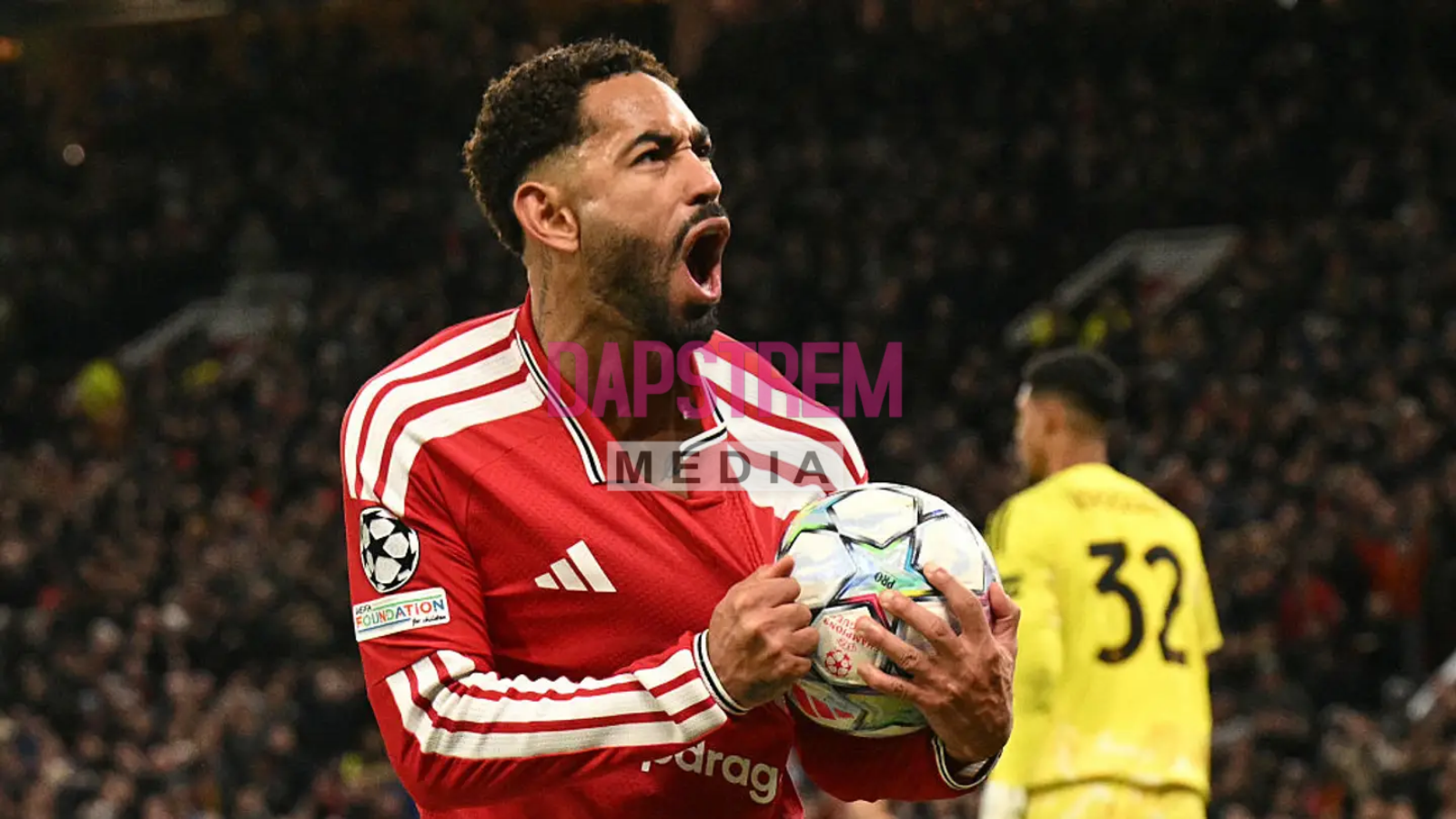
Matheus Cunha was the undisputed hero, scoring twice in the closing stages to complete an extraordinary turnaround. Captain Bruno Fernandes had earlier reignited the home side’s hopes with a penalty, while teenage substitute Shea Lacey provided the decisive assist for Cunha’s winning goal.
There was, however, a dramatic twist. Cunha was sent off in stoppage time after receiving a second yellow card, leaving United to negotiate a tense finish with ten men.
For manager Michael Carrick, it was a precious victory that ended a nine-game winless run. For Roma, it was a painful collapse after appearing to have the match firmly under control.
The atmosphere at Old Trafford carried an unmistakable tension before kick-off. United desperately needed a positive result, but Roma arrived with confidence and an opportunity to exploit a side struggling for consistency.
The Italian visitors needed just 11 minutes to expose United’s defensive organisation.
After winning possession, Rodrigo Mora delivered an intelligent diagonal pass that found Matías Soulé in space. The Argentine forward took advantage of the opportunity, finishing beyond goalkeeper Senne Lammens to give Roma the lead.
It was a poorly defended situation for United, whose defensive line struggled to deal with Roma’s movement and attacking transitions.
The situation deteriorated six minutes later.
Soulé again found space in dangerous territory, and his effort struck the arm of young defender Ayden Heaven. The referee pointed to the penalty spot, giving Roma an opportunity to extend their advantage.
Donyell Malen stepped forward and confidently sent Lammens the wrong way.
At 2–0 after just 17 minutes, United were staring at another damaging European night.
Roma’s attacking approach was working exceptionally well. Gian Piero Gasperini’s side exploited the spaces left by United’s advancing full-backs, particularly down the right-hand attacking channel.
United struggled to maintain possession, lacked defensive compactness and appeared short of confidence whenever Roma moved forward.
Malen nearly added another before the interval, forcing Lammens into an important save.
At the other end, United offered little attacking threat. Fernandes appeared increasingly frustrated, while the home supporters made their dissatisfaction clear.
The half-time whistle arrived with Roma comfortably ahead and United facing serious questions.
Whatever Carrick said during the interval, his players returned with a completely different level of urgency.
United were more aggressive in possession, pressed higher and began moving the ball into dangerous areas rather than relying on speculative efforts from distance.
Their comeback started with an opportunity that changed the entire atmosphere inside Old Trafford.
Matheus Cunha was brought down in the penalty area by Gianluca Mancini, and the referee awarded United a penalty.
Fernandes initially saw his effort saved by Roma goalkeeper Devis Vásquez, who was making his competitive debut for the Italian club.
However, the penalty had to be retaken following an infringement by a Roma player.
Given a second opportunity, Fernandes made no mistake, sending the ball into the top-left corner in the 58th minute.
Suddenly, Old Trafford had life again.
The goal gave United something they had desperately lacked in the opening half: belief.
Moments later, Bryan Mbeumo came agonisingly close to equalising. Released into space by Cunha, the forward beat the goalkeeper, but his effort struck both posts before bouncing away.
It was an extraordinary moment that captured the intensity of United’s revival.
Roma, who had dominated the opening 45 minutes, were now struggling to escape their own half.
United continued to attack, with Harry Maguire threatening from a header and the home side creating increasing pressure through crosses, corners and quick combinations around the penalty area.
The visitors were gradually losing their grip on the contest.
Cunha becomes the hero
With seven minutes of normal time remaining, United finally found the equaliser.
Fernandes delivered a dangerous ball into the penalty area. Roma defender Leonardo Balerdi failed to deal with it convincingly, allowing Cunha to find space and calmly finish past Vásquez.
At 2–2, Old Trafford erupted.
The comeback was now complete in spirit, but United were not finished.
Just three minutes later, teenage substitute Shea Lacey produced a moment of outstanding quality, finding Cunha with a superb pass.
The Brazilian forward surged into the attacking area and unleashed a powerful finish towards the goalkeeper’s near post.
Vásquez could not keep it out.
Manchester United had turned a 2–0 deficit into a 3–2 lead.
The celebrations that followed reflected the magnitude of the moment. Players and supporters shared in the excitement of a comeback that had seemed almost impossible at half-time.
Cunha had delivered when United needed him most.
His contribution was particularly significant because United had spent much of the evening looking short of attacking inspiration. His movement, determination and ability to create danger had given the team a focal point in the second half.
The most interesting aspect of the match was the dramatic difference between United’s first and second halves.
Carrick began with a 4-2-3-1 formation, using Kobbie Mainoo and Carlos Baleba in midfield, with Fernandes operating behind Cunha, Mbeumo and Amad Diallo.
The problem was not simply the formation. It was how United executed it.
Their full-backs pushed forward, leaving significant spaces behind them. Roma repeatedly exploited these areas, particularly through Soulé’s movement.
United’s defensive organisation was poor, and their midfield struggled to protect the back four.
After the interval, however, the home side became considerably more effective.
According to the match analysis published by GOAL, United registered ten second-half shots and generated 2.48 expected goals, compared with just 0.24 expected goals in the first half.
Even more revealing was Roma’s attacking decline: the visitors failed to register a single shot after half-time.
United also increased their activity in defensive duels, recording 14 second-half tackles compared with six in the opening period.
The numbers demonstrate how dramatically the balance of the match shifted.
Importantly, Carrick did not make wholesale tactical changes at half-time. Much of the improvement came from greater intensity, more effective forward movement and a willingness to attack the penalty area.
The introduction of Lacey also proved decisive, demonstrating the importance of young players in changing the momentum of difficult matches.