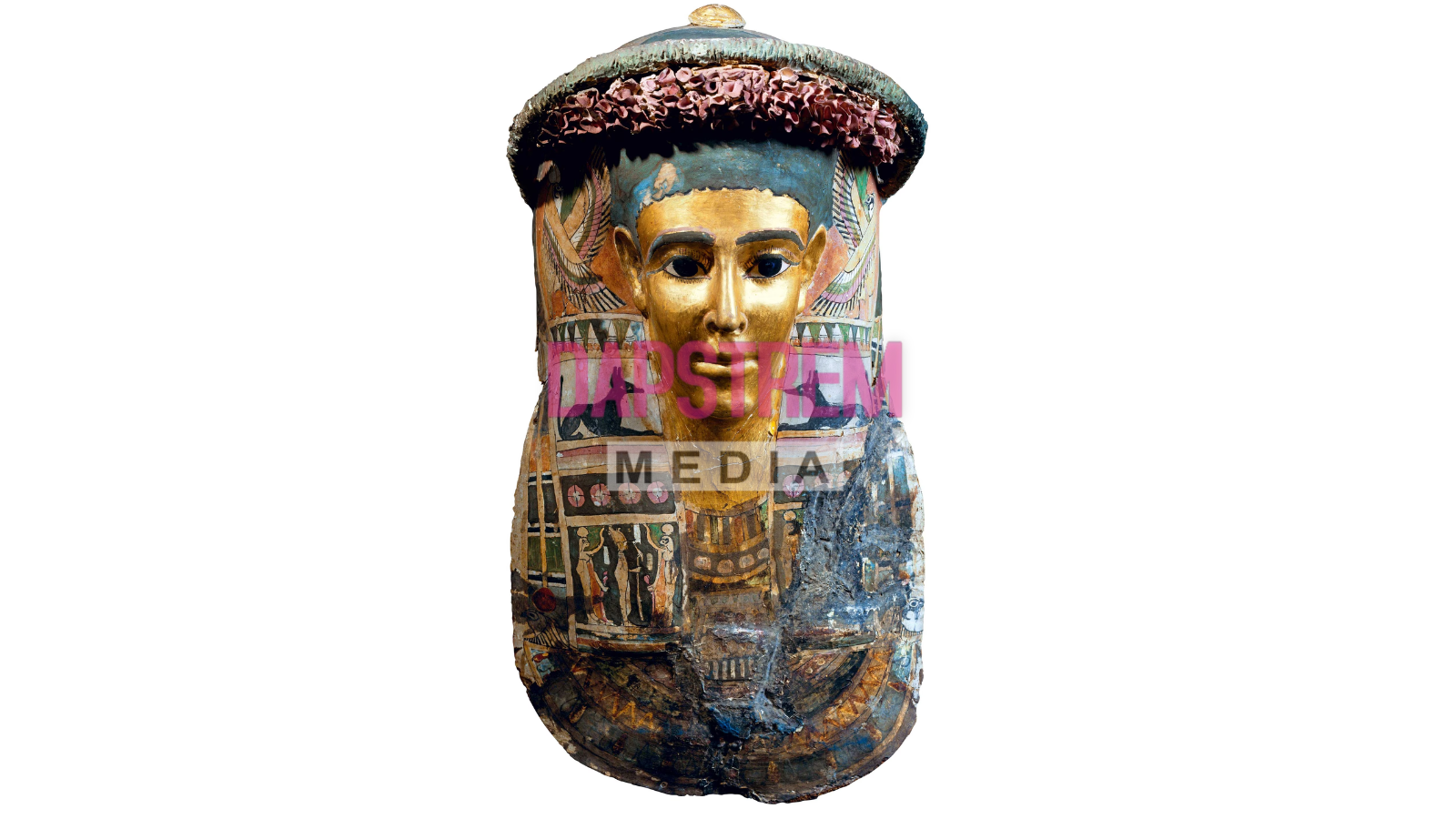
More than 2,000-year-old Egyptian mummy portraits, renowned for their remarkably lifelike faces and penetrating eyes, are set to take centre stage in a major exhibition in Rome, offering visitors a rare opportunity to encounter some of the most extraordinary surviving artworks of the ancient world.
The exhibition, titled The Power of Portraiture: Egypt and Rome – The Faces of Fayum, opens on November 5, 2026, at the Ara Pacis Museum and will run until May 2, 2027.
It brings together more than 110 historical objects, including nearly 50 painted mummy portraits, funerary masks, decorated shrouds, marble busts, plaster casts and ancient jewellery.
The exhibition is particularly significant because several of the Egyptian portraits are leaving the country’s museums for the first time, following an international conservation and loan agreement between Egypt and Italy.
Among the most anticipated exhibits is the recently restored Tondo of the Two Brothers, a rare second-century painting from the Egyptian Museum in Cairo that depicts two young men staring directly at the viewer.
The collection provides an extraordinary glimpse into the lives, identities and burial traditions of people who lived in Egypt during the period of Roman rule.
The mysterious faces of ancient Egypt
The portraits, commonly known as Fayum mummy portraits, are among the most celebrated examples of realistic painting from antiquity.
They were created between the first and third centuries AD, when Egypt was part of the Roman Empire.
Unlike conventional paintings, these portraits served a funerary purpose. Artists painted the faces of deceased individuals on thin wooden panels, which were subsequently placed over the faces of mummies and secured within their linen wrappings.
The portraits were intended to preserve the appearance and identity of the deceased for the afterlife.
Their extraordinary realism is what makes them particularly fascinating to modern audiences.
The paintings depict men, women and children with carefully rendered facial features, hairstyles, jewellery and clothing. Some subjects appear youthful, while others have visible wrinkles, facial hair and signs of ageing.
Their eyes are especially striking, often painted with remarkable detail that creates the impression that the subjects are looking directly at whoever stands before them.
The name Fayum comes from the Fayum region of Egypt, where many of these portraits were discovered, although similar examples have been excavated at other archaeological sites across the country.
Fewer than 1,000 examples are believed to survive worldwide, making the Rome exhibition an exceptional gathering of these fragile artworks.
A rare masterpiece leaves Egypt for the first time
One of the major attractions is the Tondo of the Two Brothers, a circular portrait dating to approximately the second century AD.
The artwork is unusual because it depicts two individuals rather than the single person typically represented in Fayum portraits.
The two young men are shown wearing clothing associated with the Greco-Roman world, while their facial expressions and carefully painted features demonstrate the sophistication of ancient portraiture.
The painting underwent a three-week restoration programme involving Egyptian and Italian conservation specialists before being prepared for its international exhibition.
According to Egypt’s Ministry of Tourism and Antiquities, the conservation work addressed deterioration affecting the wooden support and the painted surface.
Specialists also recovered important facial details, particularly those of the figure on the right.
The restoration included scientific examination of the painting, offering further insights into the techniques used by artists in Roman Egypt.
Claudio Parisi Presicce, one of the exhibition’s curators, described the work as an exceptional surviving example of ancient painting.
Its appearance in Rome represents a significant moment for the international exhibition of Egyptian cultural heritage.
A meeting of Egyptian, Greek and Roman cultures
Beyond their artistic beauty, the portraits reveal the multicultural character of Egypt during Roman rule.
Following the Roman conquest of Egypt in 30 BC, the country became a meeting point for Egyptian traditions, Greek artistic influences and Roman political and social customs.
This cultural interaction is clearly reflected in the portraits.
Many subjects have hairstyles, clothing and jewellery associated with Roman society, while their burial practices remained rooted in ancient Egyptian beliefs about death and the afterlife.
The paintings therefore offer more than representations of individual faces. They provide evidence of how people expressed their identities in a society shaped by different civilisations.
The exhibition explores this cultural exchange by presenting the portraits alongside Roman sculptures, Egyptian funerary objects and jewellery.
The Fayum portraits were primarily produced using two painting techniques: encaustic and tempera.
Encaustic involved mixing pigments with heated wax before applying them to wooden panels. The technique allowed artists to create rich colours, layered textures and realistic facial details.
Tempera, meanwhile, involved mixing pigments with a binding material, allowing artists to produce detailed images with a different surface appearance.
The wooden panels were sometimes only a few millimetres thick, making their survival over centuries particularly remarkable.
Egypt’s dry desert climate played a significant role in preserving the delicate paintings, textiles and other archaeological materials.
The portraits are among the few surviving examples of ancient panel painting, offering an important window into artistic traditions that have otherwise largely disappeared.
International museums contribute rare collections
The Rome exhibition draws on loans from several leading international institutions, including the Louvre in Paris, the Metropolitan Museum of Art in New York, the J. Paul Getty Museum in Los Angeles and the Landesmuseum Württemberg in Stuttgart.
One notable portrait is that of Isidora, a woman from the first century AD whose elaborate hairstyle and gold jewellery reflect her social standing.
Another highlight is the portrait of Eirene, preserved in the Stuttgart collection.
The exhibition also includes painted funerary shrouds, including an exceptionally preserved example depicting a man standing between his mummy and Anubis, the ancient Egyptian god associated with mummification and the journey into the afterlife.
These objects help visitors understand the broader funerary practices surrounding the portraits.
The exhibition is significant not only because of the rarity of the objects but also because it brings together artworks that are usually scattered across museums in different countries.
By displaying them alongside sculptures, jewellery and funerary artefacts, organisers hope to provide a more complete understanding of life, death and personal identity in Roman-era Egypt.
It also highlights the importance of international cooperation in conserving archaeological heritage.
For Egypt, the temporary loans represent an opportunity to introduce important parts of its cultural history to an international audience while demonstrating the value of scientific restoration and museum collaboration.
For visitors, the experience offers something unusual: the opportunity to look into the faces of people who lived nearly two millennia ago and encounter expressions that remain remarkably familiar.
As the exhibition prepares to open in Rome, the ancient portraits are once again demonstrating their enduring artistic power.