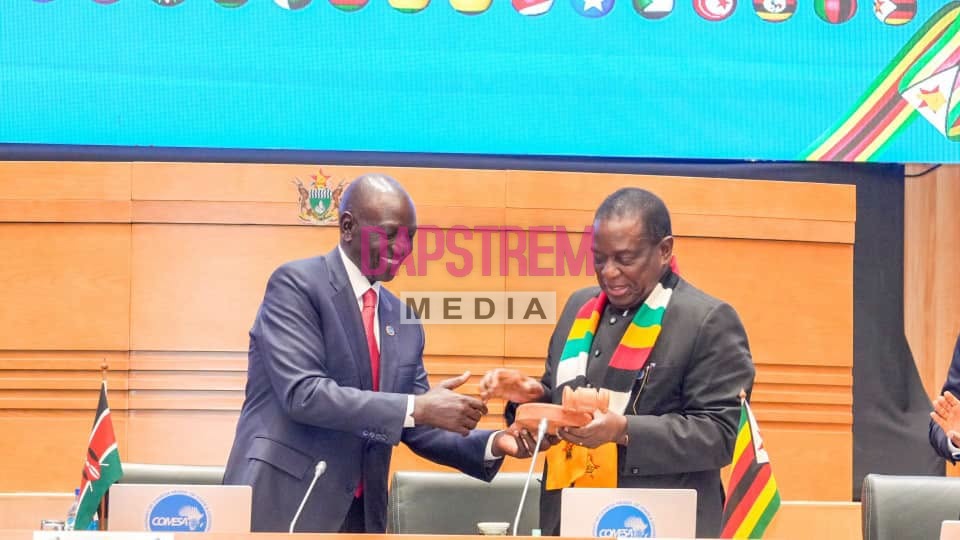
Ruto Hands Over COMESA Chairmanship as Bloc Targets 15 Per Cent Trade by 2030
President William Ruto has officially handed over the chairmanship of the Common Market for Eastern and Southern Africa (COMESA) to Zimbabwean President Emmerson Mnangagwa, marking the end of Kenya’s leadership of the regional economic bloc and the beginning of a new phase in efforts to strengthen trade and economic integration across Eastern and Southern Africa.
The handover took place on Thursday, October 22, 2026, during the 25th COMESA Summit of Heads of State and Government in Harare, Zimbabwe. The transition comes as the bloc seeks to increase trade among its member states to 15 per cent of total trade by 2030, an ambitious target that will require stronger cooperation, fewer trade barriers and improved movement of goods and services across national borders.
Ruto assumed the COMESA chairmanship in October 2025 during the bloc’s 24th summit in Nairobi, succeeding Burundi’s President Évariste Ndayishimiye. His tenure placed Kenya at the centre of regional discussions on economic integration, digital trade, industrialisation and the need for African countries to expand commerce among themselves.
During the Harare summit, Ruto congratulated Mnangagwa on assuming leadership and pledged to support his efforts to advance the organisation’s objectives. The Kenyan President also emphasised the need for member states to turn the region’s economic potential into tangible benefits for businesses, workers and ordinary citizens.
The leadership transition comes at a crucial moment for COMESA, which brings together 21 member states with a combined population of nearly 700 million people and a gross domestic product exceeding $1 trillion. Despite this substantial market, countries in the bloc continue to conduct much of their trade with economies outside the region rather than with their neighbours.
The challenge facing the new leadership is therefore not simply to increase trade figures but to make regional economic integration more practical, affordable and beneficial to the people who depend on cross-border commerce for their livelihoods.
COMESA sets an ambitious trade target
One of the most significant developments at the summit was the launch of the COMESA Medium-Term Strategic Plan for 2026–2030, which sets out the bloc’s priorities for the next five years.
The plan targets increasing intra-COMESA trade to 15 per cent of the region’s total trade by 2030. It seeks to strengthen economic cooperation, expand regional markets and create conditions that allow businesses to operate more efficiently across borders.
The target reflects a longstanding challenge facing African economies. Although countries across the continent produce a wide range of agricultural products, manufactured goods, minerals and services, trade between African countries remains limited compared with their commercial relationships with the rest of the world.
Ruto highlighted this imbalance during his address, noting that COMESA represents a substantial economic market but still trades far more with external partners than its member states trade among themselves.
Increasing intra-regional trade could help countries reduce their dependence on distant markets while creating new opportunities for local manufacturers, farmers, transporters and service providers.
For example, a Kenyan manufacturer could expand sales by supplying products to consumers in Uganda, Zambia, Zimbabwe or other COMESA markets. Agricultural producers could find additional buyers for their produce, while logistics companies could benefit from increased demand for transportation and warehousing services.
However, the existence of a large regional market does not automatically translate into increased trade. Businesses need reliable transport networks, predictable regulations, affordable financing and efficient customs procedures to compete effectively across national borders.
The success of the 2030 target will therefore depend on how quickly member states implement agreed policies and address the obstacles that continue to make regional commerce expensive and complicated.
What Ruto’s chairmanship leaves behind
Kenya’s year at the helm of COMESA provided an opportunity to push discussions on regional integration and the use of technology to improve trade.
When Ruto assumed the chairmanship in Nairobi in October 2025, he called for member states to embrace digital technology as a way of accelerating regional integration and strengthening value chains.
The broader objective was to ensure that African economies move beyond exporting raw materials and importing finished products at higher prices. Instead, countries should cooperate in processing resources, manufacturing goods and developing industries that create jobs and retain more economic value within the region.
This approach is particularly important for economies that depend heavily on agricultural exports and mineral resources. Rather than exporting raw commodities alone, countries can benefit from processing them locally, developing manufacturing capacity and supplying finished or semi-finished products to neighbouring markets.
For Kenya, regional integration provides opportunities to expand markets for agricultural produce, manufactured goods, financial services, technology and professional expertise.
Kenyan businesses already operate in several neighbouring economies, while the country’s transport, financial and communications sectors support commercial activity across the wider region. A more integrated COMESA market could create additional opportunities for firms seeking to expand beyond the domestic economy.
Nevertheless, regional leadership is a collective responsibility. The chairperson can provide direction, encourage dialogue and promote implementation, but individual governments must take the necessary steps to remove obstacles within their own jurisdictions.
Ruto’s departure from the chairmanship does not mean Kenya will stop participating in COMESA affairs. According to the summit report, he will continue serving as rapporteur, while Zambia’s President Hakainde Hichilema was named vice-chairperson of the new COMESA Bureau.
Kenya will therefore remain involved in regional discussions as the organisation moves into its next phase under Zimbabwe’s leadership.
Trade barriers remain a major obstacle
One of the main challenges confronting COMESA is the continued presence of non-tariff barriers that make cross-border trade difficult even where countries have committed to reducing tariffs.
Non-tariff barriers can include excessive paperwork, inconsistent product standards, lengthy border checks, complicated licensing requirements and administrative restrictions that delay the movement of goods.
For a business transporting perishable agricultural products, delays at border posts can result in losses if goods spoil before reaching the market. Transporters may also incur additional costs when trucks remain in queues for extended periods.
Small businesses are particularly vulnerable because they often have limited financial resources to absorb unexpected expenses. A large company may be able to maintain additional stock or employ specialists to handle complex regulations, but a small trader may struggle to meet the costs associated with delays and repeated inspections.
Ruto urged member states to remove non-tariff barriers and deepen trade liberalisation, arguing that regional commerce must become easier and more affordable if the bloc is to meet its 2030 target.
Removing such barriers would help businesses plan deliveries more accurately, reduce transport costs and improve the competitiveness of locally produced goods.
However, the process requires cooperation among governments, customs agencies, standards authorities and other institutions responsible for regulating trade.
Countries must also ensure that efforts to simplify border procedures do not compromise legitimate public interests, including product safety, consumer protection, revenue collection and the prevention of illegal trade.
The goal is to establish efficient and predictable procedures that protect these interests without creating unnecessary obstacles for legitimate businesses.
Digital trade could transform regional commerce
Digitalisation is another major priority in COMESA’s efforts to improve economic integration.
Technology can help reduce paperwork, improve the exchange of information between customs authorities and make it easier for traders to complete documentation before goods arrive at border points.
Electronic certificates of origin, digital cargo-tracking systems, online reporting mechanisms for trade barriers and national single-window platforms can help streamline procedures and reduce delays.
Certificates of origin are important because they help establish where goods were produced and whether they qualify for preferential treatment under relevant trade arrangements.
When such documents are processed efficiently, eligible businesses can benefit from reduced tariffs and avoid unnecessary administrative delays. Digital systems can also improve transparency by making it easier to track applications and identify where a process has stalled.
Electronic cargo-tracking systems can help authorities monitor shipments as they move between countries, while integrated customs platforms can reduce the need for traders to submit the same information repeatedly to different agencies.
For small and medium-sized enterprises, these improvements could make the difference between accessing regional markets and being excluded by the costs of compliance.
Digitalisation may also help governments identify recurring trade bottlenecks and develop targeted solutions based on reliable information.
However, technology must be supported by effective implementation. Digital systems will have limited impact if agencies continue demanding duplicate paper documents, if platforms are incompatible or if traders cannot access reliable internet services.
Governments must also invest in cybersecurity, staff training and technical support to ensure that digital trade infrastructure remains secure and dependable.
The broader objective is to make cross-border commerce less dependent on slow administrative processes and more responsive to the needs of modern businesses.
Improving transport, energy and digital connectivity
Trade cannot expand sustainably without reliable infrastructure connecting producers to markets.
Roads, railways, ports, border facilities and logistics centres play an important role in determining the cost of moving goods between countries. Poor infrastructure and unreliable transport services can make regional markets less attractive even when demand for products is strong.
Ruto called on member states to improve transport, digital and energy connectivity as part of efforts to lower the cost of doing business across borders.
Transport connectivity is particularly important for landlocked countries that depend on transit routes through neighbouring states to access seaports and international markets.
When transport corridors operate efficiently, businesses can move goods more quickly, reduce storage expenses and improve the reliability of deliveries. Better infrastructure can also support the movement of agricultural produce from rural production areas to regional markets.
Energy connectivity matters because manufacturing industries require dependable and affordable electricity. Businesses facing frequent power interruptions or high energy costs may struggle to compete with producers operating in countries with more reliable supplies.
Regional cooperation in energy infrastructure could help improve access to electricity and support industrial development, although projects require substantial investment, effective regulation and long-term coordination.
Digital connectivity is equally important. Businesses increasingly depend on online platforms for payments, communication, logistics management and access to market information.
Improved connectivity can help traders identify customers, compare prices and coordinate deliveries across national borders. It can also support the growth of digital services that do not require the physical transportation of goods.
For COMESA, the challenge is to ensure that these infrastructure investments complement one another. Efficient roads and border facilities will be less effective if customs systems remain slow, while digital platforms will struggle to support trade if transport networks are unreliable.
A coordinated approach could help create regional supply chains that connect producers, manufacturers, distributors and consumers across several member states.
The COMESA Free Trade Area takes centre stage
Another priority outlined by Ruto was the full implementation of the COMESA Free Trade Area.
The arrangement is intended to facilitate trade among participating countries by reducing or eliminating tariffs on eligible goods, subject to the applicable rules and requirements.
The framework provides businesses with an opportunity to access regional markets under more favourable conditions. However, the benefits depend on whether member states implement the relevant commitments consistently and whether traders understand the rules governing their products.
Businesses may face challenges when documentation requirements differ, when product standards are not recognised across borders or when administrative practices make it difficult to claim preferential treatment.
Full implementation would require governments to address these difficulties and ensure that agreed trade rules translate into practical advantages for companies.
For manufacturers, a functioning regional free trade framework could support larger production runs and help spread costs across a wider customer base. Producers could also develop specialised products for neighbouring markets rather than relying entirely on domestic demand.
Farmers and agricultural processors could benefit from improved access to buyers in other countries, while retailers and distributors could source a wider range of products from regional suppliers.
Consumers could also benefit from greater competition and more diverse product choices, although the actual effect on prices would depend on transport costs, market conditions and how efficiently businesses pass on savings.
Regional trade agreements do not eliminate every cost associated with commerce. Businesses must still meet applicable health, safety, quality and customs requirements. Nevertheless, consistent implementation can make it easier for legitimate traders to understand and comply with the rules.
For the 2030 target to become achievable, member states will need to turn the Free Trade Area from a policy commitment into a practical instrument that businesses can use with confidence.
Easier movement of people and business professionals
Ruto also called on member states to adopt the COMESA Business Visa or ratify the Protocol on the Free Movement of Persons.
The issue of movement is closely connected to trade because business relationships often require people to travel across borders for meetings, negotiations, technical work and investment opportunities.
When business travel involves complicated procedures, high costs or lengthy delays, companies may find it harder to establish partnerships and expand into new markets.
A more predictable framework for business travel could make it easier for entrepreneurs to attend trade fairs, meet suppliers, negotiate contracts and explore investment opportunities within the region.
It could also support professional exchanges and cooperation among people working in sectors such as manufacturing, finance, logistics, technology and tourism.
However, the implementation of movement arrangements requires agreement among member states and must operate within the applicable legal and administrative frameworks.
Countries must coordinate their immigration procedures, establish clear eligibility requirements and address legitimate concerns relating to border management and security.
For businesses, clarity is essential. Traders and professionals need to understand which documents are required, how long approvals take and what activities are permitted under the relevant arrangements.
If implemented effectively, easier business travel could complement trade liberalisation by allowing companies to build stronger commercial relationships across the region.
Regional payment systems and financial integration
The outgoing chairperson also urged member states to connect their national payment systems to regional platforms.
Financial integration is an important part of regional trade because businesses need reliable ways to pay suppliers, receive money from customers and settle transactions across different currencies and banking systems.
Cross-border payments can involve fees, currency-conversion costs and processing delays. These expenses can be especially burdensome for small traders who operate with limited working capital.
More efficient regional payment arrangements could help businesses complete transactions faster and improve access to customers in neighbouring countries.
For example, a Kenyan enterprise selling goods to a customer in another COMESA member state needs a dependable method of receiving payment and confirming that the transaction has been completed.
When payments are slow or expensive, businesses may face cash-flow challenges that limit their ability to purchase stock, pay workers or fulfil new orders.
Better integration between national payment systems could help reduce some of these difficulties, provided the platforms are secure, compatible and supported by clear regulatory arrangements.
Financial institutions and payment providers would also need to maintain safeguards against fraud, money laundering and other illegal activities.
Improved payment infrastructure could complement digital customs systems and transport connectivity, creating a more seamless environment for cross-border commerce.
For smaller enterprises, the greatest benefit would come from payment services that are affordable, accessible and easy to use without requiring extensive technical expertise.
Why the 2030 target matters to ordinary citizens
The push to increase intra-COMESA trade is not only about government policy or regional economic statistics. Its potential impact extends to households, workers, farmers, manufacturers and small businesses.
When companies gain access to larger markets, they may have opportunities to expand production, hire additional workers and invest in new equipment.
Farmers could find more buyers for their produce, while processors could develop products for consumers in neighbouring countries. Transporters, warehouse operators and logistics companies could benefit from increased demand as goods move through regional supply chains.
Greater regional competition may also encourage businesses to improve product quality, adopt new technologies and offer better services.
However, these benefits are not automatic. Trade expansion can create opportunities, but businesses need the capacity to compete. Small enterprises may require access to financing, training, reliable electricity and modern production equipment to benefit fully from a wider market.
Governments also need to ensure that trade policies support inclusive growth rather than concentrating the benefits among a small number of large companies.
Access to information is important because many smaller traders may not know which regional markets offer opportunities or how to comply with cross-border trade requirements.
Business associations, trade agencies and regional institutions can help address this gap by providing practical guidance on market access, product standards, customs procedures and investment opportunities.
The success of regional integration should ultimately be measured not only by the value of goods traded but also by its contribution to employment, productivity, incomes and improved access to products and services.
Zimbabwe takes over as Kenya’s tenure ends
The transfer of leadership to Mnangagwa places Zimbabwe at the centre of COMESA’s next phase of economic integration.
The new chairperson inherits an agenda that includes increasing intra-regional trade, strengthening industrialisation, improving infrastructure and making cross-border commerce more efficient.
Mnangagwa pledged to build on the progress already made and called on member states to align their actions with the bloc’s shared objectives.
The new leadership will need to work with governments across the 21-member organisation to maintain momentum and encourage the implementation of commitments made during previous summits.
Because COMESA decisions require cooperation among member states, progress will depend on the willingness of governments to coordinate policies and address disagreements that may arise over trade and economic priorities.
Countries may have different domestic interests, industrial policies and concerns about competition. Some businesses may fear that opening markets will expose them to stronger competitors, while others may welcome access to new customers.
Managing these concerns will require dialogue and policies that help businesses adapt while maintaining the broader objective of regional integration.
Zimbabwe’s leadership will also have to work with the COMESA Secretariat and other regional institutions to monitor implementation, identify obstacles and ensure that agreed priorities produce measurable progress.
The 2026–2030 strategic plan provides a framework for this work, but its effectiveness will depend on how member states translate its goals into practical action.
Accountability will determine whether the promises are fulfilled
The 15 per cent intra-COMESA trade target provides a clear objective against which the bloc’s progress can be assessed by 2030.
Achieving it will require regular monitoring of trade flows, transparent reporting and an honest assessment of the obstacles preventing businesses from expanding across borders.
Governments will need to demonstrate progress in reducing non-tariff barriers, improving border procedures, implementing free trade commitments and connecting digital systems.
They will also need to address delays in infrastructure projects and ensure that regional agreements are reflected in national laws, regulations and administrative practices.
The payment of financial contributions to COMESA is another issue Ruto raised, urging member states to meet their obligations fully and on time. Predictable funding is important for an organisation responsible for coordinating programmes across a large and diverse region.
Without sufficient resources, regional institutions may struggle to implement projects, provide technical support and monitor whether member states are meeting their commitments.
Businesses also need to be involved in the process. Their experiences can help governments identify practical barriers that may not be apparent from policy documents alone.
Regular consultation with traders, manufacturers, farmers, transporters and service providers could help ensure that reforms respond to the realities of cross-border commerce.
The target will remain difficult to achieve if governments make commitments at summits but fail to implement them at border posts, customs offices and regulatory agencies.
A new chapter for regional integration
Ruto’s handover of the COMESA chairmanship marks the end of Kenya’s year-long leadership, but the broader task of strengthening regional trade remains unfinished.
The bloc has a substantial consumer market, diverse natural resources and opportunities to develop stronger manufacturing and service industries. Yet these advantages can only translate into meaningful economic progress if countries reduce the obstacles that prevent businesses from trading efficiently with their neighbours.
The launch of the 2026–2030 strategic plan provides a framework for pursuing that objective, with a target of raising intra-COMESA trade to 15 per cent of total trade by the end of the decade.
The priorities outlined during the summit — including the removal of non-tariff barriers, digitalisation, infrastructure development, implementation of the Free Trade Area, improved business mobility and stronger regional payment systems — address several of the challenges that have limited trade across the region.
For Kenya, continued participation in COMESA offers opportunities to expand export markets, attract investment and strengthen economic ties with neighbouring countries.
For Zimbabwe, the new chairmanship brings responsibility for maintaining cooperation among member states and helping turn the bloc’s ambitions into practical results.
Ultimately, the success of the new leadership will depend on whether regional integration becomes easier to experience in everyday business. Traders should face fewer unnecessary delays, manufacturers should have better access to customers, and consumers should benefit from more competitive markets.
The 2030 deadline offers COMESA an opportunity to demonstrate that regional cooperation can deliver measurable economic benefits. Whether the bloc reaches its target will depend on the commitment of member states to move beyond declarations and implement reforms that make cross-border trade more efficient, affordable and inclusive.