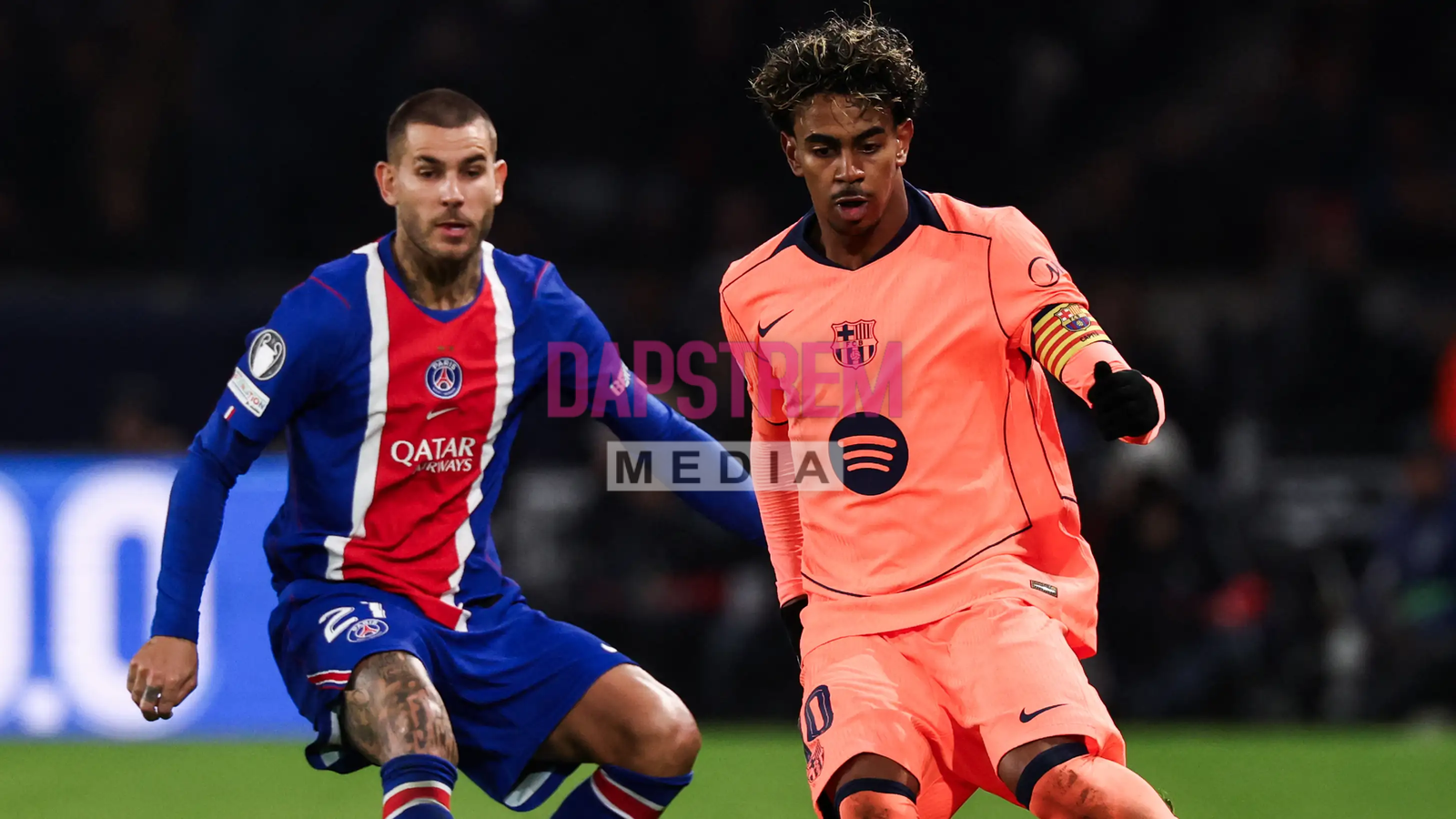
Paris Saint-Germain and FC Barcelona served up a high-scoring Champions League encounter on Tuesday night, with PSG claiming a 4–2 victory over the Catalan giants. The result gave Paris a memorable win in one of European football’s most closely watched rivalries, while Barcelona were left to reflect on a defensive display that conceded four goals.
The scoreline tells the story of an entertaining contest, but a proper match report also needs to establish how the goals came about, which players shaped the outcome, and what the result means for both clubs.
Doué sets the tone as PSG seize control
The atmosphere at the Parc des Princes was electric as two sides renowned for their attacking football met in the third round of the Champions League league phase. PSG, the reigning European champions, entered the contest looking to maintain their impressive continental form. Barcelona, meanwhile, arrived in Paris unbeaten across all competitions this season, having won their previous 11 matches.
The opening minutes immediately suggested that neither side intended to sit back. PSG threatened almost instantly when Khvicha Kvaratskhelia struck the post, while Barcelona looked to exploit the spaces left by the hosts’ aggressive pressing. The match quickly developed into an end-to-end contest, with both teams creating opportunities and forcing the opposing defence into difficult situations.
PSG’s early pressure eventually produced the breakthrough in the 38th minute. Barcelona’s Lamine Yamal lost possession in his own half, allowing PSG to regain the ball in a dangerous area. Désiré Doué seized the opportunity, manoeuvring past his marker before driving a precise, low finish beyond goalkeeper Joan García.
It was a goal that reflected PSG’s ability to punish mistakes with ruthless efficiency. Doué’s pace, confidence and composure made him a constant threat, and his performance would ultimately earn him UEFA’s Player of the Match award.
Barcelona were fortunate not to fall further behind before the interval. García produced important saves to keep his team within reach, while PSG continued to find space around the visitors’ defensive line. The French side had established a dangerous rhythm, and Barcelona needed a significant response after the break.
Barcelona fight back through youth and individual brilliance
The second half began with PSG still looking dangerous, but Barcelona gradually found a way back into the game. Their equaliser arrived in the 55th minute, following an incisive attacking move involving Fermín López, who released young defender Xavi Espart into space.
Espart drove into the penalty area and fired past Matvey Safonov to make it 1–1. The goal was particularly significant for the 19-year-old, who was making his first Champions League start. Rather than allowing the occasion to overwhelm him, he responded with the confidence and decisiveness Barcelona needed.
The equaliser changed the momentum. Barcelona began to enjoy more possession and push PSG further back, demonstrating why Hansi Flick’s team had started the season with such an impressive winning record. Their ability to combine technical quality with aggressive attacking movement made them dangerous even when they were under pressure.
Yet PSG remained threatening whenever space opened up. After Ferran Torres struck the post, the home side regained the lead in the 72nd minute. Doué delivered a dangerous ball from the right, and Lucas Hernández rose to meet it, powering a header into the net.
For a moment, it appeared that PSG had delivered the decisive blow. Barcelona, however, had another answer.
In the 79th minute, Yamal produced a moment of individual brilliance to level the score at 2–2. Reading a long ball forward and adjusting superbly, the teenage forward finished from a tight angle with remarkable precision. His goal underlined his ability to change a match in an instant and revived Barcelona’s hopes of leaving Paris with a valuable result.
Vitinha and Fabián Ruiz deliver the decisive blows
Barcelona’s second equaliser might have unsettled many opponents, but PSG responded with the composure of a team accustomed to the biggest European occasions.
Just two minutes after Yamal’s goal, Vitinha restored the hosts’ advantage. The Portuguese midfielder controlled the ball on his chest outside the penalty area before unleashing a superb volley that left García with little chance. It was a technically outstanding finish, but its timing was just as important: PSG had immediately punished Barcelona for allowing the game to become stretched.
With Barcelona chasing another equaliser, the spaces behind their defence became increasingly difficult to protect. In the 86th minute, Achraf Hakimi drove a low cross into the penalty area, where Fabián Ruiz arrived at the far post to convert and make it 4–2.
The goal finally settled a contest in which Barcelona had twice recovered from a deficit, only to be undone by PSG’s attacking quality in the closing stages. The hosts had scored twice in the final 10 minutes to turn a tense 2–2 encounter into a convincing victory.
The numbers behind the result
These figures reveal why the result was about more than finishing. PSG recorded 22 attempts to Barcelona’s 18, with both teams creating substantial opportunities. Barcelona goalkeeper García made 10 saves, an indication of how much defensive pressure the visitors faced.
Barcelona were capable of creating danger of their own, but their defensive structure struggled to contain PSG’s movement, especially when the game opened up. PSG, in contrast, repeatedly found ways to exploit the space between defenders and turn attacking transitions into clear chances.
The match also carried a physical cost. Ousmane Dembélé and Khvicha Kvaratskhelia were among the PSG players affected by injuries, while Barcelona lost Dani Olmo during the contest. Their condition and recovery would be important considerations as both teams moved into a demanding stretch of fixtures.
What the result means for PSG and Barcelona
For PSG manager Luis Enrique, the victory reinforced his side’s credentials as serious contenders for another Champions League title. His team showed that they could maintain an aggressive attacking identity, recover quickly after conceding and produce decisive moments when the pressure was highest.
The win also gave PSG three victories from their opening three league-phase matches, moving them to nine points and the top of the standings on goal difference, ahead of Liverpool. Although the competition was still at an early stage, the result strengthened their position and sent a warning to their European rivals.
Barcelona, on the other hand, suffered their first defeat of the season after 11 consecutive wins. The loss was a setback, but not a reason to dismiss their ambitions. Espart’s breakthrough, Yamal’s outstanding goal and the team’s ability to equalise twice offered genuine positives.
The central concern for Flick will be how to preserve Barcelona’s attacking threat without leaving so much room for opponents to exploit. Against a team as quick and technically gifted as PSG, even brief lapses in possession or defensive positioning can prove costly.
The defeat also came just days before Barcelona’s scheduled El Clásico against Real Madrid, giving Flick little time to address the lessons from Paris. The immediate challenge was to recover physically and mentally without allowing one difficult evening to derail the wider campaign.
Conclusion: PSG win the battle of attacking giants
PSG’s 4–2 victory over Barcelona was a compelling demonstration of the fine margins that separate elite European teams. Both sides showed attacking ambition, technical quality and the ability to produce moments of individual brilliance. Barcelona fought back twice, but PSG’s superior ruthlessness in the closing stages ultimately decided the contest.
Doué provided the spark, Hernández restored the lead, Vitinha delivered the defining moment and Ruiz completed the job. For Barcelona, Espart’s emergence and Yamal’s brilliance were highlights in an otherwise disappointing night.
Ultimately, the match was a reminder that possession and attacking talent alone are not always enough at the highest level. The decisive factor is often the ability to remain organised under pressure and convert opportunities when they matter most.
At the Parc des Princes, PSG did exactly that. They survived Barcelona’s resistance, struck when the game was finely balanced and emerged with a victory that strengthened their European ambitions while exposing areas of concern for their Spanish opponents.