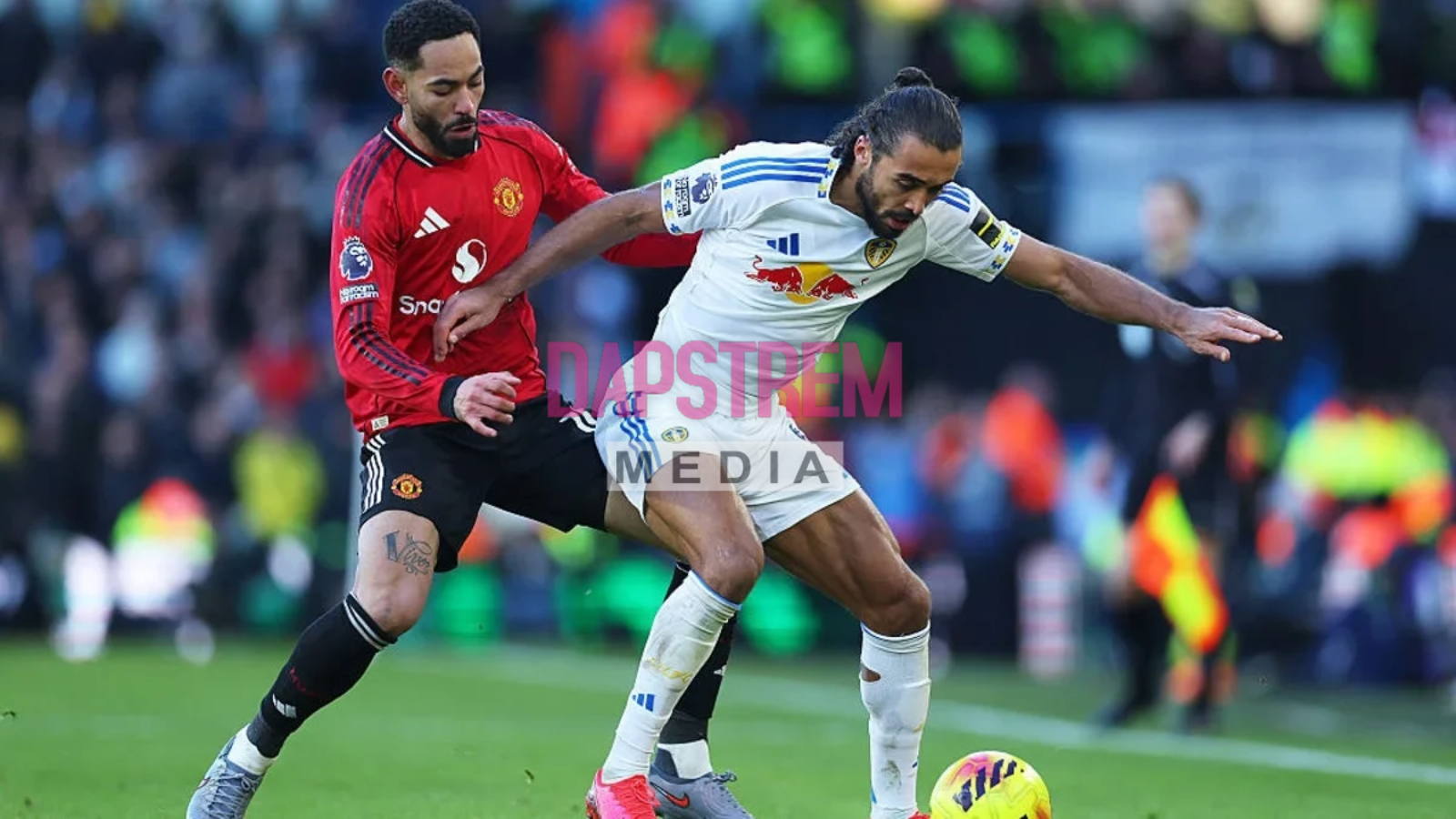
Leeds United and Manchester United shared the points in a fiercely contested Premier League encounter at Elland Road on Sunday, October 18, as Dominic Calvert-Lewin’s second-half equaliser cancelled out Bryan Mbeumo’s first-half opener in a 1–1 draw.
The result reflected a match of contrasting fortunes. Manchester United showed greater discipline and attacking purpose before the break, but Leeds responded with renewed intensity after half-time, capitalising on a set-piece opportunity to deny their rivals a much-needed victory.
For United head coach Michael Carrick, the draw offered some encouragement amid mounting pressure. For Leeds manager Daniel Farke, it was an opportunity to take a point from one of English football’s most historic rivalries, although his side could reasonably have hoped for more on home soil.
Mbeumo Gives United the Lead
The opening stages were marked by aggressive challenges, intense pressing and a hostile atmosphere, with both sides aware of the significance of the occasion. Leeds attempted to make their home advantage count, while United adopted a three-man defensive structure designed to provide greater stability.
Leeds threatened first through Nico Elvedi, whose header from Anton Stach’s delivery was comfortably dealt with by United goalkeeper Senne Lammens. The hosts also found opportunities to attack down the flanks, but their early pressure did not translate into a breakthrough.
United gradually grew into the contest, with Youri Tielemans emerging as an important creative outlet. The Belgian midfielder supplied the cross that Bryan Mbeumo failed to convert with a header in the 27th minute. It was a warning for Leeds, whose defensive organisation was beginning to come under pressure.
Eight minutes later, United found the breakthrough.
In the 35th minute, Tielemans delivered another dangerous ball from the right, and Mbeumo positioned himself well before finishing from close range. The goal rewarded United’s improved attacking movement and gave Carrick’s men a valuable advantage heading into the closing stages of the first half. The goal was Mbeumo’s second in successive Premier League matches, offering United a much-needed source of attacking encouragement. Source: Manchester United’s official match report.
The visitors looked more composed after taking the lead, protecting their defensive shape and limiting Leeds’ opportunities to build sustained pressure. However, the advantage would not survive long into the second half.
Calvert-Lewin Punishes United After the Break
United suffered a setback at half-time when Lisandro Martínez was replaced by Noussair Mazraoui after experiencing discomfort in his thigh. The substitution disrupted the visitors’ defensive arrangements at a crucial moment.
Leeds returned with greater urgency, and their improved intensity was rewarded just six minutes after the restart.
In the 51st minute, Leeds won a corner that created confusion inside the United penalty area. Tarik Muharemović made the important initial contact, directing the ball into the path of Dominic Calvert-Lewin. The striker controlled the opportunity in a crowded box, used his strength to create room and fired past Lammens to level the score at 1–1.
The equaliser transformed the atmosphere inside Elland Road. The home supporters sensed an opportunity to push their team towards a winner, while United were forced to defend for extended periods as Leeds attempted to build on their momentum.
The goal also exposed a recurring weakness for Carrick’s side: the difficulty of maintaining concentration and defensive organisation when dealing with set pieces. United had worked hard to establish their lead, only to surrender it through a situation that demanded greater coordination and defensive awareness.
Both Teams Search for a Winner
With the score level, the contest became increasingly open. Leeds looked to exploit the energy of their supporters, while United sought to regain control through possession and quick transitions.
Ao Tanaka came close for Leeds with a volley that sailed over the crossbar, as the hosts continued to test the visitors’ defensive resolve. United, however, remained capable of creating dangerous moments of their own.
Captain Bruno Fernandes came close to restoring United’s advantage when he controlled a pass from Leny Yoro and sent a shot narrowly wide of James Trafford’s goal. It was one of the visitors’ clearest opportunities of the second half.
Carrick introduced Mason Mount and later Matheus Cunha as United searched for a decisive goal. Leeds also made attacking changes, bringing on Lukas Nmecha in an attempt to increase their threat in the final third.
Despite the substitutions, neither side could find the finishing touch. United created moments of promise but lacked the consistency in possession needed to take control, while Leeds struggled to convert their second-half pressure into another goal.
The final whistle confirmed a 1–1 draw, leaving both teams with a point from a match that had offered opportunities for either side to secure all three.
Carrick Under Pressure as United’s Struggles Continue
Although United demonstrated greater defensive discipline than in some of their recent outings, the result did little to resolve the questions surrounding their form.
According to Reuters, United entered the match after a difficult run that included a 1–1 league draw against Tottenham Hotspur and a 2–0 Champions League defeat to Atlético Madrid. The club had also been dealing with unwanted attention following Martínez’s public criticism of its recruitment strategy, comments for which the defender subsequently apologised.
The draw against Leeds left United with seven points from their opening seven Premier League matches, having recorded only one league victory in that period. Their position contrasted sharply with the standards associated with a club that finished third the previous season.
Carrick nevertheless identified positives in his team’s performance, particularly its organisation and collective effort. His assessment suggested that restoring confidence and consistency would be essential if United were to turn their season around.
The challenge is that improved commitment must eventually translate into victories. United’s ability to remain competitive for long stretches is of limited value if defensive lapses and a lack of attacking precision continue to cost them points.
The manager will therefore need more than encouraging performances. He must find a way to improve his team’s control of matches, sharpen its attacking play and eliminate the mistakes that have repeatedly undermined promising results.
Leeds Take Encouragement from a Valuable Point
For Leeds, the draw represented a mixture of satisfaction and frustration.
Farke’s team showed resilience by recovering from a goal down and responded effectively after the interval. Calvert-Lewin’s equaliser demonstrated the value of attacking set pieces and the striker’s ability to make the most of opportunities in crowded penalty areas.
Nevertheless, Leeds had ambitions of taking all three points, particularly after gaining momentum following the equaliser. Their inability to find a second goal meant they had to settle for a draw despite enjoying periods of pressure.
Farke acknowledged the disappointment, saying his team should have won the match and that the players were unhappy to take only a point. His reaction reflected a sense that Leeds had done enough after half-time to threaten a more significant result. Source: The Guardian.
The performance also offered lessons for Leeds. Their response demonstrated that they could trouble United, but greater precision in the final third will be necessary if they are to turn competitive displays into victories.
A Rivalry That Continues to Deliver Intensity
The Leeds–Manchester United fixture remains one of English football’s most emotionally charged rivalries. Its significance extends beyond the three points available, shaped by geography, history and decades of competition between two clubs with deeply committed supporters.
The encounter at Elland Road once again illustrated how quickly momentum can shift in this fixture. United’s first-half advantage appeared to put them in a strong position, but Leeds’ response after the break changed the direction of the contest.
The match also demonstrated that reputation offers no guarantee of control. Manchester United arrived needing a victory to steady a difficult campaign, while Leeds had the opportunity to use their home support to challenge an opponent struggling for consistency. Neither side managed to impose itself sufficiently to claim the decisive goal.
The 1–1 draw between Leeds United and Manchester United was a competitive encounter defined by Mbeumo’s clinical first-half finish, Calvert-Lewin’s determined equaliser and the inability of either team to secure a late winner.
For Leeds, the result provided evidence of their capacity to respond under pressure, although their missed opportunity to claim victory will remain a source of frustration. For Manchester United, the performance offered some encouragement in terms of effort and defensive organisation, but the continuing shortage of league victories leaves little room for complacency.
Ultimately, the contest was a reminder that progress in the Premier League is measured not only by improved performances but also by results. Leeds and United each had opportunities to shape the outcome, yet neither could find the decisive breakthrough.
As the season continues, the key question for United is whether the resilience displayed at Elland Road can become the foundation for a sustained recovery. For Leeds, the challenge is to turn the promise of their second-half performance into more consistent results.